Korea Disease Control and Prevention Agency Distributes Safety Guidelines for Personal Mobility Devices
3 Out of 4 Emergency Room Patients Did Not Wear Helmets
"Observe the 20 km/h Speed Limit and No Passengers Allowed"
Among 10 injury patients who arrived at the emergency room due to accidents while riding personal mobility devices such as electric kickboards, 4 were adolescents aged 15 to 24. Among them, 75% were involved in accidents while riding without wearing helmets.
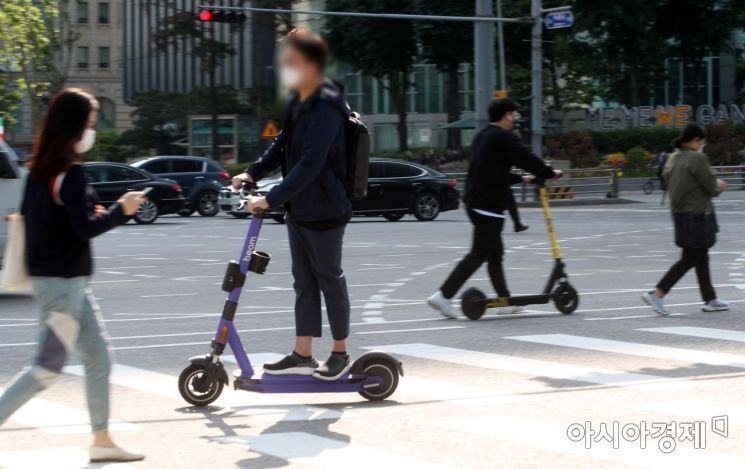
On the 3rd, the Korea Disease Control and Prevention Agency analyzed statistics from the '2023 Emergency Room Injury Patient In-depth Survey' and the '2023 Community-based Severe Trauma Survey,' revealing that the number of accidents involving "other land transport vehicles," which include personal mobility devices, increased 4.7 times from 388 cases in 2016 to 1,820 cases in 2023.
Personal mobility devices refer to single-person transportation means powered by electricity, with a maximum speed of less than 25 km/h and a total weight under 30 kg among motorized bicycles. This category includes electric kickboards, electric two-wheeled parallel vehicles, and bicycles powered solely by electric motors.
The number of severe trauma patients admitted to hospitals due to accidents involving personal mobility devices rose about threefold from 34 in 2016 to 103 in 2023. This contrasts with the decrease in severe trauma patients from transport accidents involving vehicles and motorcycles during the same period. Among patients with severe trauma, head injuries accounted for the highest proportion at 42.4%, followed by chest injuries at 32.7%, and leg injuries at 13.5%.
Among 1,258 patients who visited emergency rooms in 2023 due to personal mobility device accidents, 40.4% were aged 15 to 24, the largest group, followed by 25.6% aged 25 to 34, and 14.5% aged 35 to 44. By type of transport, electric kickboards accounted for 86.3%, and electric bicycles 10.2%. Among all patients, 66.5% suffered fall injuries caused by slipping or sudden braking, while 28.2% were involved in collisions with cars or pedestrians.
Notably, 75% of injured patients were not wearing helmets, which is 6.7 times higher than the 11.2% who were wearing helmets. For 13.8%, helmet-wearing status was unknown. Only 47% held a driver’s license. 18.3% did not have a driver’s license, and 34.7% were unknown.
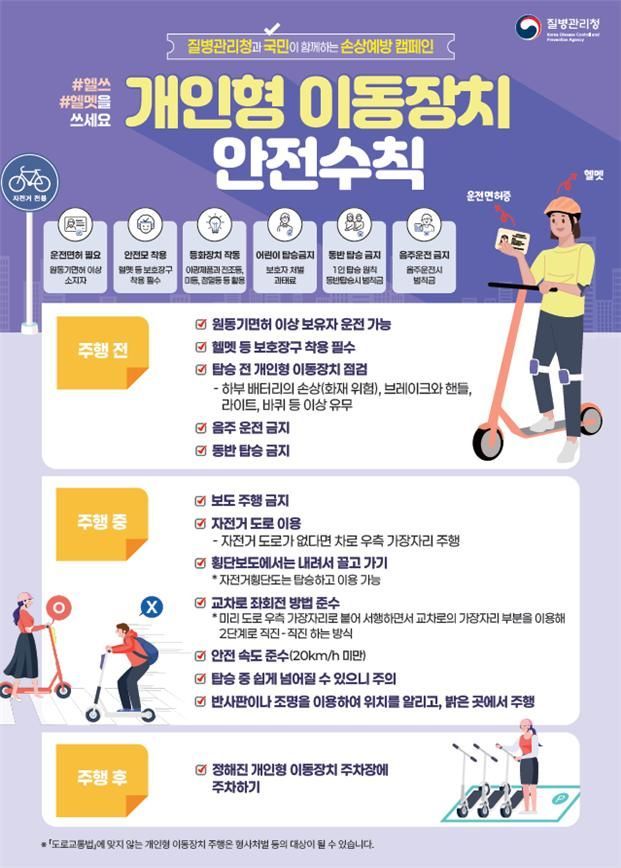
Starting from this day, the Korea Disease Control and Prevention Agency plans to distribute safety guidelines for personal mobility devices in the form of leaflets and notices, cooperating with related ministries to ensure their use at rental companies and other sites, while also conducting helmet-wearing campaigns with the National Communication Group.
To operate personal mobility devices, a driver’s license of at least a "Class 2 Motorized Bicycle License," which can be obtained from age 16, is required. Wearing a helmet before departure is mandatory; the helmet should be worn deeply above the eyebrows, and the chin strap adjusted with some slack, ensuring the helmet does not twist on the head when shaking it.
Additionally, personal mobility devices cannot carry two or more passengers, must be ridden only on bicycle paths, and riders must dismount and walk across crosswalks. At intersections, riders should not make left turns from the center of the road but should keep to the right edge and proceed slowly straight ahead. The safe speed limit of 20 km/h must also be observed.
Ji Young-mi, Director of the Korea Disease Control and Prevention Agency, stated, "Not wearing a helmet when using electric kickboards and similar devices can lead to head injuries and cause severe trauma," urging, "Please follow safety rules."
© The Asia Business Daily(www.asiae.co.kr). All rights reserved.


















