U.S. Announces 25% Reciprocal Tariff on Korean Products
Export SMEs: "Difficult to Understand Policy Changes"
Government Allocates 29 Billion KRW Export Voucher for U.S. Tariff Response
Priority Support for 750 Companies Impacted by Tariffs
Mid- to Long-Term Strategies for Export Market Diversification Also Planned
The U.S. government’s decision to impose a 25% reciprocal tariff on all Korean products has sparked growing concerns among domestic small and medium-sized export companies. Many companies are struggling to respond due to the lack of clarity on whether the tariffs will apply to their products.
On the 3rd, Lee Soon-bae, Director of Global Growth Policy at the Ministry of SMEs and Startups, spoke to reporters after the 'On-site Meeting with Export SMEs' held at the Seoul Regional Customs Office in Gangnam-gu, Seoul. He explained, "Many company representatives expressed that they do not understand how U.S. tariff policies are changing," adding, "One of the biggest difficulties cited was the challenge of confirming whether their currently exported products are subject to the tariffs."
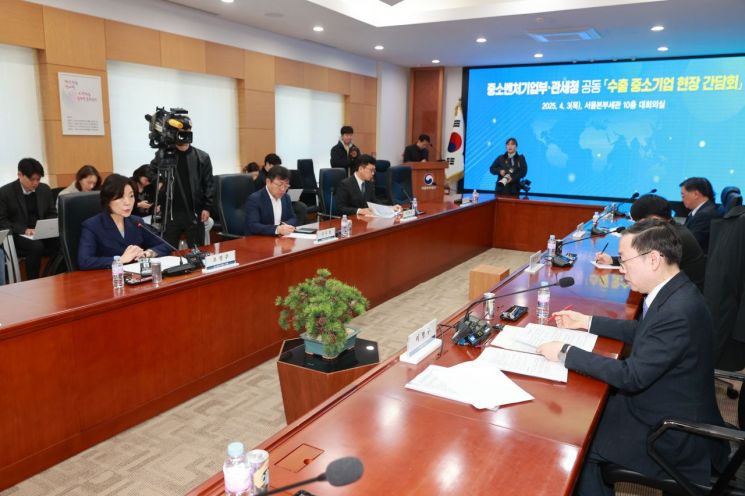 On the 3rd, the "Joint On-site Meeting for Exporting Small and Medium Enterprises by the Ministry of SMEs and Startups and the Korea Customs Service in Response to U.S. Tariffs" was held at the Seoul Regional Customs Office in Gangnam-gu, Seoul. Provided by the Ministry of SMEs and Startups
The meeting was organized to listen to the difficulties faced by export SMEs concerned about damages caused by U.S. tariff policies and to discuss practical countermeasures. On the same day, the U.S. government announced it would impose a 25% reciprocal tariff on all products produced in Korea and imported into the U.S. Following the 25% tariffs imposed last month on steel, aluminum, and their derivatives, a 25% tariff on automobiles and automobile parts has also been announced.
Concerns are growing that domestic SMEs, which are relatively vulnerable in tariff response capabilities, will suffer the greatest impact. A representative from an SME attending the meeting said, "With the U.S. deciding to impose tariffs on automobiles, the uncertainty surrounding plans to enter the North American market has increased," and added, "We requested the government to provide sufficient information even to Tier 3 companies producing basic materials and parts for automobiles."
Long-term concerns were also raised about losing price competitiveness in the U.S. market. The policy director said, "During the meeting, there were opinions expressing fear of losing the U.S. market due to loss of price competitiveness caused by the tariffs," and added, "These tariffs are applied at equal or higher levels to competitors such as Taiwan, excluding Europe and the UK, so further analysis of the ripple effects is necessary."
At the meeting, the government announced two key countermeasures for export SMEs. First, it decided to swiftly support export SMEs by launching the ‘Export Baro Program’ with a budget of 29 billion KRW. This program is part of the Ministry of SMEs and Startups’ export voucher project and applies a fast-track system that provides support within one month of application. It includes items that can offer practical help in tariff response, such as discovering alternative markets, securing supply chains, and resolving tariff disputes.
The policy director stated, "The export voucher will prioritize support for 750 companies affected by U.S. tariffs," and added, "If demand is high, we will consider supplementary budgets."
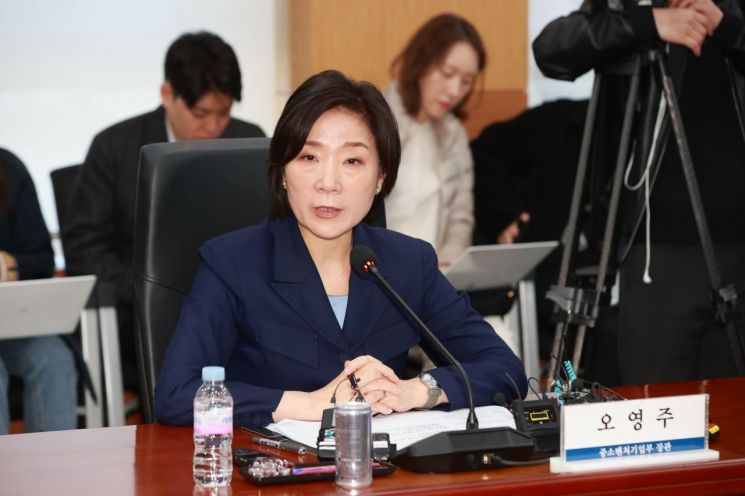 Oh Young-joo, Minister of SMEs and Startups, is giving a speech at the "Joint On-site Meeting for Exporting SMEs by the Ministry of SMEs and Startups and the Korea Customs Service in Response to U.S. Tariffs," held on the 3rd at the Seoul Main Customs Office in Gangnam-gu, Seoul. Provided by the Ministry of SMEs and Startups
The government also plans to establish a close cooperation system with the Korea Customs Service. By connecting local SME offices and regional customs offices nationwide via a hotline, they aim to improve access to tariff information and strengthen specialized consultations for export SMEs through collaboration with public interest customs brokers across the country. Additionally, excellent companies recommended by the Customs Service will be given priority participation in the Ministry of SMEs and Startups’ export support projects through institutional linkage.
The Ministry of SMEs and Startups views the U.S. tariff policy as a critical moment marking a shift from free trade agreements (FTA) to a protectionist trade system. To address this, they plan to expand policy support for diversifying export markets in the mid to long term. The policy director emphasized, "In the short term, these tariffs may pose a threat, but if you look carefully, new opportunities can be found," and added, "The government will do its best to help SMEs make the most of these opportunities."
© The Asia Business Daily(www.asiae.co.kr). All rights reserved.
![Clutching a Stolen Dior Bag, Saying "I Hate Being Poor but Real"... The Grotesque Con of a "Human Knockoff" [Slate]](https://cwcontent.asiae.co.kr/asiaresize/183/2026021902243444107_1771435474.jpg)
















