$1.62 Trillion U.S. Service Industry Becomes EU Retaliation Target
Apple, Nike, and Other Firms with Overseas Factories Also Face Increased Burden
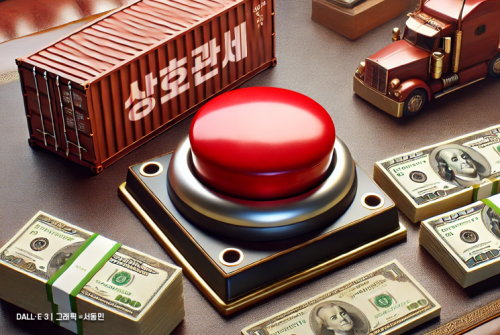
There is growing concern that the United States' 'tariff bomb' could backfire. The newly imposed tariffs are expected to severely impact the service industry, a core sector of the U.S. economy, including finance, tourism, engineering, and healthcare, as well as the supply chains of major companies. High tariffs exceeding 40% have been imposed on key supply chain countries such as Vietnam and Cambodia, and individual and reciprocal tariffs have been applied to raw materials and other U.S. imports, making future product price increases inevitable.
The New York Times (NYT) reported on the 2nd (local time) that service industry exports could become targets of retaliatory tariffs due to President Donald Trump's tariff impositions. The U.S. is the world's largest exporter of services. According to the U.S. Bureau of Economic Analysis, the U.S. earned $1.1078 trillion (approximately 1,623 trillion won) from service exports last year. The service trade surplus amounted to about $293.4 billion. According to the U.S. Census Bureau, Canada, China, Japan, Mexico, and major European Union (EU) countries, which the U.S. imposed tariffs on citing trade deficits, are running deficits in service trade with the U.S.
Experts particularly anticipate that the EU will utilize the service industry in retaliatory tariffs. Mustafa Rahman, Eurasia Group's Europe Director, evaluated, "Europe's real influence lies in the service sector."
Quoting several European diplomats, the NYT reported that the EU might invoke the Anti-Coercion Instrument (ACI) in response to trade threats. If, as predicted, the EU takes measures such as tariffs, service trade restrictions, and trade regulations related to intellectual property rights through the ACI, American big tech companies like Google will be hit. The EU has already targeted U.S. big tech to curb their influence and is about to announce fines for Apple and Meta for violations of the Digital Markets Act (DMA).
Major companies that diversified their supply chains to avoid the U.S.-China trade war during Trump's first term are also expected to be directly affected. Apple is a prime example. About 90% of iPhones are produced in China, and with tariffs on China rising from 20% to 34%, cost burdens have increased. During the first term, Apple expanded production of iPads and AirPods to Vietnam and iPhones to India to avoid tariffs on China, but this has become ineffective as the U.S. imposed tariffs of 46% and 26% on Vietnam and India, respectively.
Relocating production bases immediately is also difficult. Morgan Stanley projected that tariffs on Apple devices produced in China will add $8.5 billion in annual costs for Apple. Consequently, Apple's revenue is expected to decrease by about $7.85 billion. In after-hours trading that day, Apple's stock price fell by 7.14%.
U.S. sportswear and apparel companies that established manufacturing hubs in Southeast Asia during Trump's first term to avoid geopolitical risks are also within the impact zone. According to foreign media, 50% of Nike shoes are produced in Vietnam. Apparel company Abercrombie & Fitch sources 35% of its products from Vietnam and 22% from Cambodia. Apparel company Gap manufactures 27% in Vietnam and 19% in Indonesia. However, with the U.S. imposing high tariffs of 49% on Cambodia and 32% on Indonesia, these companies are also facing immediate emergencies.
Furniture is not exempt from tariff impacts either. According to the Home Furnishings Association, as of 2023, 26.5% of U.S. furniture imports came from Vietnam and 29% from China. Toy manufacturers also have a high dependence on Vietnam. David French, Vice President of the U.S. National Retail Federation (NRF), said, "Tariffs are taxes paid by U.S. importers and are passed on to the final consumers."
© The Asia Business Daily(www.asiae.co.kr). All rights reserved.
![Clutching a Stolen Dior Bag, Saying "I Hate Being Poor but Real"... The Grotesque Con of a "Human Knockoff" [Slate]](https://cwcontent.asiae.co.kr/asiaresize/183/2026021902243444107_1771435474.jpg)















