U.S. Allies
Australia, UK, and Brazil Each Face 10% Tariffs
South Korea Excluded Among FTA Partners
The key countries in the supply chain that become major U.S. trade surplus nations or indirect export routes are rated highly.
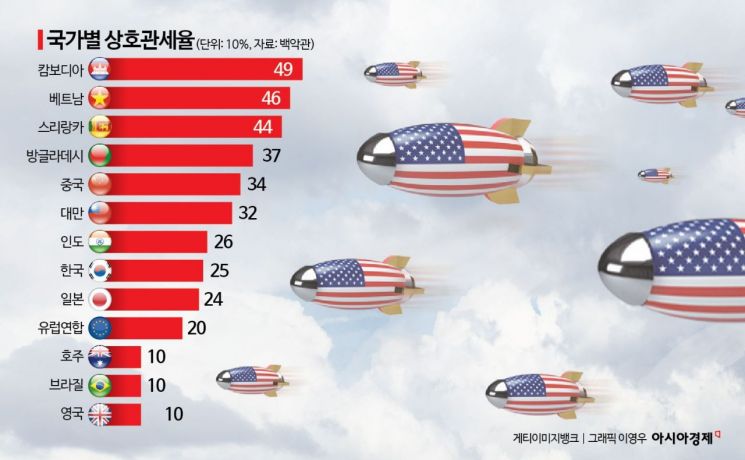
The criteria for imposing reciprocal tariffs announced by the Donald Trump administration on the 2nd (local time) can be summarized as follows. It is interpreted as an intention to pressure countries or companies that divert exports to third countries such as Vietnam amid U.S. containment, and to resolve the issue by unleashing a tariff barrage on countries causing large-scale trade deficits with the U.S.
According to the fact sheet released by the White House that day, the countries subject to the lowest reciprocal tariff rate are Australia, the United Kingdom, and Brazil, each with a 10% tariff. Australia, Brazil, and the UK are countries that the U.S. Trade Representative (USTR) has pointed out for unfair trade practices, but they are countries with which the U.S. has a trade surplus. These countries also share the commonality of having personal ties with President Trump or close relations with U.S. security.
President Trump has often expressed his closeness to the British royal family and has indicated his willingness to accept invitations. Australia is part of the informal security consultation group "the Quad" (U.S., Japan, Australia, Philippines) that counters China. The Financial Times (FT) analyzed the tariff imposition news from the Trump administration that day, stating, "Australia is part of the security network to counter China." Among the Free Trade Agreement (FTA) partner countries, excluding South Korea, ten countries including Chile, Colombia, Costa Rica, the Dominican Republic, El Salvador, Guatemala, Morocco, Peru, Singapore, and Honduras were also subject to the basic tariff rate of 10%. Argentina and the United Arab Emirates were also imposed relatively low tariffs of 10%. In Argentina's case, the friendship between President Trump and Argentine President Javier Milei is cited as a reason for avoiding high tariffs. Javier Milei, known as the "Trump of Argentina," even attended President Trump's inauguration.
Canada and Mexico, which President Trump had previously threatened with a 25% tariff due to illegal immigration and fentanyl smuggling issues after his inauguration, were excluded from the reciprocal tariff list. Accordingly, products complying with the United States-Mexico-Canada Agreement (USMCA) are tariff-free, while non-compliant products are subject to a 25% tariff. Energy and potassium products that do not comply with USMCA are subject to a 10% tariff. However, it was not disclosed whether the 25% tariff exemption on imports from Mexico and Canada would be extended. FT stated, "From the 5th, exporters from Mexico and Canada, except in the automobile sector, will be among the few worldwide who can send goods to the U.S. without tariffs."
North Korea and Russia, whose trade with other countries is virtually blocked due to economic sanctions, were also excluded from the reciprocal tariff list. The New York Times (NYT) quoted a White House official saying, "North Korea, Russia, Cuba, and Belarus are not subject to reciprocal tariffs," adding, "They are already subject to very high tariffs, and meaningful trade with these countries is impossible due to sanctions."
Notably, some of the world's poorest countries were hit with high tariffs. The Trump administration announced tariffs of 49% on Cambodia, 46% on Vietnam, 44% on Sri Lanka, and 40% on Myanmar, which suffered earthquake damage. These countries, which do not have large trade volumes with the U.S., were hit with tariffs exceeding 40% because China and others have relocated production bases to Vietnam, Cambodia, and other countries to avoid tariffs, and the U.S. aims to pressure these indirect export routes. Additionally, Vietnam ranked as the third-largest U.S. trade deficit country as of last year.
China, which is in a trade dispute with the U.S. involving retaliatory tariffs, was hit with a 34% tariff bomb. As a result, China will face a total tariff rate of 54% in addition to existing tariffs. The European Union (EU), which had harshly criticized the U.S. as "existing to exploit America," was imposed a 20% tariff rate. Japan, whose Prime Minister Shigeru Ishiba held a summit with President Trump, was imposed a 24% tariff rate, 1 percentage point lower than South Korea, and India will have to pay a 26% tariff when exporting to the U.S. in the future. China (1st), the EU (2nd), India (6th), and Japan (7th) are all major countries causing U.S. trade deficits along with South Korea. President Trump's warning to impose higher tariffs on countries with large trade deficits with the U.S. has materialized.
Data analytics firm Exiger analyzed, "Trump's announcement will impose new U.S. tariffs worth $600 billion annually, most of which will be imposed on just 10 countries," adding, "The greatest burden will fall on Chinese exports ($149 billion), with tariffs of $63 billion on Vietnamese goods, $37 billion on Taiwanese goods, and $36 billion on Japanese goods."
© The Asia Business Daily(www.asiae.co.kr). All rights reserved.
![Clutching a Stolen Dior Bag, Saying "I Hate Being Poor but Real"... The Grotesque Con of a "Human Knockoff" [Slate]](https://cwcontent.asiae.co.kr/asiaresize/183/2026021902243444107_1771435474.jpg)

















