The domestic stock market opened sharply lower following U.S. President Donald Trump's announcement on reciprocal tariffs. Green lights were turned on for major sectors such as steel, semiconductors, and automobiles.
As of 9:20 a.m. on the 3rd, the KOSPI index was trading at 2,459.93, down 45.93 points (-1.83%) from the previous trading day. The KOSPI index started the day at 2,437.43, down 2.73%.
Currently, individual investors are net buyers with 340.1 billion KRW, while foreigners and institutions are net sellers with 192.9 billion KRW and 159.5 billion KRW, respectively.
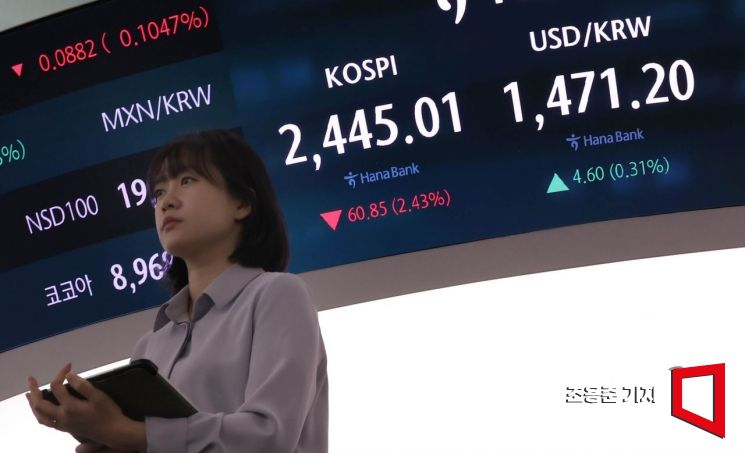 A dealer is working in the dealing room at the headquarters of Hana Bank in Jung-gu, Seoul, on the 3rd, where the Trump administration of the United States applied a 25% reciprocal tariff rate to Korea. On this day, the KOSPI opened at 2,437.43, down 68.43 points (2.73%) from the previous day, the won/dollar exchange rate rose 4.4 won to 1,471.0 won, and the KOSDAQ started at 670.75, down 14.10 points (2.06%). April 3, 2025 Photo by Jo Yongjun
The market movement on this day was influenced by President Trump's announcement of reciprocal tariffs on the afternoon of the 2nd (local time). The U.S. government officially announced a 25% reciprocal tariff on products produced in Korea and imported into the United States.
Tariff rates by country are as follows: China 34%, European Union (EU) 20%, Vietnam 46%, Taiwan 32%, Japan 24%, India 26%, among others. Additionally, Thailand faces 36%, Switzerland 31%, Indonesia 32%, Malaysia 24%, Cambodia 49%, the United Kingdom 10%, and South Africa 30% tariffs.
Han Ji-young, a researcher at Kiwoom Securities, said, "The announcement of reciprocal tariffs by Trump starting at a higher-than-expected level and the sharp drop in Nasdaq after-hours futures are expected to lead to a decline at the start of trading. During the session, the market is likely to attempt to narrow the losses influenced by tariff news flow conveyed through the White House and related parties."
By sector, most sectors except pharmaceuticals and broadcasting showed green lights. Electronic products fell the most, down 4.25%. Major sectors such as auto parts (-2.76%), display panels (-2.77%), semiconductors and semiconductor equipment (-2.81%) also experienced significant declines.
Top market capitalization stocks also showed a downward trend. Samsung Electronics (-2.72%), SK Hynix (-3.54%), LG Energy Solution (-4.10%), and Hyundai Motor (-2.85%) all declined. Meanwhile, Samsung Biologics (4.67%), Celltrion (1.30%), and Naver (0.26%) rose.
The KOSDAQ index is also declining. The KOSDAQ is trading at 680.27, down 4.55 points (-0.66%) from the previous trading day. It started the day at 670.75, down 14.10 points (2.06%).
Individual and foreign investors are net buyers with 9.6 billion KRW and 16.7 billion KRW, respectively, while institutions are net sellers with 24.7 billion KRW.
Among the top market capitalization sectors, Alteogen (-0.69%), EcoPro BM (-0.44%), HLB (-1.94%), and Hugel (-0.70%) declined. On the other hand, EcoPro (2.33%), Rainbow Robotics (1.68%), and Samchundang Pharmaceutical (2.06%) rose.
The won-dollar exchange rate opened at 1,471 KRW, up 4.4 KRW from the previous session.
© The Asia Business Daily(www.asiae.co.kr). All rights reserved.
![Clutching a Stolen Dior Bag, Saying "I Hate Being Poor but Real"... The Grotesque Con of a "Human Knockoff" [Slate]](https://cwcontent.asiae.co.kr/asiaresize/183/2026021902243444107_1771435474.jpg)















