Korea Economic Association Holds Emergency Meeting Right After Reciprocal Tariff Announcement
Yeo Han-gu: "Korea and Japan in Similar Positions... Need to Strengthen Negotiating Power"
25% Tariff on Korea... Additional Tariff Announcements by Product Expected
The Trump administration announced reciprocal tariffs of around 25% on South Korea. The business community held an emergency meeting and strongly raised the need for joint public-private responses, including cooperation with Japan.
On the 3rd, the Korea Economic Association held an emergency seminar at the FKI Tower in Yeouido, Seoul, to discuss countermeasures against the tariff pressure from the Trump administration. Peter Yeo Han-gu, a senior fellow at the Peterson Institute for International Economics (PIIE) and former head of the Trade Negotiations Department at the Ministry of Trade, Industry and Energy, emphasized the importance of cooperation with Japan to enhance companies' negotiating power with the U.S. He said, "Strategic cooperation between Korea and Japan has become important," adding, "Since we are in similar positions dealing with the U.S. and China, increasing the level of cooperation can enhance our negotiating power."
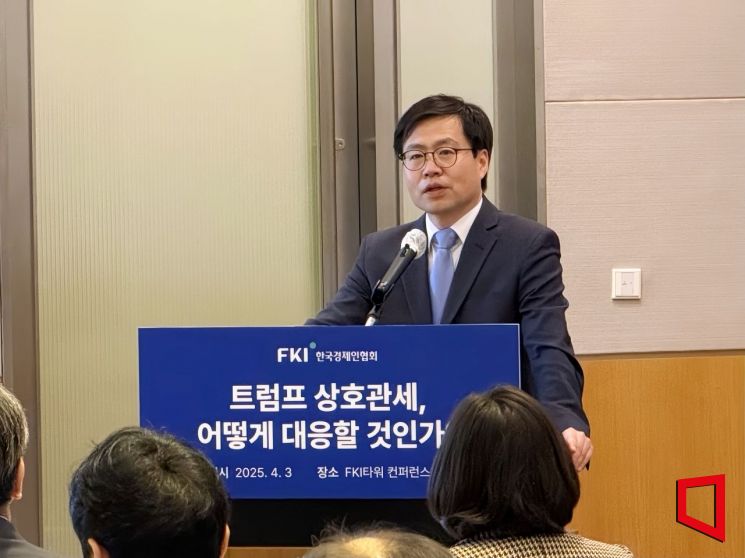 The Korea Economic Association held a seminar on the morning of the 3rd at the FKI Tower Conference Center in Yeouido, Seoul, on the theme of "Response to Trump’s Reciprocal Tariffs," where Peter Yeo Han-gu, Senior Fellow at the Peterson Institute for International Economics (PIIE), gave a presentation. Photo by Jang Hee-jun
This advice calls for active cooperation to jointly respond to changes in the global trade order, such as supply chain stability and technological hegemony competition. In fact, companies have been expanding their contacts with Japan to reduce uncertainty since the launch of Trump's second term. SK Group Chairman and Korea Chamber of Commerce and Industry Chairman Chey Tae-won recently stated, "Through exchanges with Japan, manufacturing costs can be mutually reduced, and synergies can be created." Samsung Electronics Chairman Lee Jae-yong also visited Japan after China to seek ways to overcome trade risks. Major domestic companies are refining practical countermeasures against the Trump administration's high tariffs by utilizing various channels such as technological cooperation with Japan, joint investments, and strengthened lobbying efforts in the U.S.
The business community views that since both South Korea and Japan are directly affected by the U.S.'s protectionist policies, strategic solidarity between the two countries could be a realistic solution. In particular, if the two countries pursue joint interests in key global supply chain industries such as electric vehicle batteries, semiconductors, and advanced materials, they believe they can secure a more advantageous position in trade negotiations with the U.S. To this end, various cooperation measures are being discussed, including the establishment of a regular consultative body between economic organizations of the two countries, joint statements, and joint lobbying targeting Washington's political circles.
Senior fellow Yeo pointed out that the background of the Trump administration's tariff imposition involves political intentions beyond simple protectionism. He said, "Tariffs are perceived as a means to secure tax revenue for tax cuts," and evaluated, "In terms of speed, scope, and scale, it is much bolder compared to the first term."
However, he warned against excessive concerns that could weaken the industrial sector. He said, "The basis for calculating the tariffs has not even been disclosed," and added, "We should not be swayed by such policy announcements but observe the long-term trends."
Cho Sung-dae, head of the Trade Research Office at the Korea International Trade Association, stated, "Industries competing with U.S. companies bear a heavier tariff burden." He advised, "It is like a 'race' starting with other countries that will negotiate with the U.S. From the companies' perspective, they need to find practical countermeasures such as adjusting volumes and seeking alternative supply chains."
© The Asia Business Daily(www.asiae.co.kr). All rights reserved.
![Clutching a Stolen Dior Bag, Saying "I Hate Being Poor but Real"... The Grotesque Con of a "Human Knockoff" [Slate]](https://cwcontent.asiae.co.kr/asiaresize/183/2026021902243444107_1771435474.jpg)















