Ursula von der Leyen, President of the European Commission,
to Announce Official Position on the Morning of the 3rd
Australian Prime Minister Also Issues Statement, Joining in Criticism
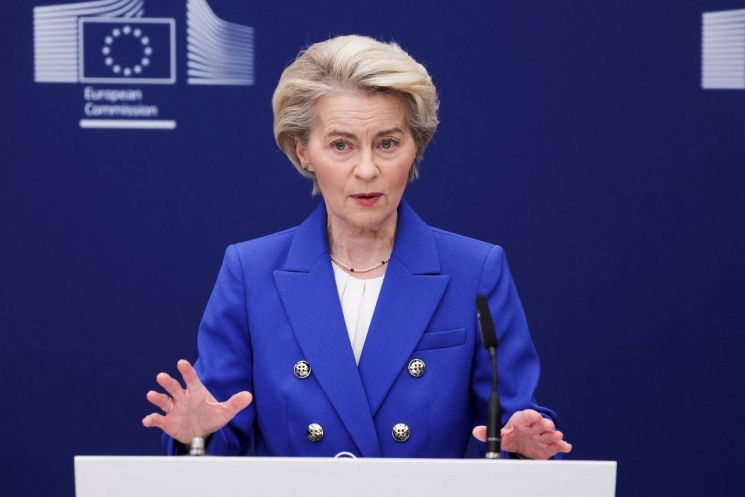 Ursula von der Leyen, President of the European Union (EU) Commission, who is visiting Uzbekistan, announced a statement on strengthening the EU's defense capabilities on the 4th of last month in Brussels, Belgium. President von der Leyen is scheduled to officially announce the EU's position on the mutual tariff policies of the U.S. Donald Trump administration at 5 a.m. local time on the 3rd. Photo by Reuters Yonhap News
On the 2nd (local time), U.S. President Donald Trump designated the 'worst countries' and imposed different reciprocal tariffs by country, resulting in mixed reactions depending on the nation. The European Union (EU), which was hit with a reciprocal tariff of 20%, double the basic tariff rate of 10%, immediately expressed strong opposition, while countries like the United Kingdom, Canada, and Mexico, which were only subject to the basic tariff, breathed a sigh of relief and began to analyze the details.
Bernd Lange, Chair of the European Parliament's Trade Committee, issued a statement immediately after the U.S. announced the reciprocal tariffs, strongly criticizing, "President Trump may call this 'Liberation Day,' but from the perspective of ordinary citizens, today is 'Inflation Day'." He added, "We hope that our stance and firm response will provide sufficient incentive to bring the U.S. to the negotiating table," and "The EU's door will always be open to finding a solution through negotiations."
The European Commission, which holds trade policy authority for the 27 EU member states, is also facing deep concerns. Ursula von der Leyen, President of the European Commission, currently visiting Uzbekistan, is scheduled to announce the official position at 5 a.m. local time on the 3rd. In her speech at the European Parliament plenary session in Strasbourg on the 1st, von der Leyen emphasized, "We do not necessarily want retaliation, but we have a strong plan to retaliate if necessary." Earlier, the EU had warned that if steel negotiations with the U.S. fail, it would impose retaliatory tariffs on U.S. goods worth a total of 26 billion euros (approximately 42 trillion won) starting around the 13th. The UK’s Financial Times reported that the EU is also considering retaliatory measures targeting major U.S. tech companies (Big Tech) such as Google, Meta (formerly Facebook), and Amazon.
Leaders of various countries also voiced their opinions individually. Swedish Prime Minister Ulf Kristersson issued a statement saying, "At the EU level, I will continue to make every effort to reverse this trend," and added, "My hope and our (EU’s) goal is to lower the tariff rates announced by the U.S. through negotiations." Italian Prime Minister Giorgia Meloni, known to have a close relationship with President Trump, criticized the tariff policy on Meta as a "wrong measure" and stated, "We will do everything we can to move toward an agreement with the U.S." Australian Prime Minister Anthony Albanese told reporters immediately after the White House announcement, "(Reciprocal tariffs) have no logical basis. It is a bad decision." He added, "True reciprocal tariffs should be 0%," and "This kind of (reciprocal tariff) decision is not the action of a friend."
Meanwhile, countries subject only to the basic 10% tariff tried to maintain a composed demeanor. The UK, relieved that its tariff was set at 10%, lower than the EU’s 20%, expressed a sense of relief. A source from UK Prime Minister Keir Starmer’s office told Sky News UK, "We did not want any tariffs, but the lower tariff compared to others proves that our approach was correct." Another source called it a "good result." They emphasized, "We will continue to negotiate calmly and rationally," and "We want to negotiate a sustainable trade agreement and, of course, reduce tariffs."
Mexico and Canada, which were effectively exempted by being excluded from the list of countries subject to reciprocal tariffs, are in a similar situation. The Trump administration announced that Canada and Mexico would be temporarily excluded not only from the 10% basic tariff rate but also from the list of countries subject to reciprocal tariffs. Ontario Premier Doug Ford appeared on Bloomberg Television that day, urging Canadian Prime Minister Mark Carney not to take retaliatory measures. He said, "I am cautiously optimistic seeing that Canada and Mexico were not on that list," and claimed, "It is evidence that two great countries are cooperating and building relationships together."
© The Asia Business Daily(www.asiae.co.kr). All rights reserved.
![Clutching a Stolen Dior Bag, Saying "I Hate Being Poor but Real"... The Grotesque Con of a "Human Knockoff" [Slate]](https://cwcontent.asiae.co.kr/asiaresize/183/2026021902243444107_1771435474.jpg)















