"Support for Prompt Operation of the Medical Workforce Supply and Demand Estimation Committee"
Focus on Fostering Regional Secondary Hospitals... Extension of Key Regional Emergency Medical Centers
The government once again urged students at 40 medical schools nationwide to "reflect on the original intention of becoming doctors who treat sick patients, actively participate in classes, and exercise their right to self-directed learning."
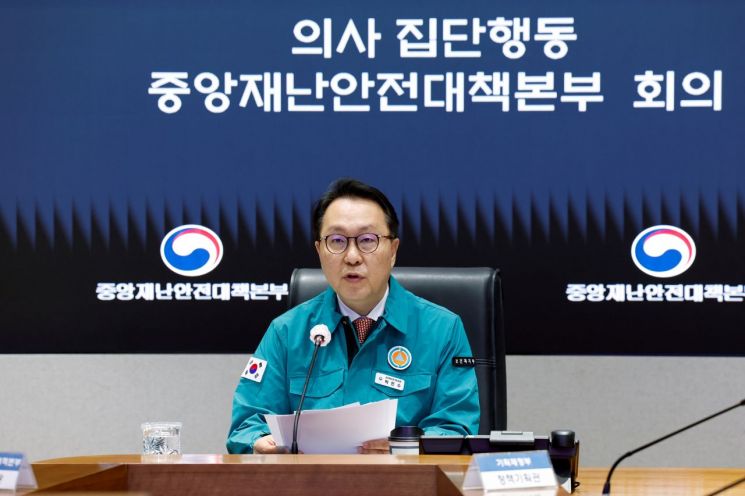 Park Min-su, Vice Minister of Health and Welfare (First Chief Coordinator of the Central Disaster and Safety Countermeasures Headquarters), is speaking at the Central Disaster and Safety Countermeasures Headquarters meeting on doctors' collective action held at the Government Seoul Office Building on the 3rd. Provided by the Ministry of Health and Welfare
On the 3rd, Park Min-su, the 2nd Vice Minister of the Ministry of Health and Welfare, held a 'Central Disaster and Safety Countermeasure Headquarters Meeting on Doctors' Collective Action' at the Government Seoul Office and said, "It has been confirmed that most medical students have registered, but there are reports of renewed movements to refuse classes, which is concerning."
The registration deadline for 39 medical schools ended on this day, with only Inje University remaining, whose registration deadline is on the 4th.
Vice Minister Park emphasized, "It is an important time for students to return to classes normally and for classes at each university to operate normally. The government will continue to communicate and actively support so that the normalization of medical education proceeds without setbacks."
He also mentioned the passage of the bill related to the establishment of the Medical Workforce Supply and Demand Estimation Committee in the National Assembly the day before, stating, "The government will promptly proceed with necessary procedures such as appointing committee members to support the swift operation of the Supply and Demand Estimation Committee."
The government announced that it is steadily implementing the '1st Medical Reform Implementation Plan' to resolve the crisis in essential and regional medical care and is discussing additional measures.
Vice Minister Park explained, "Through the support project for the structural transformation of tertiary general hospitals, the number of severe surgeries, which had decreased during the emergency medical period, has increased by about 10,000 cases, shifting the focus to severe, emergency, and rare diseases. Mild patients are encouraged to use local clinics rather than tertiary general hospitals, and a fast track is operated to ensure immediate treatment when tertiary hospital care is necessary, establishing a strengthened cooperative system with affiliated hospitals."
The 'Regional Essential Doctor System Pilot Project,' which supports regional work allowances and settlement conditions so that doctors can work long-term while treating essential subjects at regional medical institutions, is also scheduled to be implemented in July.
Through the '2nd Medical Reform Implementation Plan' announced last month, the government plans to focus on fostering secondary hospitals that can meet most medical demands within the region and have sufficient essential treatment functions such as emergency care, so that local residents can trust and visit them. Additionally, it aims to prepare measures that both the public and the medical community can agree on, such as reforming non-reimbursable and actual expense insurance and strengthening the medical accident safety net.
Regarding the 23 regional emergency medical centers expanded as part of last winter's emergency medical measures, most institutions showed improved treatment performance indicators such as 'average daily number of severe emergency patients' and 'regional burden rate,' fulfilling their role in supplementing the capacity to treat severe emergency patients. However, one center that was found to be insufficient in its role had its designation canceled, and another institution was newly designated.
Furthermore, evaluations of a total of 72 centers, including 44 regional emergency medical centers, confirmed that the acceptance rates for severe emergency patients, severe trauma patients, and pediatric emergency patients increased, and the performance in inpatient treatment and transfer patient acceptance improved, significantly contributing to maintaining the emergency medical system, according to the Ministry of Health and Welfare.
Accordingly, a total of 53.1 billion KRW in compensation will be paid to 60 institutions with excellent evaluation results. In addition, to encourage emergency medical institutions to maintain emergency treatment, the project operation period will be extended until the end of the emergency treatment period, and compensation will be provided based on contribution evaluation results.
Along with this, the government plans to extend the project supporting personnel expenses for medical staff in emergency rooms at regional and local emergency centers until May to ensure stable operation of emergency medical institutions.
Meanwhile, Vice Minister Park addressed the wildfire damage in the Ulsan-Gyeongbuk-Gyeongnam region, saying, "The government is making every effort to support disaster victims while swiftly recovering and restoring the extensive damage. We will actively support the victims so that they can return to their daily lives as soon as possible."
© The Asia Business Daily(www.asiae.co.kr). All rights reserved.
![Clutching a Stolen Dior Bag, Saying "I Hate Being Poor but Real"... The Grotesque Con of a "Human Knockoff" [Slate]](https://cwcontent.asiae.co.kr/asiaresize/183/2026021902243444107_1771435474.jpg)
















