Seven Australian Universities, Including University of Melbourne, Close Confucius Institutes
Concerns Over Transparency Amid Criticism as "Communist Party Vanguard"
Chinese Naval Vessels Recently Approach Australia and Conduct Military Exercises
Amid rising military tensions between Australia and China, Chinese 'Confucius Institutes' within Australian universities are being closed one after another. Confucius Institutes are institutions established worldwide by the Chinese government to promote Chinese language education and Chinese thought and culture, but they have been criticized as "the vanguard of the Chinese government." On the 2nd (local time), Yonhap News quoted the British BBC broadcasting, reporting that "since last year, 6 out of 13 Confucius Institutes in Chinese universities have closed."
 Confucius Institute class at the University of Sydney, Australia. Official website of the University of Sydney
According to Yonhap News, the universities in Australia where Confucius Institutes have disappeared include the University of Melbourne, the University of Queensland (UQ), the University of Western Australia (UWA), the University of New South Wales (UNSW), and the Royal Melbourne Institute of Technology (RMIT). Among them, the University of Melbourne opened a Confucius Institute in partnership with Nanjing University in 2007 but closed it in August last year. Regarding this, the university stated, "We already offer various Chinese and Asian programs, so there is no need to renew the Confucius Institute contract."
The UNSW side said, "The university is independently developing its Chinese studies program" and "is committed to encouraging open dialogue in China-Australia bilateral relations." Also, UQ stated, "The Confucius Institute at this university closed at the end of last year when the contract expired, and we received no instructions from the (Australian) government." This is interpreted to mean that the closure of Confucius Institutes is not due to tensions between the two countries. Seven Confucius Institutes are still in operation.
However, over the past few years, the Australian federal government has taken the stance of not allowing additional Confucius Institutes to open in Australia. Furthermore, universities have been required to increase transparency regarding Confucius Institute education and, in certain cases, to register under the Foreign Influence Transparency Scheme.
The United States has also pushed for the removal of Confucius Institutes citing national security threats. In 2019, the human rights organization Human Rights Watch (HRW) evaluated that "(Confucius Institutes are) an extension of the Chinese government" and "censored discussions on politically sensitive issues from the Chinese government's perspective."
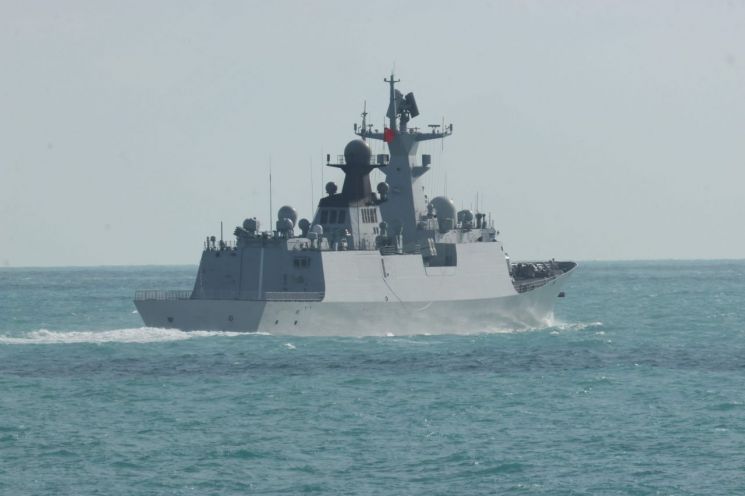
Recently, Chinese naval vessels have unusually approached Australia and conducted live-fire training, escalating military tensions between the two countries. From February for about a month, three Chinese naval ships?the cruiser Zunyi, the frigate Hengyang, and the comprehensive supply ship Weishanhu?circled the waters around Australia. In particular, on February 21?22, live-fire training was conducted in the Tasman Sea between Australia and New Zealand. After the training plan was announced shortly before the exercise, 49 civilian aircraft flying over the surrounding airspace abruptly changed their routes, causing unease.
The Australian government views such training as a "show of force" and is reported to have signed a contract worth 200 million Australian dollars (approximately 180 billion Korean won) to additionally procure Mk-48 heavyweight torpedoes from the United States to enhance the lethality of its submarine forces. Pat Conroy, Australian Minister for Defence Industry, emphasized, "Through the ongoing joint development of the Mk-48 heavyweight torpedo, the Royal Australian Navy is equipped with the latest technology to address current and future threats," and added, "The government will ensure that the navy has the necessary capabilities to safely protect the Australian people."
© The Asia Business Daily(www.asiae.co.kr). All rights reserved.
![Clutching a Stolen Dior Bag, Saying "I Hate Being Poor but Real"... The Grotesque Con of a "Human Knockoff" [Slate]](https://cwcontent.asiae.co.kr/asiaresize/183/2026021902243444107_1771435474.jpg)
















