Macroeconomic and Financial Issues Meeting Held
25% Reciprocal Tariff Announced on Korea
"High Volatility Expected to Continue in Financial Markets"
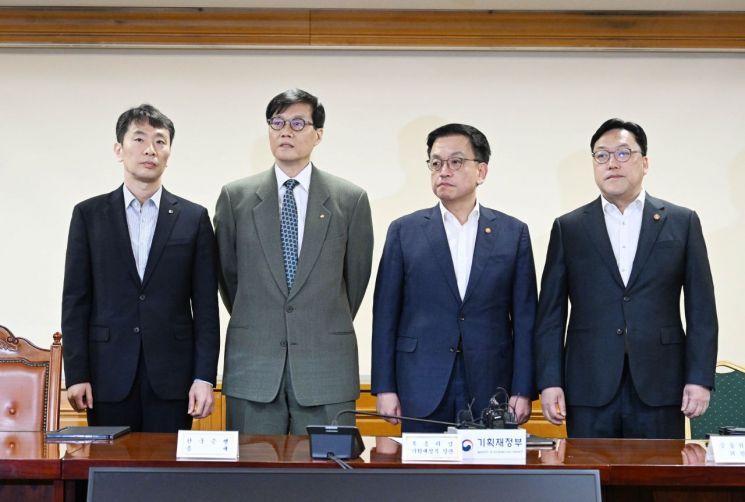 From the left in the photo: Lee Bok-hyun, Governor of the Financial Supervisory Service; Lee Chang-yong, Governor of the Bank of Korea; Choi Sang-mok, Deputy Prime Minister and Minister of Economy and Finance; Kim Byung-hwan, Chairman of the Financial Services Commission. (Source: Ministry of Economy and Finance)
Choi Sang-mok, Deputy Prime Minister for Economic Affairs and Minister of Economy and Finance, stated on the 3rd that "if market volatility expands excessively, all available market stabilization measures will be immediately implemented according to the situational response plan" in response to the U.S. announcement of reciprocal tariffs.
Deputy Prime Minister Choi made these remarks during a macroeconomic and financial issues meeting (F4) held at the Government Seoul Office that morning. The meeting was attended by Lee Chang-yong, Governor of the Bank of Korea, Kim Byung-hwan, Chairman of the Financial Services Commission, and Lee Bok-hyun, Governor of the Financial Supervisory Service.
Earlier, on the 2nd at 4 p.m. local time, the U.S. announced reciprocal tariffs imposing a basic rate of 10% on all countries, with differentiated high tariffs applied globally including on South Korea. The country-specific tariff rates are 25% for South Korea, 46% for Vietnam, 36% for Thailand, 34% for China, 32% for Taiwan, 32% for Indonesia, 24% for Japan, 24% for Malaysia, 20% for the European Union (EU), and 10% for the United Kingdom, among others.
Experts and market participants noted that the announced reciprocal tariffs represent a worst-case scenario among expected outcomes, fueling concerns over a global economic downturn due to the intensifying global trade war.
Deputy Prime Minister Choi said, "Following the announcement, the global financial market showed increased risk aversion, with the dollar value rising and U.S. Treasury yields and stock futures indices falling overall," adding, "The U.S. government's reciprocal tariff measures are expected to sustain high volatility in global financial markets for the time being, and domestic financial and foreign exchange markets will also respond sensitively."
He emphasized, "Until the market stabilizes sufficiently, a joint 24-hour monitoring system among related agencies will continue to operate, and sector-specific monitoring systems for foreign exchange, government bonds, and fund markets will also be maintained."
That morning, the government held an "Emergency Economic Security Strategy Task Force (TF) Meeting" chaired by Acting President and Prime Minister Han Duck-soo to address the U.S. reciprocal tariff announcement.
Deputy Prime Minister Choi stated, "As discussed in the meeting, we will concentrate all efforts on a full-scale response, and the F4 meeting will actively play a role in this. Based on a thorough analysis of U.S. tariff policies, we will focus government-wide efforts on negotiations with the U.S. to minimize damage to our economy, and through the Economic Security Strategy TF, the public and private sectors will jointly devise the best response strategies."
He continued, "Through the Ministerial Meeting on Strengthening Industrial Competitiveness, we will sequentially announce detailed support measures for industries expected to be affected, such as the automobile sector, and expand the supply of shipbuilding advance payment guarantees (RG) to respond to reciprocal tariffs."
Deputy Prime Minister Choi also said, "The government will actively reflect trade risk response projects such as trade finance, additional export vouchers, and stabilization of supply chains for key items in the essential supplementary budget (supplementary budget) of 10 trillion won that we proposed," and requested, "We ask the National Assembly to promptly discuss this so that our companies can overcome the unprecedented trade challenges."
© The Asia Business Daily(www.asiae.co.kr). All rights reserved.
![Clutching a Stolen Dior Bag, Saying "I Hate Being Poor but Real"... The Grotesque Con of a "Human Knockoff" [Slate]](https://cwcontent.asiae.co.kr/asiaresize/183/2026021902243444107_1771435474.jpg)















