iM Securities evaluated the U.S. government's announcement on reciprocal tariff imposition on the 2nd (local time) as "the worst-case scenario that the market had feared" on the 3rd.
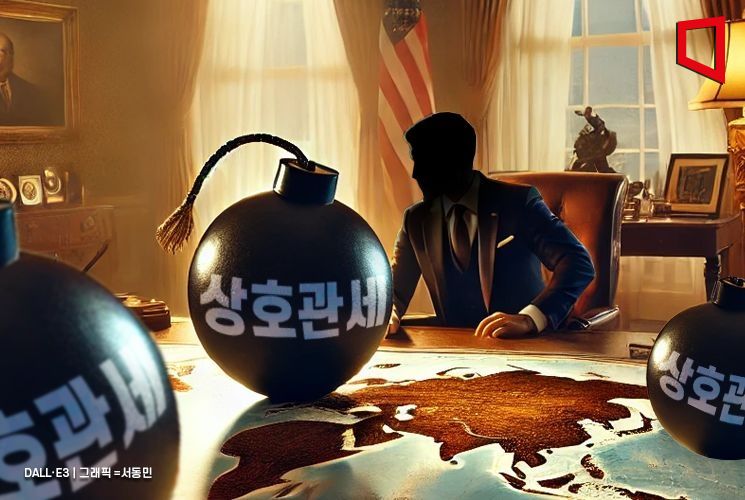
Park Sang-hyun, a researcher at iM Securities, stated, "The reciprocal tariff announcement by U.S. President Donald Trump is assessed as the worst-case scenario that the market had feared," adding, "While the universal tariff rate applied to all countries is 10%, the tariff rates imposed on the so-called Dirty 15 countries were higher than market expectations."
He explained, "The reciprocal tariff rates on major Asian countries, including Korea, were higher than expected," elaborating, "Korea faces a 25% reciprocal tariff rate, while major Asian trading partners such as China 34%, Japan 24%, Taiwan 32%, Vietnam 46%, and Thailand 36% are subjected to high tariff rates."
He added, "Despite the basic universal tariff rate being 10%, the reason Asian countries including Korea are subjected to relatively high tariff rates is because the Trump administration estimated high tariff rates on U.S. products from these trading partners."
This has increased the likelihood of shock spreading in the financial markets. He emphasized, "It is hard to deny that the reciprocal tariff rates are close to the worst level," and "There is a high probability of short-term shocks to the financial markets, and it is considered a variable that could slow down the U.S. economy and increase inflationary pressures."
He further added, "We inevitably have to monitor the adverse effects of reciprocal tariffs on the U.S. economy and inflation at least until the second quarter."
iM Securities also anticipated that major countries might retaliate further due to these reciprocal tariffs. He predicted, "China, which will immediately face an additional 34% tariff, is expected to respond with strong countermeasures," and "The conflict between the U.S. and China is bound to escalate further, and the European Union (EU) is also highly likely to take counteractions."
It is expected to affect not only global financial markets but also the economies of major countries led by the U.S. He said, "From the domestic economic perspective, significant damage is inevitable," explaining, "It is clear that exports of major products such as automobiles to the U.S. will suffer a severe blow, and indirect exports to the U.S. through production bases in Vietnam will also be heavily impacted."
He added, "From the second quarter, the pressure for further slowdown in domestic growth rate is expected to increase due to the decline in exports to the U.S. or ASEAN," and "The possibility of zero-percent growth rate this year, which had been mentioned by some, is becoming more visible."
He concluded, "Although the Constitutional Court's impeachment decision remains a variable, the possibility of further rise in the dollar-won exchange rate, potentially threatening the 1500 won level again, cannot be ruled out," emphasizing, "From the perspective of the domestic stock market, the risk of additional short-term corrections has increased, making a conservative approach necessary at this time."
© The Asia Business Daily(www.asiae.co.kr). All rights reserved.
![Clutching a Stolen Dior Bag, Saying "I Hate Being Poor but Real"... The Grotesque Con of a "Human Knockoff" [Slate]](https://cwcontent.asiae.co.kr/asiaresize/183/2026021902243444107_1771435474.jpg)











