$409.66 Billion in Reserves at End of March, Up $450 Million
Swap Transactions with National Pension Service and Quarter-End Effect
Increase Also Attributed to Higher Returns from Foreign Currency Asset Management
South Korea's foreign exchange reserves slightly increased after three months. This was due to a seasonal effect where foreign currency deposits by financial institutions rose to comply with the Bank for International Settlements (BIS) ratio at the end of the quarter.
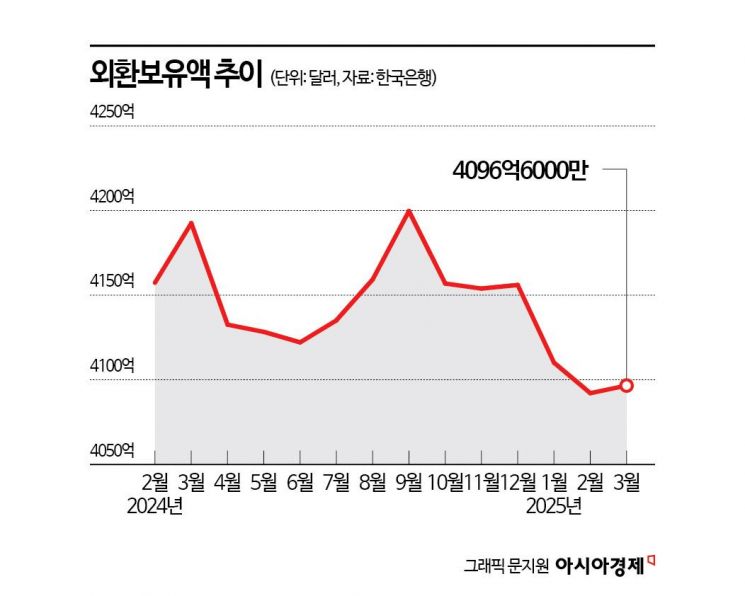
According to the Bank of Korea on the 3rd, as of the end of last month, South Korea's foreign exchange reserves stood at $409.66 billion, up $450 million from $409.21 billion at the end of the previous month.
South Korea's foreign exchange reserves steadily increased until the second half of 2021. The reserves, which recorded $469.2 billion at the end of October 2021, shrank in size due to the U.S. Federal Reserve's (Fed) policy rate hikes that began in earnest in 2022. Last year, the reserves hovered around the $410 billion mark at month-end. Since October last year, as exchange rate volatility increased due to uncertainties in U.S. trade policies under Trump, the foreign exchange authorities have been selling dollars to defend the exchange rate, leading to a continued decrease in foreign exchange reserves. However, in December last year and last month, a seasonal effect appeared as foreign exchange banks concentrated dollar deposits with the Bank of Korea to meet the BIS ratio at the end of the quarter, causing the foreign exchange reserves to increase.
A Bank of Korea official explained, "In March, despite foreign exchange swap transactions with the National Pension Service, foreign currency deposits by financial institutions increased due to the quarter-end effect." Additionally, the depreciation of the U.S. dollar led to an increase in the amount when other currency foreign currency assets were converted into dollars, and gains from foreign currency asset management also had an impact. During March, the U.S. Dollar Index (DXY) fell by about 3%. It dropped from 107.24 at the end of February to 104.04 at the end of March.
Among the components of foreign exchange reserves, securities including government bonds, corporate bonds, and government agency bonds increased by $4.15 billion from the previous month to $361.53 billion. Securities accounted for 88.3% of the total foreign exchange reserves. Deposits stood at $24.17 billion (5.9%), down $3.84 billion. Special Drawing Rights (SDR) at the International Monetary Fund (IMF) were $14.98 billion (3.7%), gold was $4.79 billion (1.2%), and the IMF position was $4.19 billion (1.0%).
As of the end of February, South Korea maintained its 9th place in the world in terms of foreign exchange reserve size. China ranked first with $3.2272 trillion in reserves. Japan was second with $1.2533 trillion, and Switzerland was third with $923.8 billion. India ($638.7 billion), Russia ($632.4 billion), Taiwan ($577.6 billion), Saudi Arabia ($432.9 billion), and Hong Kong ($416.4 billion) followed.
© The Asia Business Daily(www.asiae.co.kr). All rights reserved.
![Clutching a Stolen Dior Bag, Saying "I Hate Being Poor but Real"... The Grotesque Con of a "Human Knockoff" [Slate]](https://cwcontent.asiae.co.kr/asiaresize/183/2026021902243444107_1771435474.jpg)

















