Park Chungkwon's "Ma Eun-hyuk is a communist" remark sparks shouting
Impeachment motion against Choi Sang-mok reported to plenary session... Vote postponed
The National Assembly, led by the opposition parties, passed a resolution urging Han Deok-su, Acting President and Prime Minister, to promptly appoint Ma Eun-hyuk as a Constitutional Court Justice candidate.
On the 2nd, the National Assembly held a plenary session and passed the resolution urging Ma Eun-hyuk's appointment with 184 votes in favor and 2 against. Only two members of the People Power Party, Floor Deputy Leader Park Hyung-soo and Representative Choi Eun-seok, participated in the vote and cast opposing votes. This is the second time that a resolution urging the appointment of candidate Ma has been adopted by the National Assembly.
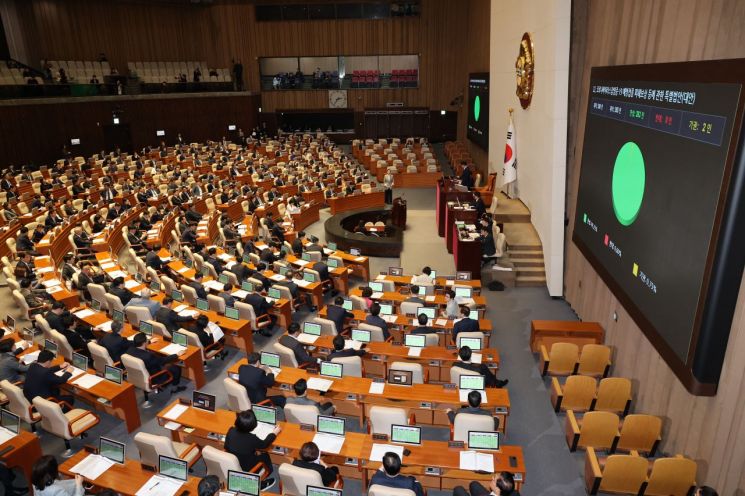
In the opposing debate, Floor Deputy Leader Park said, "It is already absurd to pass a resolution urging the appointment of a new Constitutional Court Justice just two days before the ruling on the impeachment trial of the President," and argued, "For the fairness of the impeachment trial and to secure the trust in the Constitutional Court, candidate Ma should not be appointed as a Constitutional Court Justice."
In response, Democratic Party Floor Spokesperson Kang Yoo-jung said, "The Constitutional Court ruled that it is unconstitutional for the Acting President not to appoint a Constitutional Court Justice elected by the people through the National Assembly," and questioned, "Why does Acting President Han ignore the Constitution and only look at the suspended Yoon Seok-yeol?"
During the debate, Representative Park Chung-kwon of the People Power Party caused disruption in the plenary session by calling Ma Eun-hyuk a "communist." Opposition party members demanded that Representative Park "watch his words" and "apologize," leading to a commotion.
Representative Park clarified, "My remarks were about candidate Ma Eun-hyuk, not Representative Kang Yoo-jung," and pointed out, "Candidate Ma, who was formerly affiliated with the People's Federation, is not suitable as a Constitutional Court Justice without reflecting on his past activities." In response, Floor Spokesperson Kang stated in a briefing after the plenary session, "That remark is an insult to the National Assembly and the Constitution," and added, "We first want an apology from Representative Park and will consider various measures within the floor, including filing a complaint with the Ethics Committee."
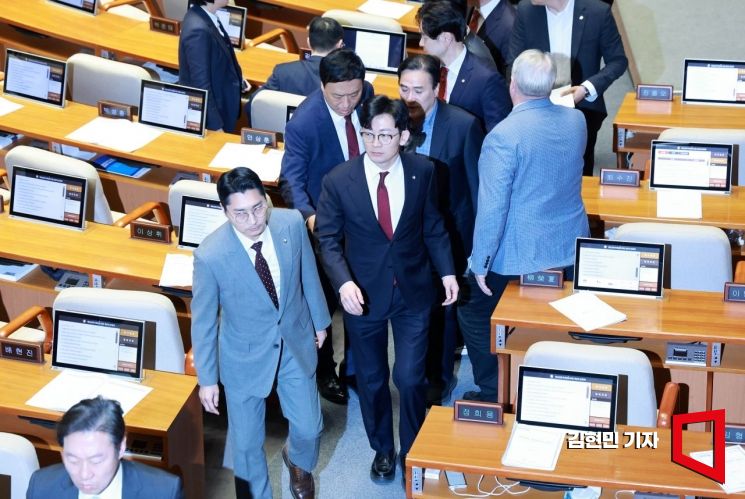 On the 2nd, during the plenary session of the National Assembly, Park Chung-kwon, a member of the People Power Party, who called Kang Yoo-jung, a member of the Democratic Party of Korea, a "communist" while she was speaking in favor of the 'Resolution Urging the Appointment of Ma Eun-hyuk,' refused to make a personal statement and left the plenary hall as opposition party members continued to condemn him. 2025.4.2 Photo by Kim Hyun-min
During the plenary session, an impeachment motion against Deputy Prime Minister and Minister of Economy and Finance Choi Sang-mok, proposed by five opposition parties including the Democratic Party, was reported. This is the 30th impeachment motion proposed by the opposition. Speaker Woo Won-shik said, "According to Article 130, Paragraph 2 of the National Assembly Act, the impeachment motion must be voted on between 24 hours and 72 hours after being reported to the plenary session," and requested, "Representatives of negotiation groups should coordinate the agenda so that the matter can be deliberated according to the National Assembly Act." The Democratic Party plans to decide whether to vote on the impeachment motion after the ruling on President Yoon Seok-yeol's impeachment trial scheduled for the 4th.
Additionally, an amendment to the Act on the Protection of Children and Youth from Sexual Abuse passed the plenary session. The bill expands the punishment for grooming crimes?crimes that lure children and youth into sexual conversations and acts for the purpose of sexual exploitation?from online to offline.
The Special Act on Metropolitan Area Wide Transportation Management, which adjusts the criteria for metropolitan areas and expands the wide-area road network in Jeonbuk Province, also passed the National Assembly led by the opposition parties. The core of the bill is to add "cities with a population of 500,000 or more that are provincial capitals and regions within the same transportation living area as those cities" to the scope of local governments defining metropolitan areas, thereby expanding support such as road network expansion for Jeonju, Jeonbuk, which has a population of approximately 633,000.
© The Asia Business Daily(www.asiae.co.kr). All rights reserved.


















