SCMP Warns of Escalating Confrontation Between the Two Powers Due to Trump's Show of Force
Relations Expected to Worsen Further If Reciprocal Tariffs Are Imposed
China's South China Morning Post (SCMP) reported on the 1st that, a day before the announcement of reciprocal tariffs by the Donald Trump administration, U.S. tariff sanctions against China and interference in Taiwan issues would dim hopes for restoring relations, making it unlikely to expect a U.S.-China summit. It warned that the Trump administration’s stance of waiting for China to make concessions rather than resolving conflicts through dialogue could lead the two countries toward a head-on confrontation.
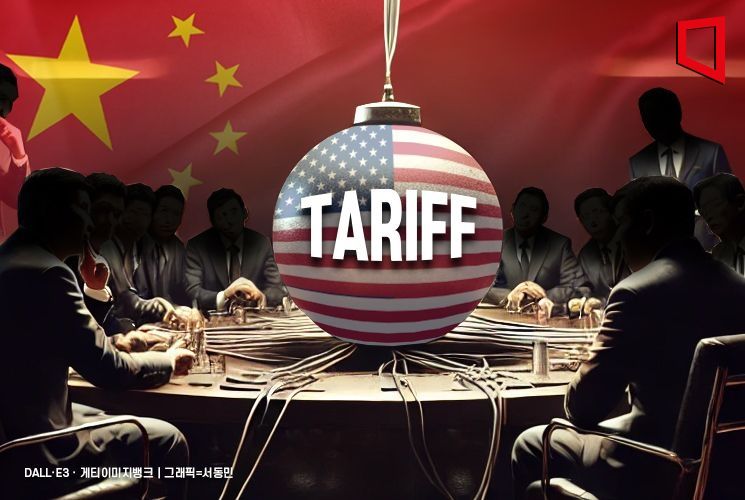
SCMP, summarizing experts' opinions that day, warned that just two months into President Donald Trump's second term, aggressive strategies such as imposing tariffs, playing the Taiwan card, and military demonstrations through Indo-Pacific alliances have shattered the atmosphere of easing diplomatic tensions between the U.S. and China, risking a slide into confrontation.
Earlier, U.S. Secretary of Defense Pete Hegseth, on his first Asia tour since taking office, visited the Philippines and Japan, emphasizing the importance of alliance relationships and expressing vigilance against the "military aggression of the Chinese Communist Party." Additionally, the Trump administration stated in its "Military Strategy Guidance Report," which designates responding to a Chinese invasion of Taiwan as the top and sole priority, that the U.S. will focus its military capabilities on countering China to ensure victory in any potential conflict.
Professor Shi Yinhong, an expert on U.S. affairs at Renmin University of China, said, "Hegseth’s tough stance on maritime disputes involving Taiwan, China, and neighboring countries shows that relations with the U.S. have rapidly deteriorated since the Trump administration took office in January," adding, "Currently, U.S.-China relations are worsening over issues such as Taiwan, the South China Sea, the East China Sea, and high tariffs, with no clear signs of easing."
Beyond military tensions, the Trump administration sanctioned senior Hong Kong officials on the 31st of last month for undermining Hong Kong's autonomy. The sanctions included mainland Chinese officials such as Dong Jingwei, head of the Hong Kong National Security Office. In response to these U.S. sanctions, Chinese Foreign Ministry spokesperson Guo Zhaokun condemned them as "vile" interference and vowed to take strong countermeasures.
With U.S.-China relations running on parallel tracks, they are expected to worsen further when reciprocal tariffs are implemented on the 2nd. Chinese Foreign Minister Wang Yi said in an interview with Russian state TV, "If the U.S. imposes tariffs on China under the pretext of fentanyl smuggling, China will take action," and pointed out, "If the U.S. truly wants to resolve the fentanyl issue, it should abolish unfair tariffs and negotiate with China on an equal footing."
Considering the schedules of the two leaders and the recent hostile atmosphere between the two countries, the possibility of the "June birthday summit" initially proposed by The New York Times (NYT) seems low at present. President Xi Jinping is scheduled to visit three Southeast Asian countries in April, and President Trump plans to visit Saudi Arabia in May. Earlier, U.S. Senator Steve Daines, who unofficially visited Beijing, hinted at the possibility of a U.S.-China summit in an interview with the NYT, saying, "This visit is the first step to arrange and prepare the next very important meeting between President Trump and Chairman Xi." President Trump also expressed enthusiasm for a summit, stating on the 17th of last month that Chairman Xi would visit the U.S. "in the not-too-distant future," but the Chinese side has not mentioned the summit at all.
Wu Xinbo, director of the Center for American Studies at Fudan University in Shanghai, said, "Talks of a summit are merely a smokescreen amid rising tensions between the two countries; a summit or high-level reciprocal visits are still a distant future," adding, "If President Trump imposes additional tariffs on China this week, bilateral relations will deteriorate further." Professor Shi Yinhong also assessed the possibility of a meeting between Chairman Xi and President Trump as low, predicting that China is likely to reduce high-level interactions and communications with the Trump administration, whether in face-to-face meetings or phone calls.
© The Asia Business Daily(www.asiae.co.kr). All rights reserved.
![Clutching a Stolen Dior Bag, Saying "I Hate Being Poor but Real"... The Grotesque Con of a "Human Knockoff" [Slate]](https://cwcontent.asiae.co.kr/asiaresize/183/2026021902243444107_1771435474.jpg)















