Automatic Recording of All Conversations Between Medical Staff and Patients, Even in Emergencies
An AI voice recognition technology has been developed that automatically records medical staff conversations into medical records without omission, even in urgent situations where every second counts, thereby protecting patient safety and improving the quality of medical care.
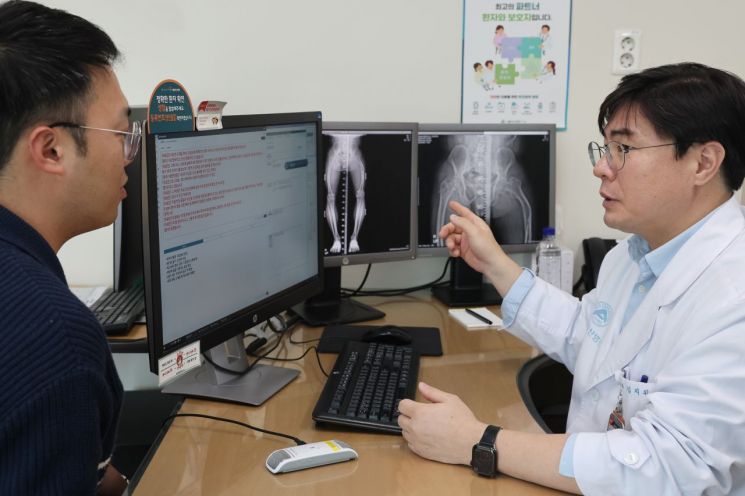 Professor Kim Ji-wan of the Department of Orthopedics at Seoul Asan Medical Center is examining a patient using an AI medical voice recognition system. The voice data of medical staff and patients input through a dedicated microphone is recorded and summarized in real time as text, and key information is automatically saved in the electronic medical records. Seoul Asan Medical Center
On the 2nd, Seoul Asan Medical Center announced that it has established the nation's first AI-based clinical voice recognition system that records and summarizes conversations between medical staff and patients in real time across all medical environments, including emergency rooms, wards, and clinics, and automatically generates medical records.
Until now, voice AI technology in the medical field has been used in a 'Voice EMR (Electronic Medical Record)' method, where AI converts medical staff’s voice data into text and stores it as medical records. The clinical voice recognition system developed by Seoul Asan Medical Center reflects the voices of both medical staff and patients not only in outpatient and examination settings but also in various emergency situations, which is expected to improve the accuracy of medical records and assist in establishing precise treatment plans.
Seoul Asan Medical Center developed the clinical voice recognition system in 2023 and conducted pilot tests in the outpatient departments of orthopedics and plastic surgery. After verifying its efficiency and accuracy, the system was recently completed for use in all clinical settings.
This clinical voice recognition system, which applies large language models (LLM), utilizes voice data from medical staff and patients generated during the clinical process to perform real-time text conversion, key symptom recording, disease classification, and conversation summarization. It is also integrated with the medical information system (AMIS 3.0), allowing users to process data in desired formats and automatically save it to EMRs and other systems.
By training the AI model with medical terminology specific to each specialty and tens of thousands of hours of clinical voice data, the system has improved the recognition accuracy of conversations between medical staff and patients. It also enhances voice recognition rates by using dedicated microphones to filter out surrounding speech and noise and precisely calculating human voice amplitude.
Medical staff can focus on the patient’s story instead of writing medical records by using the clinical voice recognition system, and they can leave a complete record of the patient’s symptom information, which forms the basis for treatment plans. Especially in emergency situations requiring cardiopulmonary resuscitation, the system converts urgent medical staff conversations into real-time text, automatically saves them as medical records, and allows for future use, contributing to patient safety.
Currently, the clinical voice recognition system is being used in 16 clinical departments including oncology, otolaryngology, and psychiatry, as well as in emergency rooms and orthopedic wards. The scope of use will gradually expand after monitoring.
Kim Young-hak, Head of the Digital Information Innovation Division at Seoul Asan Medical Center, said, "Through the AI-based clinical voice recognition system, numerous voice data that evaporate during the clinical process can be effectively recorded and stored. Accurate symptom information reflecting not only medical staff but also patients’ voices can improve medical quality and serve as the foundation for providing personalized treatment."
Meanwhile, Seoul Asan Medical Center is implementing digital innovation in various fields such as robotic process automation (RPA), digital pathology systems, mobile personal health record services, and precision medicine systems to create a future medical environment based on digital healthcare.
At the end of last year, the center received the highest level 7 certification in the 'INFRAM' category, a digital information infrastructure evaluation model for medical institutions conducted by the Healthcare Information and Management Systems Society (HIMSS) in the United States.
© The Asia Business Daily(www.asiae.co.kr). All rights reserved.
![Clutching a Stolen Dior Bag, Saying "I Hate Being Poor but Real"... The Grotesque Con of a "Human Knockoff" [Slate]](https://cwcontent.asiae.co.kr/asiaresize/183/2026021902243444107_1771435474.jpg)















