Joint Development with U.S. Company...
Maiden Flight Planned for 2027
Hanwha Aerospace is developing the Korean version of an unmanned reconnaissance and attack aircraft called the Gray Eagle. The company plans to jointly develop it with a U.S. unmanned aircraft specialist and aims for its maiden flight in 2027.
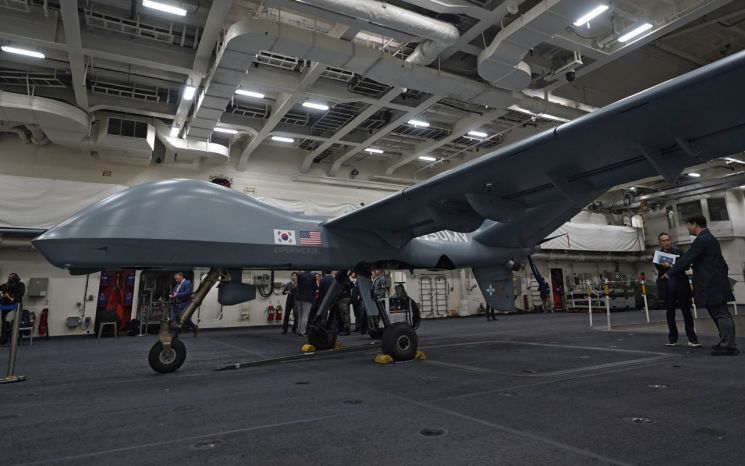
On the 2nd, Hanwha Aerospace announced, “We have decided to collaborate with the global unmanned aircraft specialist ‘General Atomics Aeronautical Systems (GA-ASI)’ to jointly develop the short takeoff and landing (STOL) unmanned aircraft ‘Gray Eagle-STOL (GE-STOL).”
GA-ASI is the company that developed the U.S. military’s most powerful unmanned attack aircraft, the MQ-9 Reaper and MQ-1 Predator, nicknamed the Predator. It supplies unmanned aircraft to major allied countries such as NATO, the United Kingdom, Japan, and Australia. Kim Dong-kwan, Vice Chairman of Hanwha, visited GA-ASI’s headquarters in San Diego, USA, last August and decided to cooperate. Through this collaboration, the two companies plan to establish a partnership covering the entire lifecycle of unmanned aircraft, from planning, design, and development to system integration, production, operation, and sales.
In November last year, a combat experiment was conducted where an unmanned aircraft developed by GA-ASI took off from the Navy’s large transport ship, Dokdo. The Navy had previously operated vertical takeoff and landing unmanned aircraft from existing ships, but this was the first time a fixed-wing unmanned aircraft was launched from a ship.
The unmanned aircraft used in the combat experiment was developed by modifying the MQ-9 ‘Reaper’ and MC-1 ‘Gray Eagle-ER’ operated by the U.S. military. It is a prototype called ‘Mojave’ with a wingspan of 16 meters, a length of 9 meters, and a height of 3 meters. Its takeoff and landing distance is only a few hundred meters, allowing operation in limited environments such as short runways, large ships with flight decks, and unpaved fields without runways. The payload capacity is 1.6 tons, enabling various missions such as reconnaissance and attack depending on the equipment. The prototype’s endurance is 3.5 hours, but the final product aims for 25 hours. During the combat experiment, the unmanned aircraft maintained communication with the Dokdo ship and the Naval Aviation Command for about an hour while flying over the East Sea and safely landed on the runway of the Pohang Naval Aviation Command about 60 km away.
Hanwha Aerospace plans to proactively invest in future defense technologies and enter the global unmanned aircraft market, which is expected to reach 50 trillion won by 2040, expanding the future growth engine of K-defense. According to market research firm Fortune Business Insights, the global military drone market size is projected to grow from $14.4 billion (19.4 trillion won) last year to $35.6 billion (47.9 trillion won) by 2030.
Hanwha Aerospace estimates that more than 750 billion won will be needed for unmanned aircraft system and engine development, as well as facility construction. Of the funds raised through a paid-in capital increase, 300 billion won will be invested in unmanned aircraft-related businesses.
© The Asia Business Daily(www.asiae.co.kr). All rights reserved.
![Clutching a Stolen Dior Bag, Saying "I Hate Being Poor but Real"... The Grotesque Con of a "Human Knockoff" [Slate]](https://cwcontent.asiae.co.kr/asiaresize/183/2026021902243444107_1771435474.jpg)















