Low-Income Groups Focus Spending on 'Survival-Related' Sectors
Perceived Inflation Rate for the Lowest Income Quintile Exceeds That of the Highest Quintile
A survey found that the perceived inflation rate is higher among low-income groups. As food prices have been rising significantly for several years, there are calls for stabilizing the supply and demand of agricultural products to support vulnerable groups.
The Korea Economic Association announced on the 2nd that an analysis of consumer perceived inflation trends by income quintile from 2014 to 2024 showed that the perceived inflation rate is higher among low-income groups. From 2014 to 2024, the perceived inflation rate for the lowest income quintile was 23.2%, which is 2.6 percentage points higher than the 20.6% for the highest income quintile. Looking at the perceived inflation rate by income quintile, ▲1st quintile 23.2% ▲2nd quintile 22.4% ▲3rd quintile 21.7% ▲4th quintile 20.9% ▲5th quintile 20.6%, showing a tendency for the perceived inflation rate to increase as income decreases.
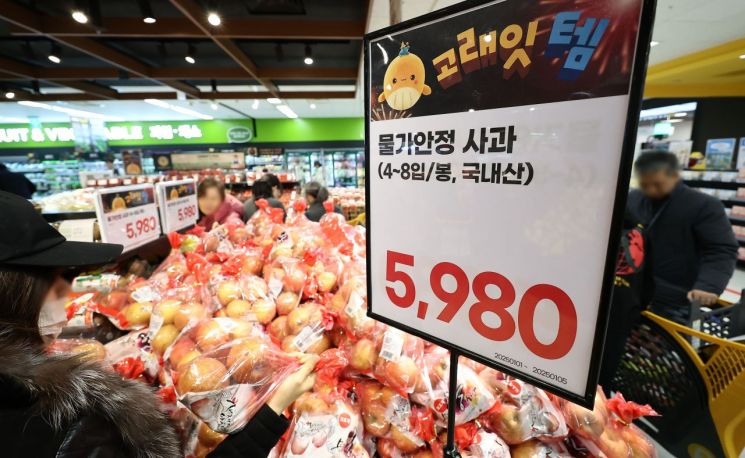 As agricultural production declined, causing a high increase in agricultural product prices, citizens are purchasing displayed "Price Stabilized Apples" at the fruit section of a large supermarket in Seoul. Photo by Yonhap News
When analyzed by year, from 2019 to 2024, except for 2022, the perceived consumer inflation rate of the 1st quintile was higher than that of the 5th quintile every year out of the six years. The Korea Economic Association interpreted this as the perceived inflation rate for the low-income 1st quintile having been consistently higher than that of the 5th quintile since just before the COVID-19 pandemic.
Examining the expenditure shares of the 1st and 5th income quintiles, the 1st quintile spent the most on ▲food and non-alcoholic beverages (20.9%), ▲housing, water, electricity, gas (20.0%), and ▲health (12.6%). This indicates that low-income groups tend to concentrate their spending on areas directly related to survival. From 2014 to 2024, food prices, which are mainly consumed by low-income groups, rose by 41.9%, about twice the overall inflation rate of 21.2% during the same period. The Korea Economic Association analyzed that the rise in food prices had a significant impact on the perceived inflation rate of low-income groups.
For the 5th income quintile, the highest expenditure shares were ▲transportation (13.0%), ▲education (10.5%), and ▲recreation and culture (9.0%). During the comparison period (2014 to 2024), the inflation rates for these items were 5.3%, 10.6%, and 9.2%, respectively, which are significantly lower than the overall inflation rate of 21.2%.
Lee Sang-ho, head of the Economic and Industrial Division at the Korea Economic Association, said, "Over the past 10 years, the sharp rise in food prices has increased the perceived inflation burden on vulnerable groups," adding, "To protect vulnerable groups, it is necessary to establish measures to stabilize the supply and demand of agricultural products, improve distribution regulations, and promote diversification of agricultural imports."
© The Asia Business Daily(www.asiae.co.kr). All rights reserved.
![Clutching a Stolen Dior Bag, Saying "I Hate Being Poor but Real"... The Grotesque Con of a "Human Knockoff" [Slate]](https://cwcontent.asiae.co.kr/asiaresize/183/2026021902243444107_1771435474.jpg)















