Each Citizen Has Used KTX 23 Times on Average
Rising Number of Foreign Passengers
The high-speed train KTX celebrated its 21st anniversary on the 1st. Since its first operation in 2004, a total of 1.14 billion passengers have ridden it. This means that each citizen has used it about 23 times. Currently, an average of 246,000 people (as of this year) take the KTX daily to travel across the country.
On this day, Korail announced, "KTX, the fifth high-speed rail in the world, has established itself as a representative transportation means in Korea over the past 21 years," and revealed key achievements.
KTX doubled the maximum speed of Korea’s main railway network from 150 km/h to 300 km/h. It was a decisive turning point that transformed the entire country into a "half-day living zone."
Over 21 years, KTX has traveled a total of 6.9 billion kilometers. This distance is equivalent to circling the Earth (40,000 km) 17,000 times. When combining the total passenger travel distance (round-trip distance), it reaches 280 billion kilometers, which is 1,880 times the distance from the Earth to the Sun.
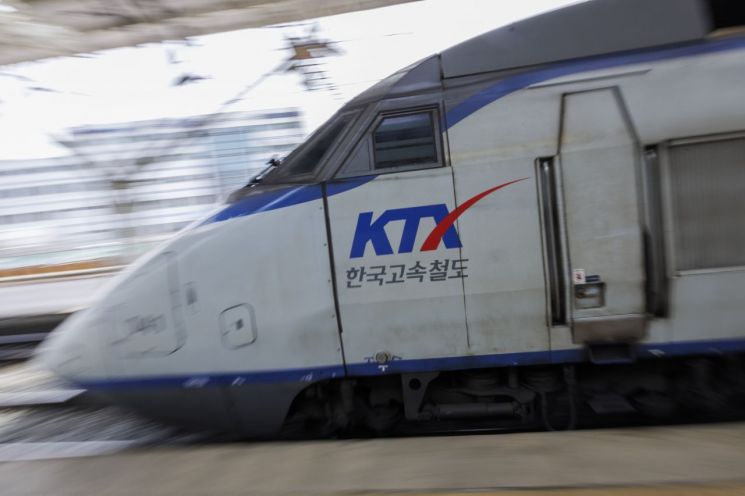 On the 26th of last month, a first-generation KTX train was moving along the platform at Seoul Station in Jung-gu, Seoul. Photo by Yonhap News
The number of passengers has steadily increased. The average daily ridership, which was 72,000 on the first year of operation, has grown 3.4 times to 246,000 this year. The number of daily trips increased 2.7 times from 142 to 385 during the same period. The day with the highest ridership this year was February 28, the day before the March 1st holiday, when 330,000 people took the KTX.
The number of stops has expanded from 20 initially to 77 currently, and the number of lines has grown from 2 (Gyeongbu Line and Honam Line) to 8. With the extension of the Jungbu Inland Line and the Jungang Line last year, the number of passengers on these two lines nearly doubled compared to the previous year. By section, 53% of travelers between Seoul and Busan, 44% between Seoul and Gwangju, and 62% between Seoul and Ulsan use the KTX.
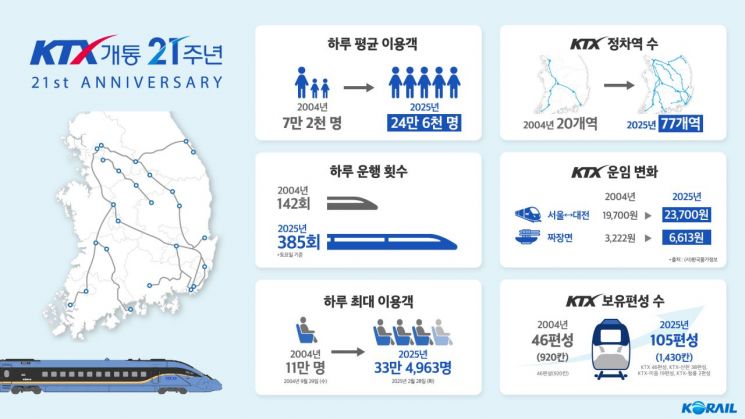
The trains have also evolved. Starting from KTX-1, the fleet now includes ▲KTX-Sancheon (power concentrated type, 2 locomotives and 8 passenger cars) ▲KTX-Ieum (distributed power type, total 6 cars) ▲KTX-Cheongryong (distributed power type, total 8 cars). The KTX-Cheongryong, which can run at a maximum speed of 320 km/h, has 36% more seats, 19% more knee room, and 34% wider aisles compared to the existing KTX-Sancheon. Korail plans to apply AI-based maintenance and an automatic emergency braking system that activates upon derailment detection to the next-generation high-speed trains that will replace aging vehicles.
Demand from foreign passengers has also increased significantly. Last year, 5.54 million foreign passengers used the railway, a 61% increase from the previous year. This means that one out of every three foreign visitors to Korea used the KTX. Korail operates dedicated counters for foreigners, a multilingual website, and seat selection functions.
Cha Seong-yeol, head of Korail’s Passenger Business Division, said, "We deeply thank the public for supporting KTX to establish itself as a representative transportation means," and added, "We will continue to strive to provide safer and more comfortable railway services."
© The Asia Business Daily(www.asiae.co.kr). All rights reserved.
![Clutching a Stolen Dior Bag, Saying "I Hate Being Poor but Real"... The Grotesque Con of a "Human Knockoff" [Slate]](https://cwcontent.asiae.co.kr/asiaresize/183/2026021902243444107_1771435474.jpg)
















