Ruling Party: "Supplementary Budget for Areas of Consensus First, Further Discussions Later"
Leadership Seeks to Gain Public Support Through On-Site Activities
Visits to Seoul AI Hub and Appearance on Wildfire Relief Broadcast
Opposition: "With Sluggish Domestic Demand and Trade Pressure, Bold Policies Are Needed"
The ruling and opposition parties are engaged in a war of nerves as they fail to narrow their differences over the scale of the supplementary budget. The People Power Party has repeatedly criticized the Democratic Party of Korea for pushing through a budget cut proposal and is seeking to gain the upper hand in public opinion through on-site activities. Meanwhile, the Democratic Party insists that the government's supplementary budget proposal of 10 to 15 trillion won is woefully insufficient to revive the livelihoods and economy, arguing that a 35 trillion won budget is necessary.
On the morning of April 1, Kwon Seongdong, floor leader of the People Power Party, referred to Democratic Party leader Lee Jaemyung's previous emphasis on the need for a supplementary budget, even though the Democratic Party had cut and pushed through this year's budget and disaster reserve funds. He stated at a party meeting at the National Assembly, "Now that the government has actually announced plans for a supplementary budget, they are trying to block it. Where else in the world is there such a contrarian attitude?"
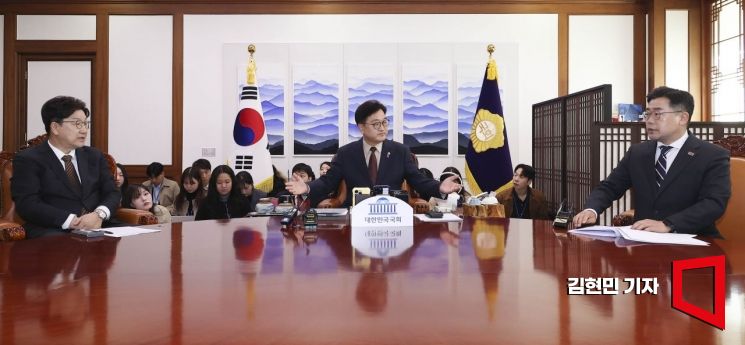 Speaker Woo Wonsik and the floor leaders of the two major parties are meeting at the National Assembly on the 31st. From the left, Kwon Seongdong, floor leader of the People Power Party, Speaker Woo, and Park Chandae, floor leader of the Democratic Party of Korea. 2025.3.31 Photo by Kim Hyunmin
Previously, under the mediation of National Assembly Speaker Woo Wonsik, Kwon and Park Chandae, floor leader of the Democratic Party, held three meetings on the supplementary budget on the morning and afternoon of the previous day, but failed to reach an agreement. The People Power Party maintains that budget allocations should first be secured for urgent issues on which both parties agree, such as building an artificial intelligence (AI) ecosystem, recovering from wildfires in the Yeongnam region, and responding to customs issues. The Democratic Party, on the other hand, has proposed its own supplementary budget plan totaling 35 trillion won, including 13.1 trillion won for a 250,000 won per capita livelihood recovery grant and 2 trillion won to support local currency discounts.
Regarding this, Kwon reiterated his proposal: "Let's first process as the first phase of the supplementary budget the urgent issues for which there is no disagreement between the parties, and then, for the budgets each party wants, discuss them thoroughly and process them as a second phase." Kim Sanghoon, the party's policy chief, also said, "The damage from the Yeongnam wildfires is estimated at 2.45 trillion won, including 3,600 houses completely destroyed, 1,500 hectares of crop damage, 1,326 agricultural and livestock facilities lost, and the death of about 80,000 livestock. People are shedding tears of blood due to the wildfire damage," urging the opposition's cooperation.
The People Power Party leadership immediately set out to gain public support through on-site activities. Kwon Youngse, acting leader of the People Power Party’s emergency committee, and Kim Sanghoon, policy chief, visited the Seoul AI Hub in Seocho-gu, Seoul at 10 a.m. to hold a field meeting on building the AI ecosystem. Kwon and Kim promised, "We are preparing various measures to build the AI ecosystem, including supporting a 2 trillion won budget for AI infrastructure expansion such as purchasing graphic processing units (GPUs) through the supplementary budget. We will do our utmost to smoothly build the AI ecosystem and make Korea one of the top three AI countries (G3)." On the same day, Kwon Seongdong appeared on a special live SBS broadcast to help wildfire victims and expressed his intention to participate in disaster recovery efforts.
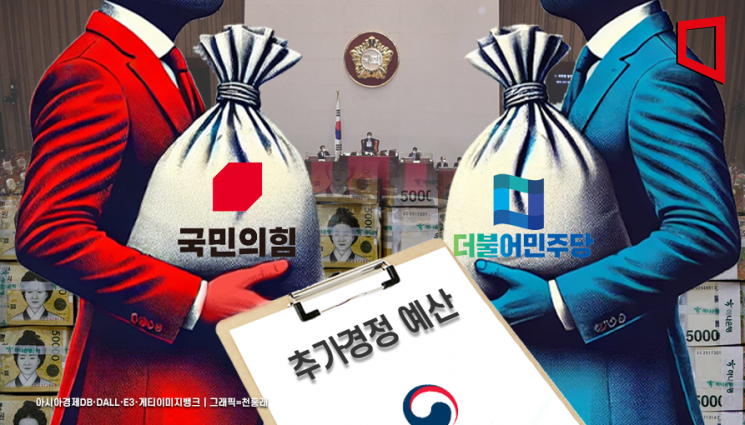
On the other hand, the Democratic Party continued to stress the urgent need for economic stimulus, emphasizing that it is just as important as wildfire recovery and building the AI ecosystem, and reiterated the necessity of a 35 trillion won supplementary budget. Jin Sungjoon, the Democratic Party's policy chief, said at a party meeting held at the tent headquarters in Gwanghwamun, "The government announced a 10 trillion won supplementary budget plan but said this supplementary budget is not for economic stimulus. Then what is it for?"
He continued, "This year, the economic growth outlook for our country has plummeted to 0%. With the prolonged state of civil unrest and impeachment, sluggish domestic demand, and mounting trade pressure from the Donald Trump administration in the United States, livelihoods and the economy are reaching a critical breaking point. Bold policies are needed not only for immediate disaster response but also for supporting domestic demand." He pressed the government and the ruling party, asking, "Is it because you don't want to admit policy failure? Or is it because the insufficient scale of the supplementary budget is embarrassing?" He then urged, "The government should immediately submit a supplementary budget proposal to the National Assembly that reflects a bold willingness to spend. The People Power Party should stop talking about reserve funds and actively cooperate for a supplementary budget that supports people's livelihoods."
© The Asia Business Daily(www.asiae.co.kr). All rights reserved.
![Clutching a Stolen Dior Bag, Saying "I Hate Being Poor but Real"... The Grotesque Con of a "Human Knockoff" [Slate]](https://cwcontent.asiae.co.kr/asiaresize/183/2026021902243444107_1771435474.jpg)

















