Ministry of Trade, Industry and Energy Releases March 2025 Export-Import Trends
Trade Surplus Reaches $4.98 Billion
All IT Product Exports, Including Semiconductors, Turn Positive for the First Time in Eight Months
Exports in March increased by more than 3%, driven by growth in IT products centered on semiconductors, marking two consecutive months of export growth following last month. The government plans to continue dialogue with the U.S. to resolve uncertainties faced by the export industry, such as U.S. tariff measures, while swiftly preparing domestic support measures.
According to the 'March 2025 Export-Import Trends' announced by the Ministry of Trade, Industry and Energy on the 1st, export value reached $58.28 billion, up 3.1% compared to the same month last year. This is the second-highest March performance on record, following March 2022, with exports increasing for two consecutive months. The average daily export value, considering working days, was $2.65 billion, up 5.5% year-on-year, also marking the second-best March performance on record.
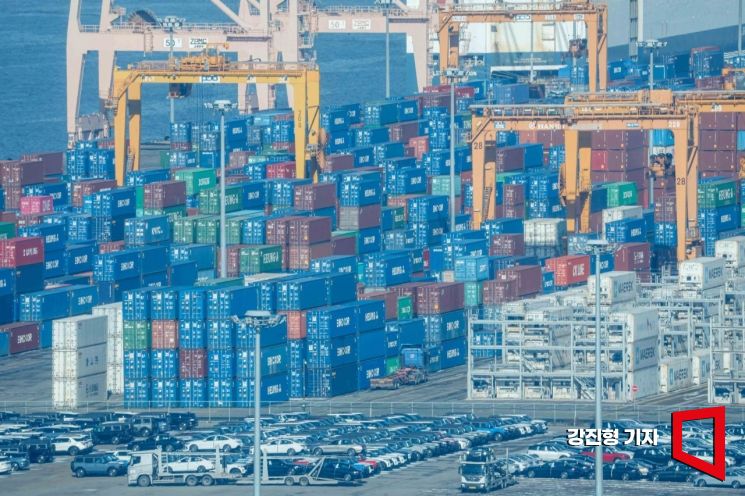
Minister An Deok-geun of the Ministry of Trade, Industry and Energy evaluated, "In March, despite uncertainties in the trade environment, exports of all IT products recorded positive growth for the first time in eight months, achieving both export growth and a trade surplus simultaneously following February."
In March, exports increased in 7 out of the 15 major export items. Exports of all IT products recorded simultaneous positive growth for the first time in eight months since July last year. Semiconductor exports turned positive, reaching $13.1 billion (11.9%) due to strong demand for high-value-added memory such as High Bandwidth Memory (HBM). Computer SSD exports ($1.2 billion, 33.1%) increased for the 15th consecutive month, and wireless communication device exports ($1.3 billion, 13.8%) rose for the second consecutive month. Display exports ($1.5 billion, 2.9%) broke a seven-month declining trend since August last year and turned positive.
Automobile exports, one of the two major export items along with semiconductors, recorded $6.2 billion, up 1.2% overall, as exports of hybrid and internal combustion engine vehicles increased despite a 39% decrease in electric vehicle exports compared to the same period last year.
Ship exports turned positive, recording $3.2 billion, the highest in 15 months since December 2023 ($3.7 billion). Biohealth exports increased for the second consecutive month to $1.4 billion, up 6.9%, mainly driven by pharmaceuticals ($900 million).
Petroleum product exports fell 28.1% to $3.3 billion due to a decline in international oil prices, with Dubai crude oil dropping from $84.2 per barrel in March last year to $72.5 in March this year, and a decrease in export volume caused by regular maintenance of major refineries. Steel product exports decreased 10.6% to $2.6 billion due to price declines, while aluminum exports increased 20.4% to $500 million.
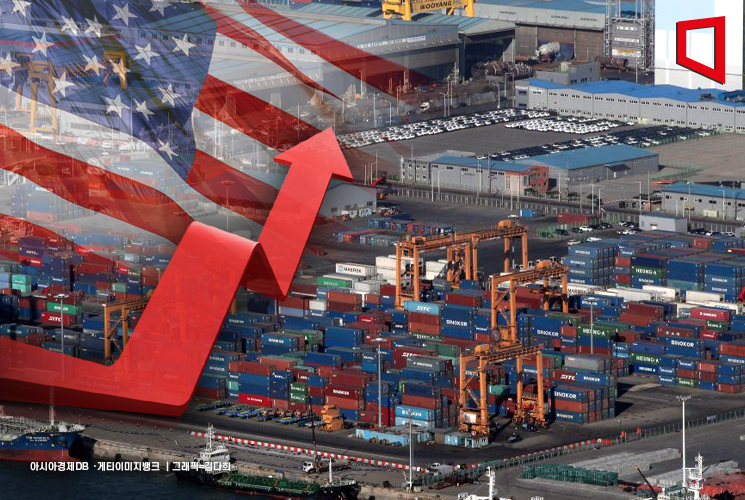
Last month, exports increased in 6 out of 9 major markets. Exports to China decreased 4.1% to $10.1 billion overall, as semiconductor exports declined despite strong performances in petrochemicals and wireless communication devices. Exports to the U.S. increased 2.3% to $11.1 billion.
Exports to ASEAN (Association of Southeast Asian Nations) rose 9.1% to $10.3 billion, surpassing exports to China for the second consecutive month in March, driven by strong exports of IT products such as semiconductors and displays. Exports to the European Union (EU) increased 9.8% to $6.3 billion, supported by more than doubling of ship exports and strong biohealth exports. Exports to the Middle East increased for the second consecutive month to $1.8 billion (13.6%), while exports to Japan and the Commonwealth of Independent States (CIS) turned positive.
Imports in March rose 2.3% year-on-year to $53.3 billion. Energy imports decreased 7.3% to $10.1 billion due to declines in crude oil (-9.0%) and coal (-34.8%) imports. Non-energy imports, including semiconductor equipment (86.2%), increased 4.8% to $43.2 billion.
The trade balance in March recorded a surplus of $4.98 billion. As a result, the cumulative trade surplus from January to March this year reached $7.34 billion.
To sustain the export growth trend, the government plans to provide Korean export companies with one-stop access to U.S. trade policy information and full support for resolving difficulties through the integrated tariff response consultation window, 'Tariff Response 119.' In addition, while supporting the export capabilities of small and medium-sized enterprises through the existing export voucher program (2025, 53.1 billion KRW), an additional 8 billion KRW 'Tariff Response Voucher' will be supplied to provide local expert assistance for customs clearance, logistics support, and new market development. Should the U.S. impose additional tariffs, industry-specific countermeasures will be promptly prepared.
© The Asia Business Daily(www.asiae.co.kr). All rights reserved.
![Clutching a Stolen Dior Bag, Saying "I Hate Being Poor but Real"... The Grotesque Con of a "Human Knockoff" [Slate]](https://cwcontent.asiae.co.kr/asiaresize/183/2026021902243444107_1771435474.jpg)
















