NH Investment & Securities analyzed on the 1st that the KOSPI is expected to show downside resilience around the mid-2400 level.
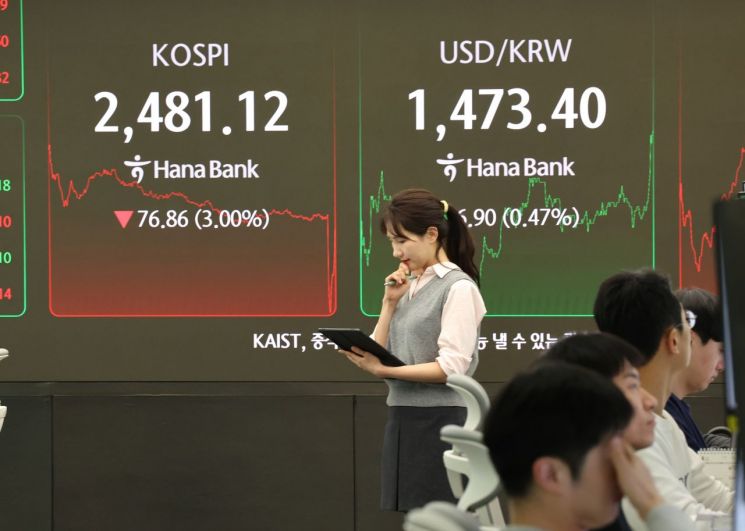
On the 31st of last month, the KOSPI plunged 76.86 points (3.00%) from the previous trading day to 2481.12, and the KOSDAQ also fell 20.91 points (3.01%) to 672.85.
Jung-Hwan Na, a researcher at NH Investment & Securities, said, "Not only the Korean stock market but also the Japanese Nikkei 225 index dropped 4.3% intraday, and the Taiwan Weighted Index fell 4.2%, showing a general weakness in Asian stock markets," adding, "U.S. President Donald Trump's reciprocal tariff policy combined with U.S. economic uncertainty worsened investor sentiment."
He stated, "With the resumption of short-selling transactions in the Korean stock market, some stocks experienced significant price declines, which expanded volatility," and evaluated, "The decline was particularly notable in secondary battery and pharmaceutical/biotech stocks with high loan balance ratios. Additionally, the delay in the domestic impeachment ruling prolonged the policy vacuum period, which also contributed to the stock price decline."
However, NH Investment & Securities expects the KOSPI to show downside resilience around the 2400 level. He said, "There is a possibility of further price declines following Trump's reciprocal tariff announcement on April 2," but added, "Last year, when the KOSPI stayed around the 2400 level, it was the period when concerns about Trump's election and tariff wars were fully reflected."
He continued, "It was a time when political uncertainty in Korea was at its peak," and predicted, "The KOSPI index is likely to show downside resilience in the mid-2400 range."
In addition, valuation attractiveness is emerging. He emphasized, "In December last year, when tariff concerns and political uncertainty expanded after Trump's election, the KOSPI fell to 0.86 times on a 12-month trailing price-to-book ratio (PBR) basis," adding, "Due to the price decline, the KOSPI's trailing PBR also dropped again to 0.86 times, and on a 12-month forward price-to-earnings ratio (PER) basis, it is 8.7 times, below 9 times."
He explained that since the reason the Korean stock market could rise at the beginning of the year was low valuation, attention should be paid to related sectors or stocks. He said, "It is important to remember that one of the reasons the Korean stock market rose since the beginning of the year was the attractiveness of low valuation," and added, "Interest in domestic sectors that have excessively declined, such as low-performance and low-valuation sectors (domestic consumption stocks and semiconductors), should be maintained."
© The Asia Business Daily(www.asiae.co.kr). All rights reserved.
![Clutching a Stolen Dior Bag, Saying "I Hate Being Poor but Real"... The Grotesque Con of a "Human Knockoff" [Slate]](https://cwcontent.asiae.co.kr/asiaresize/183/2026021902243444107_1771435474.jpg)















