US CNBC Survey of Economists
First Quarter GDP Growth Rate Expected to Reach Only 0.3%
Contraction in Consumer and Corporate Activity... Goldman Raises Probability of Recession
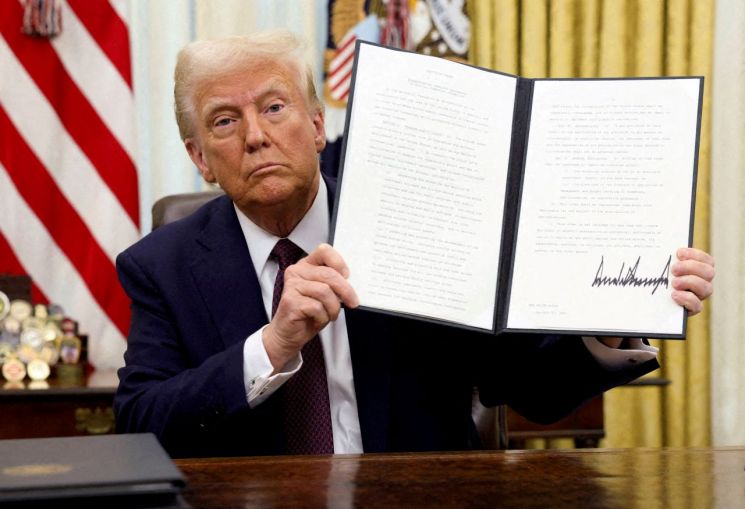
There is a forecast that the U.S. economic growth rate slowed rapidly in the first quarter of this year. As consumer sentiment and corporate activities froze due to the tariff war triggered by Trump, the U.S. economic exceptionalism, which had been maintaining a 'lone boom,' is also being shaken. Following the announcement of tariffs on steel, aluminum, and automobiles, and with reciprocal tariffs set for the 2nd of next month, there is growing anticipation that the U.S. economy will fall into 'stagflation'?a combination of inflation and recession?due to President Donald Trump's 'tariff bombshells.'
According to a survey conducted by the U.S. economic news channel CNBC of 14 economists and released on the 31st (local time), the real Gross Domestic Product (GDP) of the U.S. in the first quarter is expected to have increased by 0.3% on an annualized basis compared to the previous quarter. This is significantly lower than the confirmed 2.4% GDP growth rate in the fourth quarter of last year and represents the lowest figure since the U.S. economy began recovering from the COVID-19 pandemic in 2022.
Experts expect the economic growth rate to slump to 0.3% in the first quarter, then gradually recover to 1.4% in the second quarter, 1.6% in the third quarter, 1.9% in the fourth quarter, and 2.1% by the first quarter of 2026.
Inflation is expected to remain well above the monetary authorities' target of 2% for most of this year. The core Personal Consumption Expenditures (PCE) price index is projected to rise by 2.8% in the first quarter, 2.6% in the second quarter, and 3.0% in the third quarter, before easing to 2.4% in the fourth quarter and 2.1% in the first quarter of 2026. The core PCE price excludes volatile items such as food and energy, showing the underlying trend in prices, and is the inflation indicator most closely monitored by the U.S. Federal Reserve (Fed).
This outlook comes amid a sharp deterioration in U.S. consumer sentiment due to the uncertainty caused by President Donald Trump's indiscriminate tariff policies, with companies also postponing spending and investment decisions. According to the U.S. Department of Commerce, nominal personal consumption expenditures in February increased by 0.4% compared to the previous month, falling short of expert expectations of 0.5%. The inflation-adjusted increase in personal consumption expenditures in February was only 0.1% month-on-month. Despite expectations of a strong rebound in February following a 0.3% decline in January due to cold weather, the increase fell short. This indicates signs of contraction in consumption, which accounts for two-thirds of the U.S. economy. Companies are also delaying spending and investment decisions. The Institute for Supply Management (ISM) stated in its February Manufacturing Purchasing Managers' Index (PMI) report released earlier this month that "customers (companies) are halting new orders due to tariff uncertainties."
Since President Trump took office on January 20 and has relentlessly launched tariff attacks for over two months, concerns about an economic recession have been growing inside and outside the market. There are expectations that retaliatory tariffs and protectionist measures by various countries will lead to a global tariff war and inflation. U.S. investment bank Goldman Sachs forecasted the U.S. GDP growth rate for the first quarter at 0.2% and the annual growth rate at 1%, raising the probability of a recession within the next 12 months from 20% to 35%. The Atlanta Federal Reserve Bank's GDPNow, which provides real-time forecasts of U.S. economic growth, predicted a -2.8% growth rate for the first quarter, and some analysts have even forecasted a contraction in the U.S. economy.
Mark Zandi, chief economist at global credit rating agency Moody's, said, "Our baseline forecast is that real GDP will not decline, but with the intensification of the global trade war and the Department of Government Efficiency (DOGE) cutting jobs and subsidies, there is a possibility that GDP will decrease in the first and second quarters of this year," adding, "If the president does not withdraw tariffs by the third quarter, the likelihood of a recession is high."
© The Asia Business Daily(www.asiae.co.kr). All rights reserved.

















