Three Factors That Fueled the Gyeongbuk and Gyeongnam Wildfires
Presence of 'Rimdo' Determined Firefighting Success
Pine Trees and Leaf Litter Accelerated Fire Spread
"Expand Equipment and Strengthen Training for Firefighting Personnel"
The main factors that exacerbated the large-scale wildfires in Gyeongbuk and Gyeongnam were identified as the characteristics of Korean forests, which have many coniferous trees, the lack of forest roads (rimdo) accessible to firefighting equipment, and the poor condition of large firefighting helicopters and other equipment. While warm and dry weather and strong winds also influenced the spread of the fires, there are conditions that can be changed by human effort, so suggestions have been made for future countermeasures.
Firefighting and Spread Divided by Forest Roads, Not the First Time
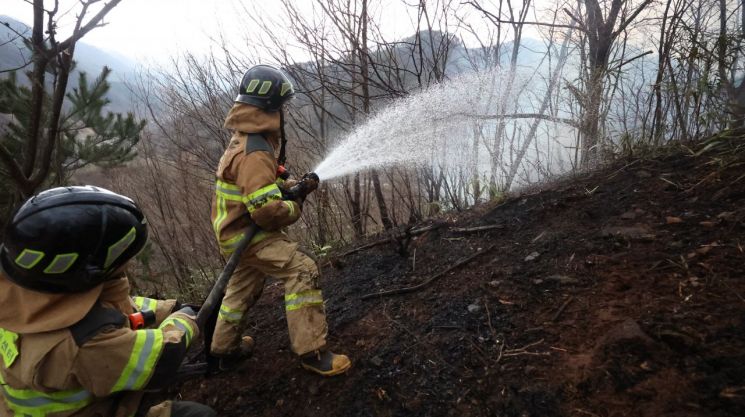
Forest roads, or rimdo, are literally 'access roads' in forests. They are not simply hiking trails for people but paths made for vehicles and equipment to pass through. Existing rimdo are less than 3 meters wide, while forest fire-fighting rimdo built for wildfire suppression are at least 3.5 meters wide, allowing firefighting equipment to move smoothly. During the daytime, firefighting helicopters operate for fire suppression, but when it gets dark and flying helicopters becomes difficult, firefighting personnel and ground equipment can conduct nighttime firefighting operations directly via the rimdo. If the roads are not properly maintained, nighttime firefighting becomes difficult.
Rimdo had a decisive impact on firefighting and fire spread after this wildfire outbreak. In the Ulju Onyang and Eonyang wildfires, the presence or absence of rimdo determined the timing of firefighting. The wildfire that occurred on April 25 at Hwajangsan in Eonyang was contained within 29 hours thanks to nighttime firefighting using rimdo. However, the Onyang wildfire on April 22 took six days to control due to steep terrain and lack of rimdo. Ulsan Mayor Kim Doo-gyeom said, "After seeing this fire, I felt that rimdo should be built on all mountains in the future," adding, "If there is a role that local governments can play, such as consulting with forest owners, we will do so."
The wildfire suppression in Sancheong, Gyeongnam, also faced difficulties due to the absence of rimdo. At a briefing on March 30, Lim Sang-seop, head of the Korea Forest Service, said, "Although a large amount of water was dropped by firefighting helicopters, the fire repeatedly reignited because it was under the leaf litter layer," adding, "To suppress such wildfires, firefighting personnel need to go directly to the site to completely extinguish the fire hidden in the leaf litter, but the wildfire site is located on a high peak at 900 meters above sea level, and there are no rimdo for access, which hindered the movement of firefighting teams."
Similar cases occurred during the 2023 wildfire incidents. The Hapcheon wildfire in March 2023 had a firefighting rate of only about 10% even with helicopter deployment before sunset, but nighttime firefighting using rimdo raised the containment rate to 92%. In contrast, the Hadong wildfire around the same time failed to be contained despite nighttime ground firefighting after sunset. This was because the area is part of Jirisan National Park, where there are no rimdo and the terrain is rugged. The efficiency of nighttime firefighting between Hapcheon and Hadong wildfires reportedly differed by about five times.
The Korea Forest Service is expanding forest fire-fighting rimdo annually, but the density of rimdo in Korea is very low at 2.1 meters per hectare as of 2023. Overseas rimdo densities are 54 m/ha in Germany, 50.5 m/ha in Austria, 10.3 m/ha in Canada, and neighboring Japan has about 24.1 m/ha. Experts emphasize the importance of expanding rimdo. Professor Lee Yong-jae of the Fire Safety Management Department at Kyungmin University said, "Korea has many private forests, and rimdo are scarce due to opposition from owners," adding, "Rimdo also serve as a defensive line that cuts off wildfire spread in the middle, so expanding rimdo is absolutely necessary."
Dense Leaf Litter Below, Pine Trees Ablaze Above
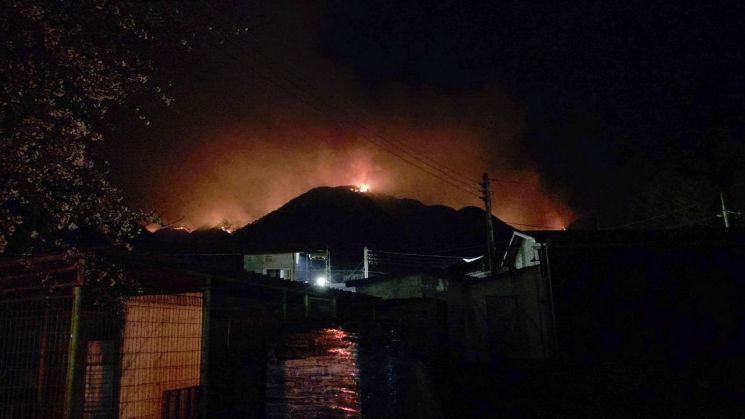
The fact that most domestic forests are composed of pine and other coniferous trees is also analyzed as a factor for the rapid spread of fire. Coniferous forests account for 39% of Korea's total forest area. This is because the hard soil characteristics provide a favorable environment for conifers to grow well. Pine species contain volatile substances such as resin and terpenes, which have a higher heat release than broadleaf trees, making them more vulnerable to wildfires.
Additionally, the ground surface below is covered with old leaf litter fallen from broadleaf forests. The dry leaf litter, like coniferous forests, easily ignites. Hidden embers in the leaf litter can also reignite. The National Institute of Forest Science viewed this vertical forest structure as influencing the spread and persistence of this wildfire. The fuel structure extended like a 'ladder' from the upper to the lower parts of the forest.
Therefore, a measure has been proposed to plant fire-resistant tree species within forests composed only of conifers. The Korea Forest Service's "2023 Nationwide Simultaneous Wildfire White Paper" recommended creating 'firebreak forests' with broadleaf trees around residential areas and wildfire-damaged sites. It also suggested selectively thinning overly dense trees to secure spacing.
Equipment and Personnel Are 'Aged'
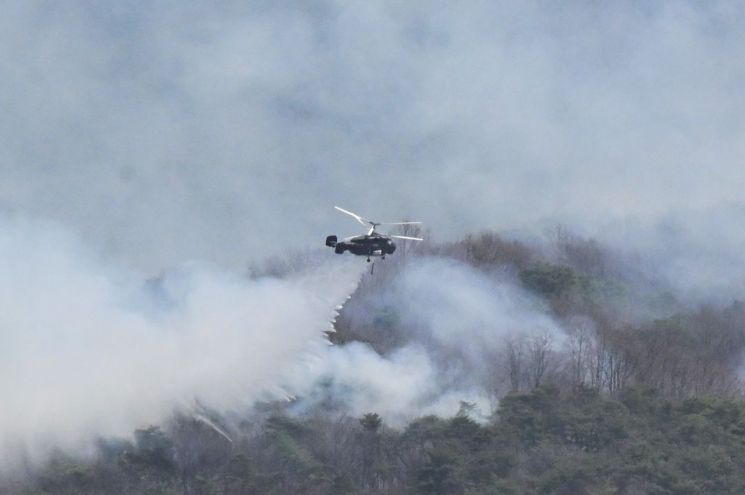
The shortage of 'large firefighting helicopters' capable of quickly suppressing main fires was also pointed out as an area for improvement. Currently, among the 50 helicopters owned by the Korea Forest Service, only seven are 'large helicopters' with a capacity of 5,000 liters or more. Even these are severely aged. Among the Korea Forest Service's wildfire suppression helicopters, 33 (70%) are over 20 years old, and 12 (25%) are over 30 years old.
Wildfire suppression personnel, who need stamina to fight fires for long hours, also include many elderly members. According to data on wildfire suppression personnel received by Rep. Eo Gi-gu of the Democratic Party from the Korea Forest Service, 29.1% (129 people) of the Special Wildfire Disaster Suppression Team were aged 50 or older. This was followed by 122 people in their 20s, 103 in their 30s, and 56 in their 40s. Among the Wildfire Prevention and Monitoring Team, which conducts wildfire prevention and surveillance activities, 74.9% (7,071 out of 9,446) were aged 60 or older.
Professor Gong Ha-seong of the Fire and Disaster Prevention Department at Woosuk University said, "When wildfires become massive like this, it is appropriate for the Fire Agency, which has more equipment and trained personnel, to take command," adding, "Education for wildfire suppression personnel should be as systematic as that for firefighters." He also said, "In principle, since there are not many large helicopter models domestically, it is right to expand large helicopters with a capacity of 8,000 liters or more," but added, "Because maintenance and management costs are high in addition to purchase costs, acquiring too many helicopters at once requires careful consideration."
© The Asia Business Daily(www.asiae.co.kr). All rights reserved.



















