Korea Disease Control and Prevention Agency Issues Japanese Encephalitis Advisory on the 27th
Urges Strict Vaccination After 12 Months of Age
Comprehensive Vector Control Training Provided for City and County Officials
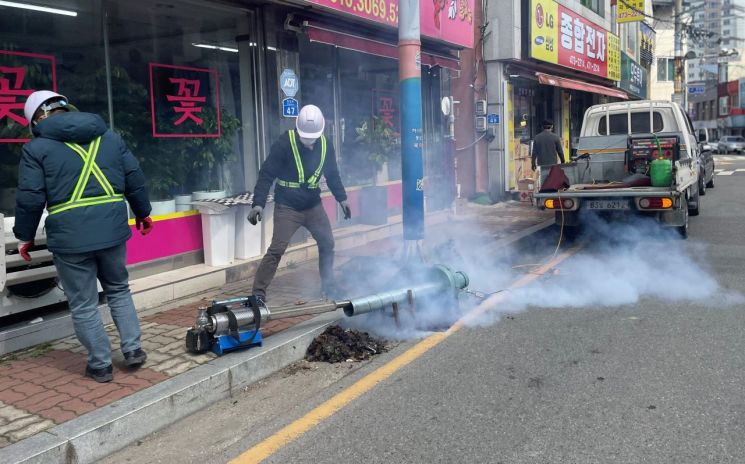 A scene of Jeonnam Province conducting pest control disinfection to eliminate mosquitoes that transmit Japanese encephalitis. Provided by Jeonnam Province
Jeollanam-do has urged residents to take extra precautions to avoid mosquito bites after the Korea Disease Control and Prevention Agency issued a Japanese encephalitis advisory on the 27th, following confirmation of Japanese encephalitis mosquitoes in the province.
The Japanese encephalitis advisory is issued based on the first collection date of Culex tritaeniorhynchus mosquitoes. The presence of these mosquitoes was confirmed among those collected from March 24 to 26.
Culex tritaeniorhynchus mosquitoes inhabit rice paddies and puddles, are mainly active at night, and begin to appear from late March, reaching their peak between August and September.
Japanese encephalitis is a third-class notifiable infectious disease. Most infected individuals experience mild symptoms such as fever or headache, but in rare cases, it can progress to encephalitis, causing high fever, seizures, convulsions, and paralysis. Among these severe cases, 20-30% can be fatal, so special caution is required.
Last year, there were no reported cases of Japanese encephalitis in Jeollanam-do, but due to rising temperatures from climate change, the first domestic cases have been occurring earlier, shifting from August 2022-2023 to May 2024.
From April to October, when mosquitoes are active, it is important to follow preventive measures such as: ▲wearing long, loose-fitting clothing during outdoor activities ▲using mosquito repellent ▲eliminating standing water around the home ▲using screens and mosquito nets.
The national Japanese encephalitis vaccination program begins after 12 months of age, so vaccinations should be administered according to the schedule. Information can be found at public health centers or on the Immunization Helper website.
For adults aged 18 or older who have not previously received the Japanese encephalitis vaccine, vaccination (paid) is recommended if: ▲they reside or work near livestock farms or in high-risk areas ▲they are foreigners who have moved from non-endemic regions and plan to stay long-term in Korea ▲they plan to travel to countries where Japanese encephalitis is prevalent. High-risk countries include Bangladesh, Bhutan, India, Nepal, Pakistan, Sri Lanka, Brunei, Myanmar, Cambodia, Indonesia, Laos, Malaysia, the Philippines, Singapore, Thailand, Timor-Leste, Vietnam, China, Japan, North Korea, South Korea, Taiwan, Russia, Australia, Papua New Guinea, and others.
Since April 4, Jeollanam-do has been conducting disinfection operations with public health centers and voluntary quarantine teams at 23,000 sites where vectors may breed, including apartment complexes, garbage dumps, rivers, and sewage treatment plants, to prevent infectious diseases transmitted by vectors such as Japanese encephalitis.
On April 2, comprehensive vector control training will be provided to 120 city, county, and township quarantine officials, covering mosquito ecology and control agents, environmentally friendly vector management, and sharing of field case studies.
© The Asia Business Daily(www.asiae.co.kr). All rights reserved.
![Clutching a Stolen Dior Bag, Saying "I Hate Being Poor but Real"... The Grotesque Con of a "Human Knockoff" [Slate]](https://cwcontent.asiae.co.kr/asiaresize/183/2026021902243444107_1771435474.jpg)















