Increase in November → Decline in December → Increase in January → Decline in February
Industrial Activity Indicators Change Every Month
"Too Early to Say the Recovery Is Strong"
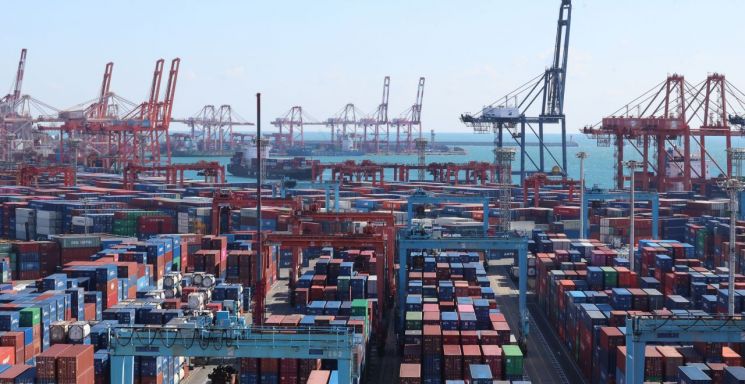
Last month, the three pillars of industrial activity?production, retail sales, and investment?recorded a 'triple increase.' Although the indicators suggest a positive signal, the government finds it difficult to be optimistic about the economy due to the unstable fluctuations of these three indicators.
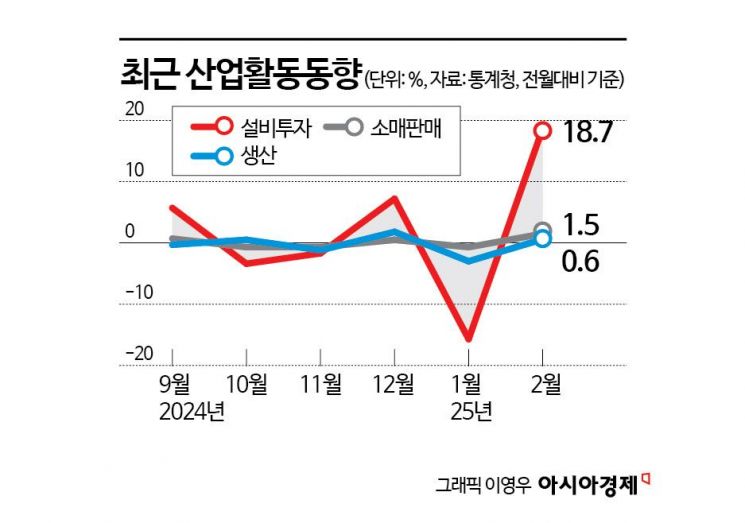
According to the 'February 2025 Industrial Activity Trends' released by Statistics Korea on the 31st, last month, total industrial production, retail sales, and facility investment all increased compared to the previous month. The triple increase, where all three sectors simultaneously recorded positive growth, occurred for the first time in two months since December last year. The industrial indicators have been fluctuating over the past four months. In November last year, all three recorded negative growth, but a month later, they all increased simultaneously, only to show a 'triple decline' again in January this year.
With industrial indicators changing every month, the government has also taken a cautious stance on the economic outlook. Lee Doowon, Director of Economic Trend Statistics at Statistics Korea, said, "We can say there are signs of economic recovery," but added, "Since the rebound lasted only one month, we need to observe further." Cho Sungjoong, Head of Economic Analysis at the Ministry of Economy and Finance, also explained, "Just because there was a triple increase, it does not mean the recovery is strong or that positive signals for economic recovery have appeared."
Total industrial production recorded a slight rebound, increasing by 0.6% compared to the previous month. Since July last year, total industrial production has repeatedly alternated between negative and positive growth each month. Production, which recorded -0.6% in July last year, turned to 1.0% in August but fell back to -0.3% in September. It continued to fluctuate in October (0.5%), November (-1.2%), December (1.8%), and January this year (-3.0%), showing no clear upward trend.
By sector, production increased in mining and manufacturing (1.0%), construction (1.5%), and services (0.5%). Although mining and manufacturing declined in primary metals (-4.6%) and chemical products (-3.0%), production increased in electronic components (9.1%) and electrical equipment (6.0%) due to growth in OLED and IT LCD production. The service sector saw a 3.0% decrease in accommodation and food services, marking the largest decline in three years, but retail trade (6.5%), including electric vehicles and mobile phones, led the growth.
Retail sales rose 1.5% compared to the previous month, marking the largest increase in 11 months since March last year (1.5%). Despite being the largest increase in 11 months, the 1.5% rise still reflects sluggish consumption. Notably, durable goods (13.2%) increased the most in 15 years and 5 months since September 2009 (14.0%). The early execution of electric vehicle subsidies in early February, due to the government's rapid execution policy this year, led to a 13.5% increase in passenger car sales.
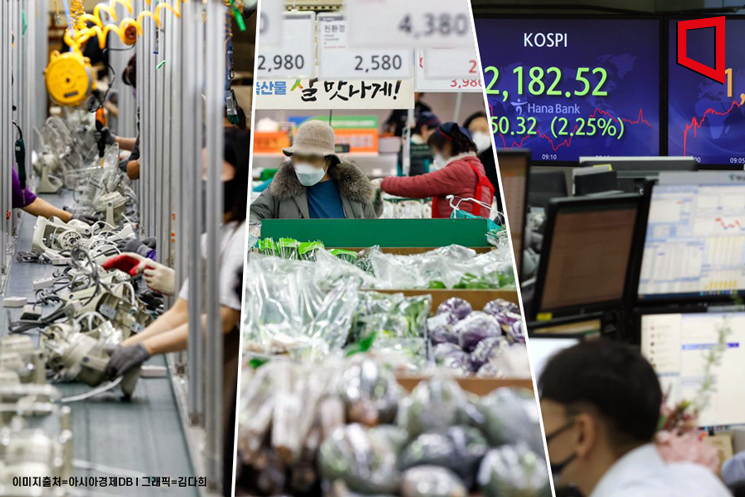
However, retail sales excluding durable goods remained weak. Non-durable goods retail sales, including food and beverages, decreased by 2.5% compared to the previous month. This marks a decline for two consecutive months following January (-1.4%). Semi-durable goods such as shoes and bags also fell by 1.7%, continuing the decrease from January (-2.2%).
Facility investment increased by 18.7% compared to the previous month, the largest increase in 22 years since a 19.4% rise in February 2003. Machinery, including semiconductor manufacturing equipment (23.3%), and transportation equipment such as automobiles (7.4%) all increased. Construction performance rose by 1.5%, with civil engineering (13.1%) increasing despite a decline in building construction (-2.2%). However, construction orders fell by 6.9% year-on-year due to decreases in building construction such as factories and warehouses (-9.3%).
The coincident index, which reflects the current economy, rose slightly by 0.1 points from the previous month to 98.5. The leading index, which predicts future economic conditions, fell by 0.1 points from the previous month to 100.4.
© The Asia Business Daily(www.asiae.co.kr). All rights reserved.
![Clutching a Stolen Dior Bag, Saying "I Hate Being Poor but Real"... The Grotesque Con of a "Human Knockoff" [Slate]](https://cwcontent.asiae.co.kr/asiaresize/183/2026021902243444107_1771435474.jpg)


















