"New Tariffs on Critical Minerals
to Be Reported on April 1"
As the United States prepares to announce reciprocal tariffs on April 2, the tariff war is expected to reach its peak with the proposal to impose "Broader, Higher" tariffs. The Wall Street Journal (WSJ) reported that President Donald Trump has instructed his aides to consider imposing a universal tariff of up to 20%.
On March 30 (local time), WSJ cited sources familiar with the matter, reporting that one of the key issues for the Trump administration is whether the U.S. will impose individual tariff rates on its trading partners or impose a universal tariff affecting all countries trading with the U.S.
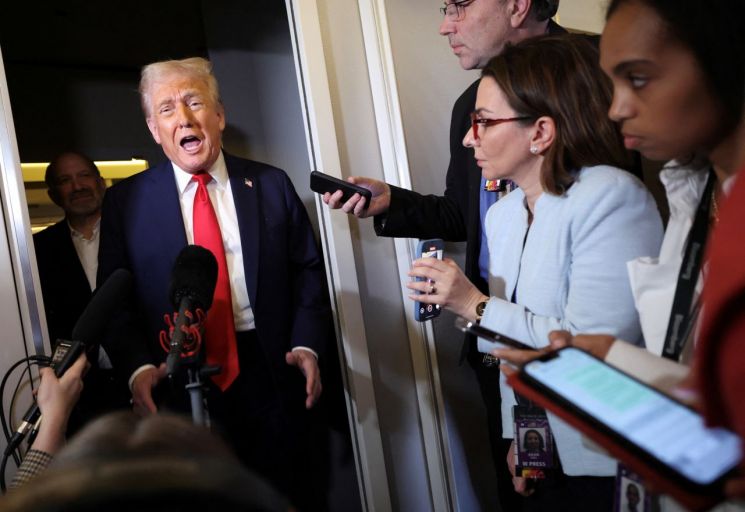
President Trump has recently shown a more conciliatory stance toward imposing tariffs. On March 26, reaffirming the plan to impose reciprocal tariffs, he said, "We will be very generous, and in many cases, the tariff rates will be lower than what other countries have imposed on the U.S. for decades." On March 24, he also stated, "We can grant exemptions to several countries."
Earlier, U.S. Treasury Secretary Scott Baesant mentioned the "Dirty 15," countries that have large trade surpluses against the U.S. and have erected trade barriers. These countries are expected to be targets of reciprocal tariffs, and experts predict that South Korea is likely to be included.
However, according to sources, President Trump pressured his aides to take a more aggressive stance and urged them to devise a plan to apply higher tariff rates to a broader range of countries, WSJ reported. Accordingly, in recent days, Trump's economic advisers have considered imposing a 20% blanket tariff affecting nearly all of the U.S.'s trading partners.
The Washington Post (WP) also reported the previous day that President Trump ordered his aides to formulate a more aggressive tariff policy and revived the idea of universal tariffs. During his campaign, Trump pledged to impose a 10% universal tariff on all imports. After entering the White House, he announced plans to impose reciprocal tariffs by country, but now he is reconsidering the universal tariff approach. This raises the possibility that tariffs, initially expected to target only the Dirty 15 countries, could be expanded more broadly.
However, it is not yet fully inclined toward imposing universal tariffs. A U.S. government official told WSJ that the reciprocal tariff plan is still ongoing. He added that President Trump tends to impose tariffs on all countries with which the U.S. runs a trade deficit and has not yet made a final decision. The official also said that regardless of the final tariffs imposed, President Trump wants the policy to be "big and simple." WSJ explained that this implies the final measure will be broader than the previous plan to impose tariffs on about 15% of the world's countries.
Kevin Hassett, chairman of the White House National Economic Council (NEC), said in an interview with Fox News that when asked how many countries would be affected by reciprocal tariffs, "How many countries will be is up to President Trump to decide." This statement suggests that the tariff imposition policy has not yet been finalized.
Meanwhile, the Trump administration is also considering imposing new industry-specific tariffs targeting critical minerals and products containing them, in addition to reciprocal tariffs. Since taking office, President Trump has introduced tariffs on industries such as aluminum, steel, and automobiles. WSJ said it is uncertain whether these tariffs will be announced on April 2, but they are expected to be included in the National Trade Estimate (NTE) report on trade barriers by country, which the U.S. Trade Representative (USTR) plans to deliver to President Trump on April 1.
Sources said the Trump administration is considering using the International Emergency Economic Powers Act (IEEPA) to impose reciprocal or universal tariffs. This is the law President Trump used last month to impose 25% tariffs on Canada and Mexico and 10% tariffs on China.
© The Asia Business Daily(www.asiae.co.kr). All rights reserved.
![Clutching a Stolen Dior Bag, Saying "I Hate Being Poor but Real"... The Grotesque Con of a "Human Knockoff" [Slate]](https://cwcontent.asiae.co.kr/asiaresize/183/2026021902243444107_1771435474.jpg)















