Personal Information Protection Commission Announces 2024 Survey Results on Protection and Utilization of Personal Information
Nine out of Ten Recognize the Importance of Personal Information Protection
Only Half Respond They Check Consent Details When Providing Information
Public Sector Outperforms Private Sector in Implementing Personal Information Protection Measures
Seven out of ten Koreans expressed concerns about privacy violations due to the spread of artificial intelligence (AI). Nine out of ten recognized the importance of personal information protection.
The Personal Information Protection Commission announced the results of the "2024 Personal Information Protection and Utilization Survey," which includes the status of personal information protection and utilization as well as awareness of personal information protection, on the 31st.
This survey is a nationally approved statistic conducted annually targeting public institutions, private companies, and the general public. It is used to analyze the effectiveness of personal information policies and as basic data for system improvements. Notably, this year, new items such as awareness of personal information risks due to the spread of AI were added.
This year's survey was conducted over three months from September to December last year. The subjects included 3,000 domestic residents aged 14 to 79, 1,200 public institutions, and 6,000 companies with at least one employee. The survey was conducted through face-to-face interviews and online methods.
According to the results, 92.7% of adult respondents answered that personal information protection is important. Among youth respondents, 95% also regarded personal information protection as important. These results are similar to the previous year (adults 94.3%, youth 91.7%).
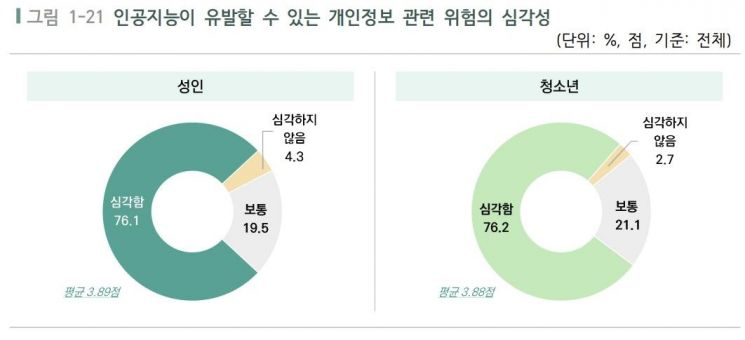
Regarding the seriousness of personal information risks that AI may cause, 76.1% of adults and 76.2% of youth responded that it is "serious." The importance of disclosing the status of personal information processing by AI services was also highly recognized, with 72.1% of adults and 71% of youth acknowledging its significance.
However, the response rate for checking consent details related to personal information provision, such as privacy policies, was low. The proportion of those who check consent details when providing personal information for service use was 55.4% among adults and 37.4% among youth.
In particular, the rate of youth checking consent details was relatively low, likely because the consent content is difficult to understand. The main reason for not checking consent details was "there is a lot of content and it is difficult to understand," answered by 32.5% of adults and 34.8% of youth. The Personal Information Protection Commission analyzed that improvements in the method of information delivery are needed to make consent content easier to understand.
Additionally, the implementation rate of personal information protection measures was higher in public institutions than in private companies. According to the survey of personal information handlers, the implementation rate of personal information protection measures was 99.5% in public institutions and 59.9% in private companies. However, among private companies with 300 or more employees, 90.8% were implementing measures for personal information management.
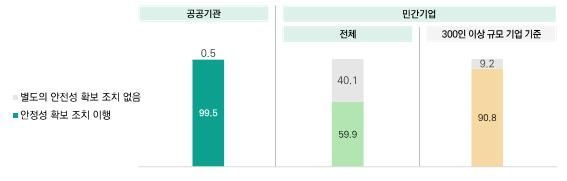 Implementation of measures for the secure management of personal information (multiple responses allowed)
To protect personal information, public institutions mainly implemented safety measures such as ▲establishing and enforcing internal management plans (97.7%), ▲managing access rights (81.9%), and ▲access control (76.8%). Private companies mainly implemented safety measures such as ▲malicious program prevention measures (36.7%) and ▲establishing and enforcing internal management plans (25.7%).
There was also a significant gap between public and private sectors in the implementation rate of personal information protection education for responsible persons or staff. The education implementation rate in public institutions was over 90%, while it was less than 10% in the private sector. However, in private companies with 300 or more employees, the education implementation rate was 60%.
Regarding government policies necessary for personal information protection, both public institutions (65.7%) and private companies (25.2%) identified "promotion of technology development and dissemination related to personal information protection" as a top priority.
Ko Eun-young, Planning and Coordination Officer of the Personal Information Protection Commission, stated, "Based on the results of this survey showing the importance of personal information protection in the AI era, we will systematically promote legal and institutional improvements, technical support, and strengthened inspections to continue policies aimed at realizing a society of trust in personal information."
© The Asia Business Daily(www.asiae.co.kr). All rights reserved.
![Clutching a Stolen Dior Bag, Saying "I Hate Being Poor but Real"... The Grotesque Con of a "Human Knockoff" [Slate]](https://cwcontent.asiae.co.kr/asiaresize/183/2026021902243444107_1771435474.jpg)

















