Basel III Capital Ratios of Domestic Banks Declined in 2024
Exchange Rate Rise and U.S. Protectionism Cited as Main Factors
All Banks Still Exceed Regulatory Minimums, but Risk-Weighted Assets Increased
Financial Supervisory Service Emphasizes Need to Strengthen Capital Capacity

Due to the rise in exchange rates and the impact of U.S. protectionism, the Basel III capital ratios of domestic banks declined last year.
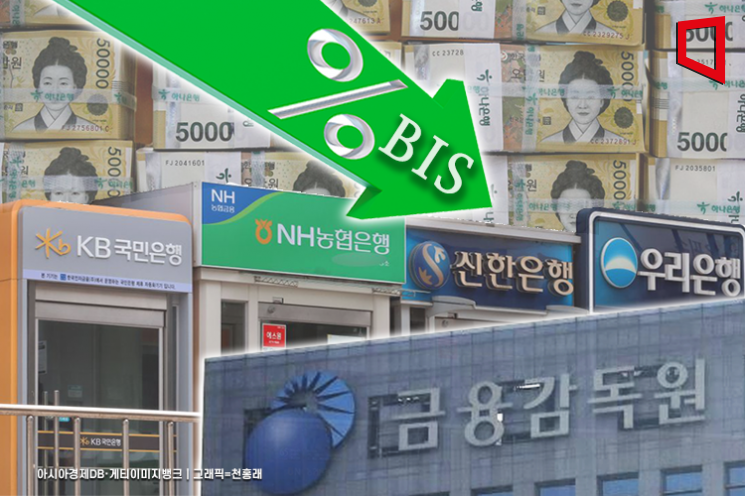
According to the "Status of Bank Holding Companies and Banks' BIS Capital Ratios at the End of 2024" announced by the Financial Supervisory Service on the 31st, the total capital ratio at the end of 2024 was 15.58%, down 0.26 percentage points from the previous quarter. The common equity tier 1 (CET1) ratio fell by 0.26 percentage points to 13.07%, and the tier 1 capital ratio dropped 0.28 percentage points to 14.37%.
The BIS capital ratio is the ratio of a bank's own capital to total assets (risk-weighted assets) and is considered a key indicator of a bank's financial soundness. The regulatory minimums set by supervisory authorities are 8.0% for CET1 ratio, 9.5% for tier 1 capital ratio, and 11.5% for total capital ratio.
As of the end of last year, all domestic banks' capital ratios significantly exceeded regulatory requirements, but the rise in exchange rates caused a substantial increase in risk-weighted assets, leading to a decline compared to the previous quarter.
Among the five major financial holding companies, the total capital ratios were highest in the order of KB Financial Group (16.43%), Shinhan Financial Group (15.79%), Woori Financial Group (15.71%), Hana Financial Group (15.59%), and NongHyup Financial Group (15.37%).
Based on capital ratios, KB, Citi, SC, and Kakao all exceeded 16.0%, showing very stable levels. For the CET1 ratio, Citi, SC, Kakao, and Toss recorded over 14%, while KB, Hana, Shinhan, Export-Import Bank, and K Bank were above 13%, indicating relatively high levels.
The Financial Supervisory Service stated, "High exchange rates have continued this year, and due to delayed economic recovery, intensified U.S. protectionism, and other domestic and international uncertainties, the possibility of credit losses is increasing. Therefore, it is necessary to continuously strengthen capital capacity."
© The Asia Business Daily(www.asiae.co.kr). All rights reserved.
![Clutching a Stolen Dior Bag, Saying "I Hate Being Poor but Real"... The Grotesque Con of a "Human Knockoff" [Slate]](https://cwcontent.asiae.co.kr/asiaresize/183/2026021902243444107_1771435474.jpg)
















