"It's Not Just a Beekeeping Issue, But a Food Security Problem"
Hypotheses Raised Such as Climate Crisis, But Cause Remains Unclear
In the United States, hundreds of millions of honeybees have died en masse over the past eight months.
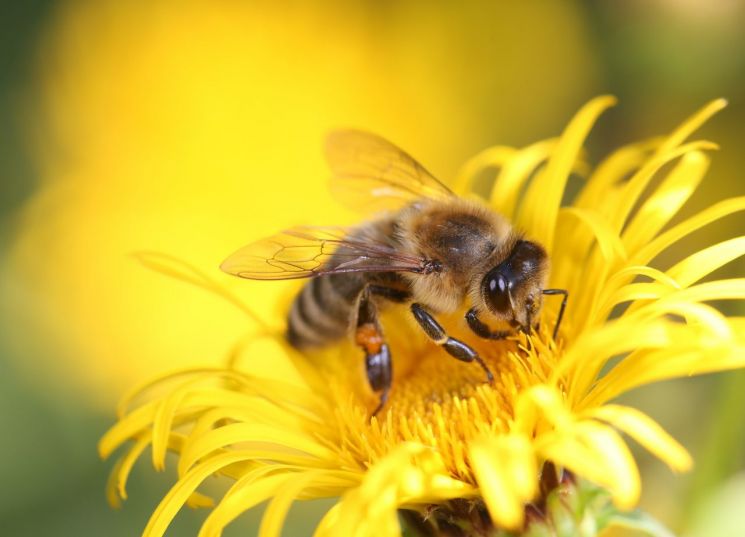
On the 29th (local time), US media including CBS reported that 'Project Apis M,' a US nonprofit organization related to beekeeping, conducted a survey of 702 beekeepers nationwide and found that on average, 62% of bee colonies decreased last winter. The surveyed beekeepers manage about 68% of all honeybees in the US, corresponding to 1.835 million bee colonies.
Large-scale beekeeper Blake Shuck stated, "Tens of thousands of honeybees died at the apiaries I operate," adding, "This is the first time such a large number of bees have perished." When honeybees die in such large numbers, it not only threatens the beekeeping industry but can also have adverse effects on agriculture as a whole. This is because honeybees play a role in pollinating 75% of fruits, nuts, and vegetables, in addition to producing honey.
Shuck pointed out that if honeybee deaths continue, the way food is consumed in the US will change. He said, "If we lose 80% of honeybees every year, the beekeeping industry cannot survive, and pollination at the scale necessary for food production in the US will be impossible," emphasizing, "This is not just a problem for beekeepers but a national food security issue." For example, through honeybee pollination, 900 to 1,360 kg of almonds can be produced per acre (4,046㎡), but without honeybee pollination, only 90 kg per acre can be produced.
What is more problematic is that although several hypotheses have been proposed as causes of honeybee deaths, no definitive reason has yet been identified. Scientists believe that the climate crisis, reduction of honeybee habitats, and pesticide use have adversely affected honeybees. However, Juliana Langle, an entomology professor at Texas A&M University, said, "There is still no definite answer."
The situation is reported to be similar in South Korea. The Ministry of Agriculture, Food and Rural Affairs announced that about 7.8 billion honeybees disappeared last winter alone. Jeju Province reported that the honeybee population in the region has decreased by more than 30% over the past five years, and Gyeongnam Province recently decided to strengthen support for the beekeeping industry as the honeybee population fell below average levels due to abnormal weather and the spread of honeybee diseases. In this regard, the beekeeping industry pointed out that the flowering periods of trees necessary for honey production have become irregular and the number of flowering days has decreased, shortening the lifespan of honeybees.
© The Asia Business Daily(www.asiae.co.kr). All rights reserved.
![Clutching a Stolen Dior Bag, Saying "I Hate Being Poor but Real"... The Grotesque Con of a "Human Knockoff" [Slate]](https://cwcontent.asiae.co.kr/asiaresize/183/2026021902243444107_1771435474.jpg)















