Media Briefing on Support for Affected Residents
Push for Designation as 'Employment Crisis Area'
On the 30th, Governor Lee Cheolwoo of North Gyeongsang Province held a briefing in the briefing room of the provincial government office to inform residents about the 'Status of Wildfire Aftermath Cleanup and Support for Affected Residents.'
The wildfire that began in Uiseong on March 22 rapidly spread to Andong, Cheongsong, Yeongyang, and Yeongdeok, with the main fire extinguished on the 28th. As the cleanup of remaining embers is now in its final stage, this briefing was held to share the progress of post-wildfire response measures with the residents.
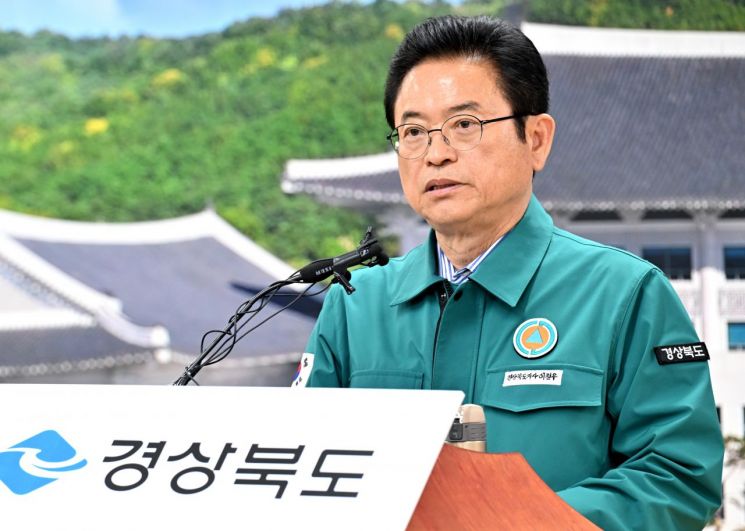 Lee Cheolwoo, Governor of Gyeongbuk Province, is holding a press briefing regarding support for residents affected by the wildfire.
Governor Lee expressed his condolences, saying, "It is deeply tragic that 26 people lost their lives in this large-scale wildfire," and added, "We will work with the government to establish an advanced firefighting system and completely overhaul our wildfire response to prevent this from ever happening again."
In North Gyeongsang Province, the massive wildfire affected a total area of 45,157 hectares and damaged 3,369 homes. Currently, 639 people have evacuated to advanced residential facilities such as hotels and corporate training centers, while 3,773 evacuees are staying at emergency shelters.
Governor Lee first explained the status of the ember cleanup. He reported that the remaining embers in two locations in Seokbo-myeon, Yeongyang County, are being cleared, and that 3,421 firefighting personnel and 59 helicopters have been deployed across five cities and counties. The cleanup will be completed by today, after which the focus will shift to monitoring for potential flare-ups.
The provincial government has determined that the most urgent issue is the housing problem for residents who lost their homes, and has activated a three-tier support system for housing, relief, and medical care for the disaster victims.
North Gyeongsang Province has secured 43 advanced residential facilities, including institutional training centers and hotels, where 639 evacuees are currently staying temporarily.
Efforts to support evacuated residents are being carried out at a 'quasi-wartime' level. Essential items such as mattresses, blankets, and coats, as well as cold-weather supplies, will continue to be provided to ensure comfort. Governor Lee expressed his gratitude, saying, "The entire nation is helping our region, and I am deeply thankful to the many volunteer organizations and individuals who are sharing our pain and offering comfort through meal services, cleaning shelters, and more."
A disaster site-centered medical support system is also in operation to care for the physical and mental well-being of evacuees. A total of 47 doctors from Pohang, Gimcheon, and Andong medical centers, as well as 15 pharmacists, are providing emergency medical support at the shelters. Starting on the 31st, an additional 100 doctors from the North Gyeongsang Medical Association will be deployed. To prevent infectious diseases, public health centers in 22 cities and counties are conducting disinfection and providing sanitary supplies in the affected areas.
As it is the farming season, emergency modular housing will be installed near residents' original homes to support their daily lives and livelihoods. Beginning with 100 units in Andong and other locations, emergency housing will be supplied to all disaster victims who wish to move in, ensuring there are no obstacles to resuming their livelihoods.
Governor Lee also announced plans to pursue the enactment of a special law for rapid recovery and restoration. This law would provide the legal basis for creating residential complexes where local communities can live together, and for focused investment and development in wildfire-affected areas, thereby enabling a paradigm shift in forest policy.
To revive the economic foundation of small and medium-sized businesses and small business owners, the province will also seek the designation of employment crisis areas by the Ministry of Employment and Labor and special support areas by the Ministry of SMEs and Startups.
North Gyeongsang Province will strongly propose changes in forest policy to central government agencies to better protect cultural heritage. As numerous cultural assets, including the thousand-year-old Gounsa Temple, suffered damage in this wildfire, the province is working to improve emergency disaster response manuals, such as preemptively removing trees near cultural properties.
Governor Lee Cheolwoo stated, "Due to climate change, wildfires are likely to become more frequent and larger in scale, so the nation's forest policy and disaster response systems must be completely overhauled." He emphasized, "It is essential to introduce large helicopters capable of dropping more than 10,000 liters of water at once, fixed-wing transport aircraft, and equipment for nighttime firefighting to enable early suppression of wildfires."
He also stressed, "The government should establish a 'Relief Support Division' to stockpile disaster relief supplies such as modular housing, clothing, medicine, and emergency food, so that these can be immediately deployed to protect evacuees when a disaster occurs."
© The Asia Business Daily(www.asiae.co.kr). All rights reserved.
![Clutching a Stolen Dior Bag, Saying "I Hate Being Poor but Real"... The Grotesque Con of a "Human Knockoff" [Slate]](https://cwcontent.asiae.co.kr/asiaresize/183/2026021902243444107_1771435474.jpg)















