Joo Jinwoo, Na Kyungwon, and Kim Kihyun Urge Direct Judgment
Direct Judgment Seen as Faster Than Remand
Some in Ruling Party Say, "Victory Should Come Through Politics, Not Judicial Risk"
Lawmakers from the People Power Party with legal backgrounds have claimed that the Supreme Court may issue a direct judgment overturning the appellate court's ruling that acquitted Lee Jae-myung, leader of the Democratic Party of Korea, who was sentenced to one year in prison with two years of probation for violating the Public Official Election Act.
Assuming that the appellate court's decision was unjust, the People Power Party interprets that the Supreme Court finds it more advantageous in terms of speed to directly overturn the appellate court's ruling by reviewing the evidence from the first and second trials and make its own judgment, rather than overturning the original ruling and remanding the case back to the High Court for reconsideration.
On the morning of the 27th, Representative Kim Ki-hyun held a press conference at the National Assembly Communication Office, urging, "To restore the shaken trust in the judiciary, please promptly issue a direct judgment." Article 397 of the Criminal Procedure Act stipulates that when the Supreme Court overturns the original judgment, it may render a judgment based on the case records and evidence investigated by the original and first trial courts if it deems the evidence sufficient.
He mentioned the Supreme Court's criteria for direct judgments, such as cases where evidence investigation is unnecessary, clear legal errors, the need for promptness or efficiency in litigation, and cases with significant social controversy, stating, "(Lee's appellate trial) meets all four criteria," and added, "Direct judgment is the principle, and remand is supposed to be the exception according to the legislative intent."
Representative Kim also cited the fact that from Lee's indictment for violating the Public Official Election Act to the sentencing in the first and second trials, 30 months of evidence investigation and witness examination took place; that the 6-3-3 principle for election law violation trials is explicitly stated in the law; and that there is social controversy regarding Lee's eligibility to run for president.
When reporters asked about the rarity of direct judgments, Representative Kim rebutted, "Cases where a guilty verdict in the first trial was overturned to a not guilty verdict in the second trial without special reasons account for only 1.7%, so the rate of direct judgments would be about five times higher."
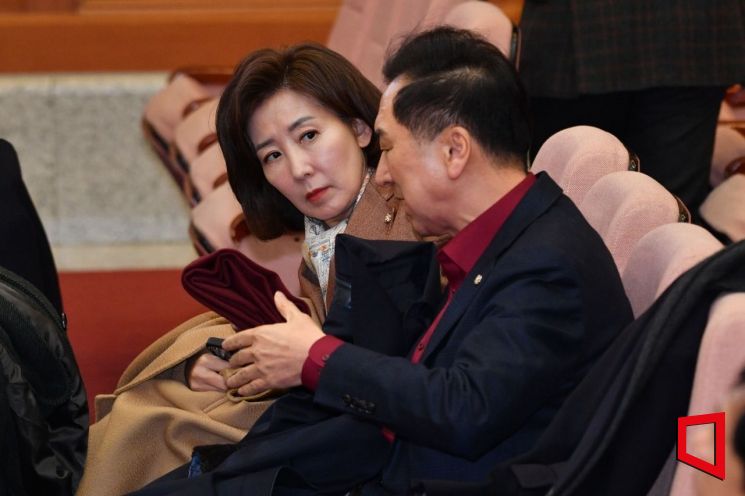 People's Power Party lawmakers Na Kyung-won and Kim Ki-hyun are seated to observe the final arguments of President Yoon Seok-yeol's impeachment trial held at the Constitutional Court in Jongno-gu, Seoul on February 25, 2025. Photo by Joint Press Corps
Like Representative Kim, Representative Na Kyung-won, also a former judge, urged at a press conference in the afternoon, "If the Supreme Court follows the usual practice of remanding the case to the High Court, the trial period will be further delayed. We must break free from the passive attitude stuck in precedent." She also pointed out that since the prosecution's grounds for appeal involve legal misinterpretation, the Supreme Court has the conditions to directly rule on the case.
After Lee's appellate trial, the People Power Party initially argued that the Supreme Court should remand the case, but the strategy shifted to urging a direct judgment due to the speed of final judgment. If an early presidential election is held, and the Supreme Court confirms Lee's disqualification by direct judgment before the election, Lee would lose his eligibility to run.
On the other hand, if the Supreme Court remands the case with a guilty intent, the High Court must retry the appellate trial after remand. This process inevitably takes time as the High Court's ruling follows the Supreme Court's decision. Even if a guilty verdict is rendered in the appellate trial after remand, Lee's right to appeal remains, and if he files a further appeal, the Supreme Court's judgment must be awaited again.
In contrast, a direct judgment allows the Supreme Court to overturn the appellate court's ruling and issue a final judgment itself, which takes relatively less time. Representative Joo Jin-woo, a former prosecutor and legal advisory chairman of the People Power Party, also argued at the emergency committee meeting the day before that the appellate court created bizarre legal reasoning and that "the Supreme Court can issue a direct judgment when there is sufficient evidence, as in this case." He pointed out that since Lee was acquitted and has no right to appeal, the usual 7-day deadline for submitting an appeal and 20-day deadline for submitting an appeal brief, totaling 27 days, are no longer applicable, enabling a swift trial.
However, some within the ruling party argue that Lee should win politically rather than through judicial risk. Shin Ji-ho, former deputy head of strategic planning and a member of the pro-Han Dong-hoon faction, said on the same day, "From now on, we need to get our act together. Continuously hoping for a direct judgment is wishful thinking. If the Supreme Court grants it, consider it a fortunate windfall, but politics should be about how to defeat Lee Jae-myung through politics."
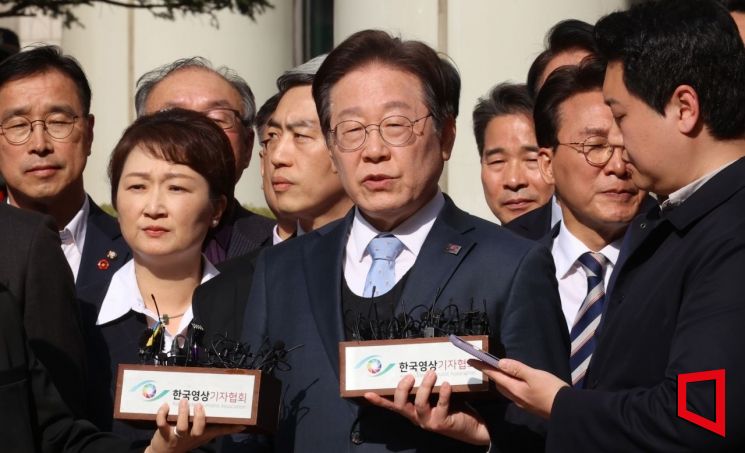 Lee Jae-myung, leader of the Democratic Party of Korea, is giving a statement after being acquitted in the appeal trial of a violation of the Public Official Election Act held at the Seoul High Court on the 26th. 2025.3.26 Photo by Joint Press Corps
© The Asia Business Daily(www.asiae.co.kr). All rights reserved.


















