Returned Home After Meeting with President Xi Jinping
Remained Silent on Questions About China Trip
Leadership Vacuum Issues Pile Up at Home
Samsung Electronics Chairman Lee Jae-yong returned to Korea on the 28th through Gimpo Airport after a week-long business trip to China.
On that day, at the Seoul Gimpo Business Aviation Center in Gangseo-gu, Seoul, Chairman Lee got into his car without responding to reporters' questions about his impressions of the China trip. He remained silent when asked about his meeting with Chinese President Xi Jinping and the semiconductor crisis facing Samsung Electronics.
Earlier, at 11 a.m. (local time), Lee attended a global CEO meeting with President Xi at the Great Hall of the People in Beijing and immediately headed back to Korea. The meeting, named the "International Business Representatives Conference," was an official event linked to the China Development Forum (CDF), and it was reported that about 30 global company CEOs, including Lee and SK Hynix President Kwak No-jung, participated.
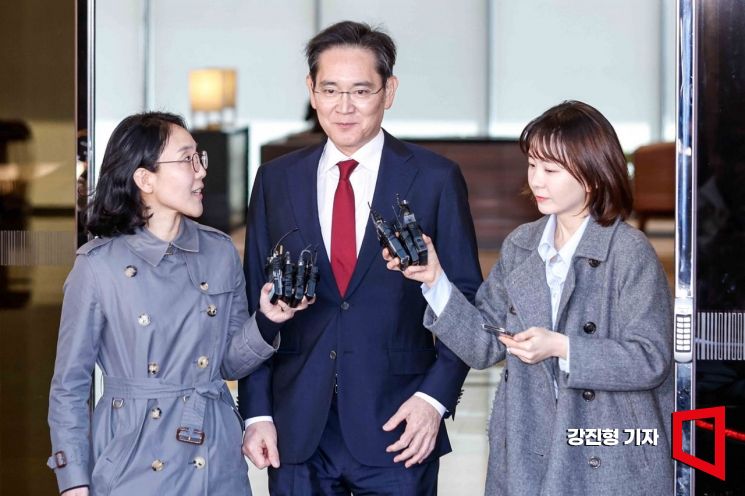 Samsung Electronics Chairman Lee Jae-yong, who met with Chinese President Xi Jinping, is returning to Korea through the Gimpo Airport Business Aviation Center in Gangseo-gu, Seoul on the 28th. 2025.3.28. Photo by Kang Jin-hyung
During his trip, Lee visited Xiaomi's electric vehicle factory in Beijing on the 22nd and the headquarters of BYD, the world's largest electric vehicle manufacturer, in Shenzhen, Guangdong Province, on the 24th, continuing efforts to expand Samsung's automotive electronics business in China. This has been interpreted as China identifying Korean companies as partners to expand its domestic semiconductor industry. There is also speculation that Samsung Electronics may significantly increase cooperation with China in the future.
Meanwhile, the fact that Chairman Lee and SK Hynix President Kwak No-jung both met with Chinese President Xi Jinping has been interpreted as a strategic "love call" from China to Korean memory semiconductor companies. This reflects China's urgent interest in securing advanced technology amid the prolonged U.S. semiconductor export restrictions to China.
The direct meeting between Samsung and Hynix executives and President Xi clearly conveyed China's message. As the U.S.-China technological hegemony competition intensifies and foreign direct investment sharply declines, China has identified Korean companies as practical partners to sustain its semiconductor industry. Facing U.S. export controls that have hindered access to high-performance memory, China urgently needs to restore cooperation with Korean companies that possess both production bases and technology.
Samsung Electronics produces NAND flash memory in Xi'an, China, while SK Hynix manufactures DRAM and NAND flash in Wuxi and Dalian. Both companies face restrictions on importing equipment into their Chinese factories due to U.S. semiconductor equipment export controls, but currently, they are able to bring in equipment through designation as Verified End Users (VEU). If the U.S. government resumes export controls, production in China could be disrupted, directly impacting China's advanced industries.
President Xi stated on the day, "China is an ideal and promising investment destination for foreign companies," and promised "equal market participation according to the law." He also indirectly criticized the U.S. technology blockade strategy by saying, "Turning off someone else's light does not make my light shine brighter." This was interpreted as a subtle message urging Korean semiconductor companies not to leave China.
An industry insider said, "Samsung and Hynix are by no means simple foreign-invested companies in China. They are essential pillars for maintaining China's semiconductor ecosystem, and President Xi's direct meeting with them reveals China's desperation."
Another insider commented, "Since China remains a core market for Korean semiconductor businesses, this meeting can be seen as a signal to strengthen local partnerships and cooperation. In the ongoing U.S.-China conflict, it is important for private companies to maintain good relations with the Chinese government, which can be viewed as a strategic move to secure business stability and sustainability for Korean semiconductor firms."
On the other hand, amid ongoing concerns about Samsung Electronics' leadership crisis, there are pressing challenges to address. During Lee's visit to China, on the 25th, Samsung Electronics Vice Chairman Han Jong-hee passed away, creating a leadership vacuum in the dual leadership system of Han Jong-hee and Jeon Young-hyun (head of the DS division). Samsung Electronics is expected to maintain a single vice chairman representative system for the time being.
© The Asia Business Daily(www.asiae.co.kr). All rights reserved.
![Clutching a Stolen Dior Bag, Saying "I Hate Being Poor but Real"... The Grotesque Con of a "Human Knockoff" [Slate]](https://cwcontent.asiae.co.kr/asiaresize/183/2026021902243444107_1771435474.jpg)















