The Korea Customs Service is rolling up its sleeves to minimize on-site confusion caused by the United States' tariff policies.
On the 28th, the Korea Customs Service announced the launch of the "Customs Service Special Response Headquarters" to proactively respond to the tariff policies of the Trump administration in the United States.
The Response Headquarters will be led by Lee Myung-gu, Deputy Commissioner of the Korea Customs Service. The purpose of establishing and operating the Response Headquarters is to minimize the anticipated confusion that countries around the world, including Korea, will face due to the U.S. government's reciprocal tariff policy scheduled to be announced on the 2nd of next month.
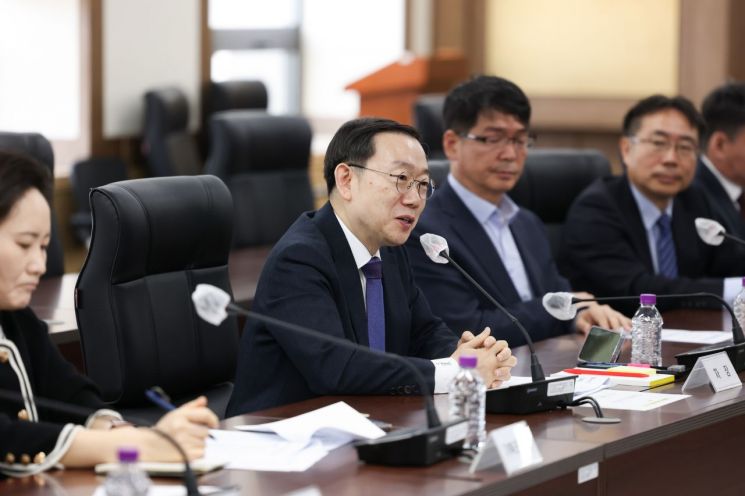 Lee Myung-gu, Deputy Commissioner of the Korea Customs Service, is emphasizing the role and importance of the Response Headquarters at the launch ceremony of the "Korea Customs Service Special Response Headquarters" on the 28th. Photo by Korea Customs Service
The anticipated confusion arising from the reciprocal tariff policy includes differential tariff rates, an increase in circumvention exports aimed at evading export-import regulations and attempts to undermine trade security, and disadvantages (risks) faced by domestic companies due to the difficulty in promptly responding to the increasingly complex tariff system.
To proactively respond to these situations, the Korea Customs Service’s calculation is to minimize confusion by fully mobilizing all available customs administration measures on the premise that sufficient support must be provided to domestic companies.
To this end, the Response Headquarters will organize subordinate units under the head of the headquarters, including the Special Trade Security Investigation Team (hereinafter referred to as the Special Investigation Team), the Risk Inspection Team (hereinafter referred to as the Inspection Team), and the Corporate Support Team (hereinafter referred to as the Support Team), to enable sector-specific responses.
First, the Special Investigation Team will take charge of investigating and cracking down on acts that threaten trade security by exploiting uncertainties in the trade environment.
The Special Investigation Team’s main role is to focus on investigating acts of laundering origin as domestic or circumvention exports to evade the U.S.'s high tariffs and export-import regulations, and to closely monitor circumvention exports of sensitive items (such as solar cells, electric vehicle battery parts, graphite, steel, aluminum, etc.) where competition between countries is fierce and the U.S. has raised tariff rates on other countries.
In addition, the Special Investigation Team will concentrate its capabilities on cracking down on attempts to evade U.S. export controls or to leak strategic materials and core technologies.
The Inspection Team will preemptively check the risks to the domestic industry caused by the implementation of reciprocal tariffs. It will expand inspections of origin labeling and focus on proactively planning and verifying whether the management process of preferential origin under Free Trade Agreements (FTAs) for exporting companies is being properly operated. In terms of import management, it plans to intensively inspect distribution history reports to prevent goods such as steel imported through unfair means from disrupting the domestic market.
Previously, the Korea Customs Service has been operating the "U.S. Tariff Policy Change Response Task Force" since last month to quickly grasp policy trends of the U.S. customs authorities and disseminate them to the domestic industry, while also participating in intergovernmental response governance such as the "Export Company Support One Team" to provide tangible support to companies.
Furthermore, going forward, the Support Team plans to fully mobilize the customs officer network to focus on gathering information such as practical trends in U.S. customs administration. The acquired U.S. customs practical information will be shared through information provision briefings.
In particular, the Support Team plans to predict and analyze the impact of the reciprocal policy announced by the U.S. administration on the 2nd of next month on Korea, and then establish and disclose corresponding detailed support strategies.
Ko Kwang-hyo, Commissioner of the Korea Customs Service, said, "The Korea Customs Service will concentrate its institutional capabilities on minimizing the confusion (risks) experienced by the public and companies on the ground due to U.S. tariff policies."
© The Asia Business Daily(www.asiae.co.kr). All rights reserved.
![Clutching a Stolen Dior Bag, Saying "I Hate Being Poor but Real"... The Grotesque Con of a "Human Knockoff" [Slate]](https://cwcontent.asiae.co.kr/asiaresize/183/2026021902243444107_1771435474.jpg)















