KDCA Reports Mosquitoes Detected Three Days Earlier Due to Rising Temperatures
"Timely Vaccination is Essential"
The Korea Disease Control and Prevention Agency (KDCA) announced on the 27th that it has issued a Japanese encephalitis advisory nationwide following the first detection this year of the 'small red house mosquito (Culex tritaeniorhynchus),' which transmits Japanese encephalitis (a Class 3 legally designated infectious disease), in Jeju Special Self-Governing Province and Jeollanam-do.
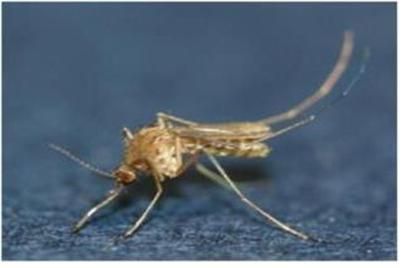 Japanese encephalitis vector mosquito 'Culex tritaeniorhynchus'. Provided by Korea Disease Control and Prevention Agency
According to the KDCA, among 42 mosquitoes collected between the 24th and 26th of this month in Jeju Special Self-Governing Province and Jeollanam-do, 10 were identified as small red house mosquitoes. This is three days earlier than last year's first detection date of March 30. The KDCA estimates that the mosquito activity accelerated due to the average temperature in Jeju and Wando areas rising by 6.2 degrees Celsius compared to the previous year.
The small red house mosquito inhabits rice paddies and puddles. It mainly feeds at night, beginning to appear from late March and reaching peak activity in August and September.
Symptoms appear 5 to 15 days after being bitten by a mosquito infected with Japanese encephalitis. Most cases are asymptomatic or experience mild symptoms such as fever and headache.
However, in rare cases, it can progress to encephalitis, causing symptoms such as high fever, seizures, confusion, convulsions, and paralysis, with 20 to 30% of these cases resulting in death.
Even after recovery from encephalitis, 30 to 50% of patients may suffer from various neurological complications depending on the damaged areas.
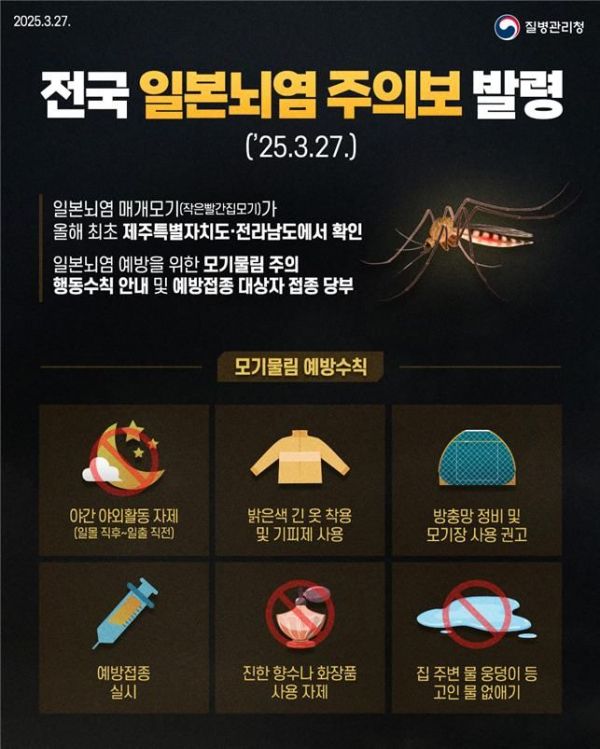
The KDCA recommends actively receiving vaccination to prevent Japanese encephalitis infection. Currently, vaccination support is provided through the national immunization program for those born after 2012, and designated medical institutions and public health centers where vaccinations are available can be found on the 'Vaccination Helper' website.
Adults aged 18 and over who have never been vaccinated against Japanese encephalitis and live near rice paddies or pig farms, or plan to be active in these areas during the transmission season, are advised to get vaccinated. Those planning to travel to countries at risk of Japanese encephalitis, such as India, Indonesia, Laos, the Philippines, Thailand, Vietnam, China, and Japan, also need vaccination.
Ji Young-mi, head of the KDCA, stated, "As the activity of Japanese encephalitis-carrying mosquitoes has officially begun this year, it is essential to strictly follow preventive measures during the mosquito activity period," and urged, "Children eligible for the national mandatory vaccination should complete their vaccinations on time."
© The Asia Business Daily(www.asiae.co.kr). All rights reserved.
![Clutching a Stolen Dior Bag, Saying "I Hate Being Poor but Real"... The Grotesque Con of a "Human Knockoff" [Slate]](https://cwcontent.asiae.co.kr/asiaresize/183/2026021902243444107_1771435474.jpg)

















