Stronger Market on Upward Revision of Q4 Growth Estimate
Trump Announces 25% Auto Tariff
Market Cautious as Tariff Front Expands
GM and Ford Fall... Tesla Soars
Focus on February Core PCE Price Index to Be Released on the 28th
The three major indices of the U.S. New York stock market were on the rise in early trading on the 27th (local time). After U.S. President Donald Trump announced a 25% tariff on all imported cars the previous day, the market initially fell at the opening but is attempting a rebound, supported by strong economic growth in the fourth quarter of last year. The stocks of U.S. automakers, which are heavily impacted by the tariff measure, are all falling, while Tesla, expected to be relatively less affected, surged more than 6%.
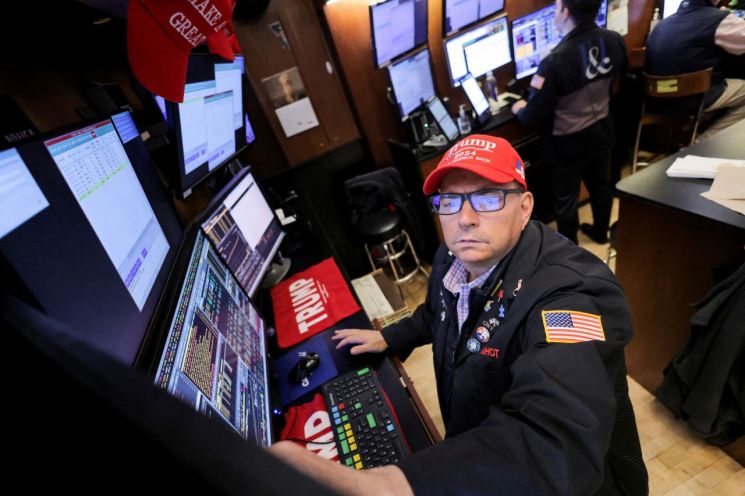
As of 11:03 a.m. in the New York stock market that day, the Dow Jones Industrial Average (Dow), centered on blue-chip stocks, was trading at 42,454.85, up 0.06 points (less than 0.1%) from the previous trading day. The S&P 500, focused on large-cap stocks, rose 15.64 points (0.27%) to 5,727.84, and the Nasdaq, centered on tech stocks, increased 68.34 points (0.38%) to 17,967.35.
By individual stocks, automobile-related shares are all declining following the news of the 25% tariff imposition. General Motors (GM) is down 6.63%. Ford and Stellantis are showing weakness of 2.38% and 1.76%, respectively. Tesla, which is expected to be relatively less affected by the auto tariff measure, surged 6.12%. Tesla reportedly produces the vehicles sold in the U.S. domestically, so it is relatively less impacted by tariffs compared to other automakers. Apple rose 0.49%, and Amazon increased 0.99%.
Buying interest is flowing in as the U.S. economy showed faster growth than the preliminary estimate for the fourth quarter of last year. On this day, the U.S. Department of Commerce's Bureau of Economic Analysis (BEA) announced that the final real Gross Domestic Product (GDP) for the fourth quarter of last year increased by 2.4% annualized compared to the previous quarter. This exceeded the previously announced preliminary figure (2.3%) by 0.1 percentage points. The final GDP figure for Q4 reflects upward revisions in net exports, government spending, and business investment. The annual growth rate for 2024 was recorded at 2.8%, the same as the preliminary estimate. Personal Consumption Expenditures (PCE) increased by 4% in Q4 compared to the previous quarter, slightly below the preliminary figure (4.2%) by 0.2 percentage points. The core PCE price index, which the Federal Reserve (Fed) places the most importance on, was revised downward from 2.7% to 2.6%.
Brett Kenwell, a U.S. investment analyst at eToro, analyzed, "Investors will want to see inflation indicators similar to or better than now and strong employment figures to gain reassurance about the current economic conditions."
However, the relentless tariff barrage from President Trump continues to stir market anxiety. He announced the previous day that a permanent 25% tariff would be imposed on all foreign cars imported into the U.S. The 25% tariff applies not only to finished vehicles but also to key components. Until now, the U.S. imposed tariffs of 2.5% on passenger cars and small trucks and 25% on pickup trucks, but this measure unifies the tariff rate for all imported cars at 25%. The tariff will take effect at midnight Eastern Time on April 3. President Trump stated that this measure is "permanent" and that "vehicles produced in the U.S. will have no tariffs at all." He emphasized that if the European Union (EU) and Canada cooperate in retaliatory measures against the U.S., "much larger" tariffs will be imposed.
He also reaffirmed the plan to impose reciprocal tariffs on the 2nd of next month. Regarding reciprocal tariffs, President Trump said, "We will be very generous," but added that "all countries" are subject. On the 24th, he said, "We may grant exemptions to several countries," but changed his stance two days later to apply tariffs to all countries. He also hinted at additional tariffs on items such as pharmaceuticals and lumber, suggesting that the tariff front will widen further.
As President Trump's tariff barrage continues, Wall Street expects stock market volatility to intensify further. Daniel Skelly, head of asset management market research and strategy at Morgan Stanley, said, "Despite the recent stock market rebound, it has been confirmed once again that volatility continues due to policy uncertainty," adding, "Moreover, the reciprocal tariff deadline next week is more likely to be a starting point for negotiations rather than a conclusion, so the market may find it difficult to recover to higher levels."
Investors are focusing on the core Personal Consumption Expenditures (PCE) price index for February, which will be released on the 28th, among the remaining major economic indicators announced this week. The core PCE price is expected to have risen 2.7% year-on-year, based on Bloomberg's forecast, an increase from January's 2.6%.
Bond yields are rising mainly in long-term maturities. The 10-year U.S. Treasury yield, a global bond yield benchmark, is trading at 4.38%, up 4 basis points (1bp = 0.01 percentage points) from the previous trading day. The 2-year U.S. Treasury yield, sensitive to monetary policy, remains at the previous day's level of around 4.0%.
© The Asia Business Daily(www.asiae.co.kr). All rights reserved.
![Clutching a Stolen Dior Bag, Saying "I Hate Being Poor but Real"... The Grotesque Con of a "Human Knockoff" [Slate]](https://cwcontent.asiae.co.kr/asiaresize/183/2026021902243444107_1771435474.jpg)















