Six Months After Acquiring Jeju Soju
Careful Approach to First Soju Product Development
No Dedicated Soju Team Yet
Expected Launch as Early as Year-End or Next Year
It has been six months since OB Beer announced its entry into the soju market by acquiring Jeju Soju, but the company is showing a cautious approach to product launches. As this will be OB Beer's first soju product, they are deeply considering not only packaging and taste but also their market strategy. While the primary goal is to produce export-oriented products such as fruit soju, they are also keeping in mind the possibility of launching an original soju to compete in the domestic market. Industry interest in 'OB Soju,' which could shake up the soju market landscape, is growing.
According to the liquor industry on the 29th, OB Beer's first soju is expected to be released as early as the end of this year or by next year at the latest. Internally, a dedicated soju team has yet to be formed. Although internal studies on what kind of soju to produce are ongoing, no concrete actions have been reported.
OB Beer, which had focused primarily on the beer business, took its first step into the soju business last September by acquiring Jeju Soju from Shinsegae L&B. At the time, OB Beer announced the acquisition was to accelerate global expansion. Industry analysts widely believed that OB Beer acquired Jeju Soju to use it as a forward base for exports.
In fact, Jeju Soju has been building its overseas network since 2022 through original design manufacturing (ODM) of export-oriented soju products. Although it started as a local Jeju company in 2011, after being acquired by Shinsegae Group's E-Mart in 2016 and rebranding its soju as 'Pureunbam,' it failed to expand market share and subsequently withdrew from the domestic business. In 2021, E-Mart transferred Jeju Soju to its subsidiary Shinsegae L&B, which then expanded ODM operations mainly in Southeast Asian countries such as Vietnam, Singapore, and Thailand.
OB Beer has taken over Jeju Soju's export business and is focusing on producing export products. The company has registered fruit soju flavors such as pure soju peach flavor, margarita flavor, watermelon flavor, and Punter Soju green grape flavor with the Ministry of Food and Drug Safety. It has also filed trademark applications with the Korean Intellectual Property Office for brands using English letters such as ▲JJAN ▲ZZAN ▲DOLDOL. These brands are registered for soju and fruit wine.
The growing popularity of Korean soju in the global market is also cited as a reason for entering the soju business. Domestic soju export value increased from $135 million in 2020 to $200 million last year, setting a record high. In terms of volume, it reached 124,000 tons, a 4.2% increase from the previous year.
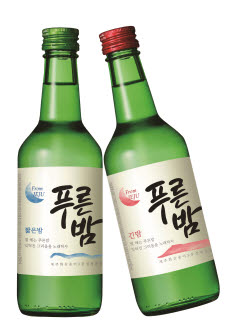 'Pureunbam' soju produced by Jeju Soju until 2021.
Although the target is overseas, OB Beer may not rule out launching both fruit soju and original soju to turn its attention to the domestic market as well. By acquiring Jeju Soju, OB Beer automatically obtained a liquor manufacturing license that allows the production of diluted soju. With this license, they can outsource production to other soju manufacturers through original equipment manufacturing (OEM). In recent years, domestic small and medium craft beer companies have responded to market demand by outsourcing craft beer production to large manufacturers with extensive facilities, such as Lotte Chilsung Beverage.
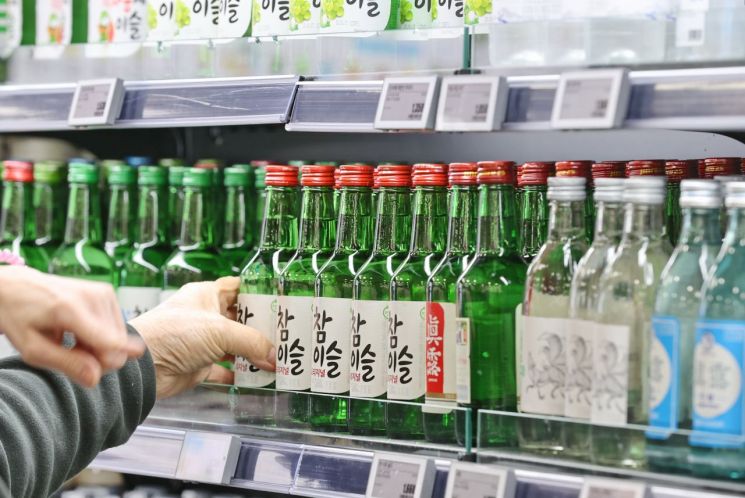
However, there are also forecasts that establishing a foothold in the domestic market with their own product could be challenging. Currently, the domestic soju market is dominated nationwide by Hite Jinro's 'Chamisul' and 'Jinro,' and Lotte Chilsung Beverage's 'Cheoeumcheoreom' and 'Saero,' while the rest is firmly held by small and regional soju brands.
Industry insiders expect that it may take more time before a product is launched. One industry official said, "It is possible to make changes to existing products within a few months, but creating a new product requires much consideration, from packaging, alcohol content, sweeteners that determine taste, to the product's worldview. The more you want to do well, the longer it can take."
OB Beer also takes the stance that there is no immediate rush. This is because they acquired not an operating factory but a facility that had been inactive at the time of acquiring Jeju Soju. Furthermore, to create soju that can succeed in the global market like beer, they believe a thorough branding strategy is more important than a quick launch.
An OB Beer representative explained, "We could make soju immediately if we wanted, but we are carefully considering various aspects. Some trademarks were carried over from Shinsegae, but there have been no specific discussions yet on when and what kind of product will be made."
© The Asia Business Daily(www.asiae.co.kr). All rights reserved.

















