Some Analysts Say the Impact May Be Limited
Considering Market Competitiveness
Bloomberg reported on the 27th that the possibility of the Bank of Japan (BOJ) raising interest rates on May 1 has significantly decreased following U.S. President Donald Trump's announcement of a 25% tariff on automobiles.
Atsushi Takeda, chief economist at Itochu Research Institute, said, "The likelihood of a rate hike in May has further diminished," adding, "The BOJ needs to carefully examine the impact of tariffs on the economy. There is no way to complete this by the May meeting."
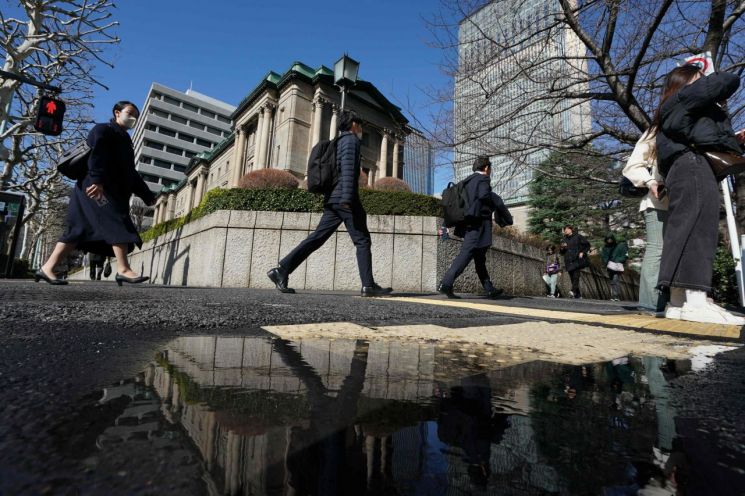
The BOJ raised its policy rate from 0.25% to 0.5% in January this year. Recent wage increases and continuous rises in food prices had raised inflationary pressures, leading to speculation about a possible rate hike in May. However, the imposition of a 25% tariff on the automobile sector, a core industry of the Japanese economy, is analyzed to potentially burden the entire industry. According to Nihon Keizai Shimbun (Nikkei), Japan's automobile exports to the U.S. last year amounted to 6 trillion yen (approximately 58.5426 trillion won), accounting for 30% of total exports.
Bloomberg analyzed that future interest rates depend on how the yen reacts to the high tariffs. Recently, the yen-dollar exchange rate has been hovering around 150 yen per dollar. This is cheaper than the 10-year average exchange rate of 121 yen per dollar, which is said to be fueling import-driven inflation.
However, economist Takeda notes that it is still uncertain whether the 25% tariff will actually be implemented, and considering that Japanese automakers have competitiveness in the U.S. market, the economic impact may not be significant. He said, "This deepens the downside risks to the economy," but added, "However, the economy will probably not deviate from the path of gradual recovery."
Goldman Sachs analysts expect Japan's gross domestic product (GDP) growth rate to decline by 0.1 percentage points due to the automobile tariffs. This is because additional tariffs will apply to all countries, so Japanese companies are not expected to lose relative competitiveness.
The Japan Automobile Manufacturers Association announced that 5.58 million employees work in automobile-related companies and suppliers across Japan. This accounts for 8.3% of the total workforce in Japan.
Japanese Prime Minister Shigeru Ishiba stated at the House of Councillors (upper house) Budget Committee on the same day, "We are strongly requesting that the 25% tariff not be applied to Japan."
© The Asia Business Daily(www.asiae.co.kr). All rights reserved.
![Clutching a Stolen Dior Bag, Saying "I Hate Being Poor but Real"... The Grotesque Con of a "Human Knockoff" [Slate]](https://cwcontent.asiae.co.kr/asiaresize/183/2026021902243444107_1771435474.jpg)















