Michael Vizziano, Hanwha's North America Government Relations Director, Participates in Expert Discussion at U.S. Think Tank KEI
"Active Incentives Needed, as in the First Trump Administration"
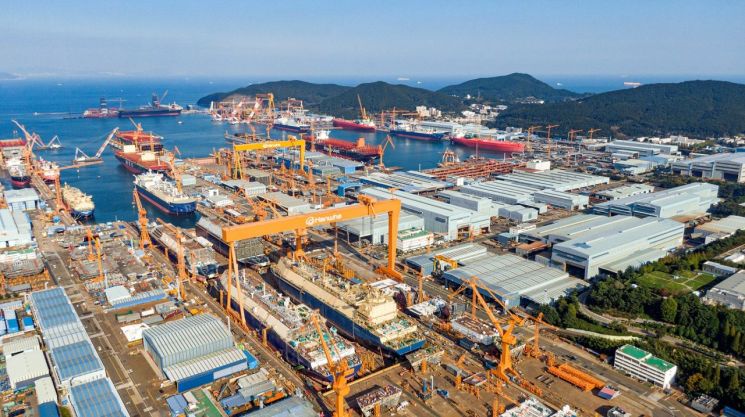
As U.S. President Donald Trump declared his intention to lead the revival of America's lagging shipbuilding industry, Hanwha Group, which owns Hanwha Ocean, expressed its strong willingness to actively cooperate with the U.S. government at a U.S. think tank event. As a recommendation for the U.S. shipbuilding industry, they emphasized the external trust associated with 'Made in USA' products and argued that active incentive policies from the U.S. government must accompany this effort.
"Korean Production Capacity, Technology, and Workforce Can Also Be Applied in the U.S."
Michael Vizziano, Hanwha's North America government relations director, responded on the 26th (local time) during an expert discussion at the Korea Economic Institute (KEI) in Washington D.C. when asked about how to apply the success factors of the Korean shipbuilding industry to the U.S. He said, "If the production capacity, skilled workforce, and advanced technology of the Korean shipbuilding industry are integrated into the U.S., I believe it is entirely feasible."
He emphasized, "Hanwha Ocean has the capability to build as many as 40 world-class liquefied natural gas (LNG) carriers annually," adding, "The reason Hanwha invested in Philly Shipyard was precisely because we saw that potential." He also cited the growing interest of the U.S. government and Congress in shipbuilding and the establishment of a shipbuilding office at the White House as positive factors.
Amid the prolonged stagnation of the U.S. shipbuilding industry, he argued that a stable supply chain is a prerequisite to replicating Korea's shipbuilding infrastructure in the U.S. Vizziano stated, "When Hanwha invested in Philly Shipyard, we recognized that not only the shipyard itself but the entire supply chain needed improvement," urging policy support from the U.S. government.
He also added, "Fortunately, manufacturing revival and reshoring have become the spirit of the times in the U.S.," and "Hanwha Group is ready to cooperate with the U.S. government and other companies by providing technology and manpower."
 Michael Vizziano, Executive Director in charge of North American government relations at Hanwha Group (center), is speaking at an expert panel event held on the 26th (local time) by the Korea Economic Institute of America (KEI), a U.S. think tank, on the theme "Revival of the U.S. Shipbuilding Industry and Korea's Strategic Role." Also attending the event were Andy Hong, KEI Program Officer (left), and Colin Grabow, Deputy Director of Trade Policy Research at the Cato Institute (right). Photo by KEI (YouTube capture)
The Differentiator for U.S. Shipbuilding Is 'Made in USA'
As a unique differentiation strategy for the U.S. shipbuilding industry, he pointed to the value of 'Made in USA.' Vizziano said, "The U.S. cannot simply follow a lowest-price strategy," emphasizing, "It must offer the best technology, competitive pricing, and the value of being American-made." He also called for policy support and industry innovation to back this up.
Especially given that, unlike Korea, Japan, and China, the U.S. currently lacks a properly established shipbuilding cluster, he viewed the Trump administration's policy will and incentives as key factors that will determine the fate of the U.S. shipbuilding industry. He said, "During the first Trump administration, when the workforce at Philly Shipyard dropped to 80, the U.S. government did not hesitate to provide support under the judgment that strategic assets must be protected," and argued, "This approach should be applied to the entire shipbuilding industry."
The decline of U.S. commercial shipbuilding has led to weakened competitiveness of U.S. Navy shipyards. The U.S. sees strengthening naval defense capabilities as urgent from a military and security perspective. As of 2024, China possesses 234 surface combatants, surpassing the U.S. with 219. Although the U.S. still holds qualitative superiority, as a global hegemon, it requires a more abundant naval force to counterbalance China, the dominant power in East Asia.
From the early days of his second term, President Trump expressed his determination that rebuilding the U.S. shipbuilding industry must come first to strengthen the U.S. Navy. He reiterated this commitment to rebuilding the U.S. shipbuilding industry in his congressional speech on the 4th. Against this backdrop, Korea and others were identified as strategic partners to support the U.S.'s insufficient shipbuilding capacity, raising expectations within the related industries.
 Michael Vizziano, Executive Director in charge of North American government relations at Hanwha Group (center), is speaking at an expert panel event held on the 26th (local time) by the Korea Economic Institute of America (KEI), a U.S. think tank, on the topic of "Revival of the U.S. Shipbuilding Industry and Korea's Strategic Role." Photo by KEI (YouTube capture)
Hanwha Group Plans to Enter Naval Shipbuilding Sector
When asked about the practical difficulties of attracting foreign shipbuilders like those from Korea to the U.S. for dual-use military and civilian shipbuilding, Vizziano explained, "Technology transfer related to defense industries must undergo review by the Committee on Foreign Investment in the United States (CFIUS)," adding, "When Hanwha acquired Philly Shipyard, the technology transfer was primarily directed toward the U.S., so the review proceeded smoothly."
He also revealed that Hanwha Group plans to enter the naval shipbuilding sector. He said, "We will comply with U.S. government regulations and follow the necessary procedures," noting, "There have been past cases where foreign shipbuilders entered the U.S. and built naval vessels."
Regarding the controversy over the Jones Act, which protects the U.S. shipbuilding industry, he drew a clear line, stating, "Without this law, shipbuilding in the U.S. could completely disappear," and "Repealing it is not the answer." The Jones Act, enacted 105 years ago in 1920 as Section 27 of the Merchant Marine Act, requires that cargo transported between two points in the U.S. must be on vessels registered in the U.S., at least 75% owned by U.S. citizens, crewed by U.S. citizens, and built in the U.S. Some have pointed to this law as a cause of the decline of the U.S. shipbuilding industry.
Vizziano proposed, "Incentives must be provided so that shipbuilders can invest, innovate, and compete," and "Since the U.S. is likely to become an energy-exporting country, energy should be exportable on American-made vessels." He also mentioned that legislative efforts such as the recently introduced 'SHIPS for America Act' in Congress and government support through it would be a 'creative solution.'
Previously, Hanwha Group secured a foothold for entry into the North American shipbuilding and defense markets by acquiring Philly Shipyard in Philadelphia through Hanwha Ocean and Hanwha Systems. It is currently known to be re-pursuing the acquisition of Australian shipbuilder Austal, a U.S. naval ship manufacturer and supplier, through Hanwha Systems and Hanwha Aerospace.
© The Asia Business Daily(www.asiae.co.kr). All rights reserved.
![Clutching a Stolen Dior Bag, Saying "I Hate Being Poor but Real"... The Grotesque Con of a "Human Knockoff" [Slate]](https://cwcontent.asiae.co.kr/asiaresize/183/2026021902243444107_1771435474.jpg)













