A Critical Situation for the Korean Automotive Industry Following the US 25% Tariff Decision
Hyundai Begins HMGMA Operations, US Production Reaches 1 Million Units
1.7 Million Units Sold Last Year... 700,000 Units at Risk
Korean Automotive Production Capacity Down 7% in 9 Years
Now the 6th Largest Producer... Comparable to Mexico
As the United States announced its decision to impose a 25% tariff on foreign-made automobiles, the domestic automotive industry found itself in a critical situation. If production in the U.S. increases due to the tariff hike, export volumes from Korean production are bound to decrease. There are concerns that this could not only lower Korea's standing as an automobile manufacturing country but also impact the Korean economy, which is highly dependent on exports.
On the 26th (local time), President Trump announced plans to impose a 25% tariff on imported automobiles starting from the 3rd of next month, making it inevitable for the domestic automotive industry to adjust its global production portfolio immediately from next month.
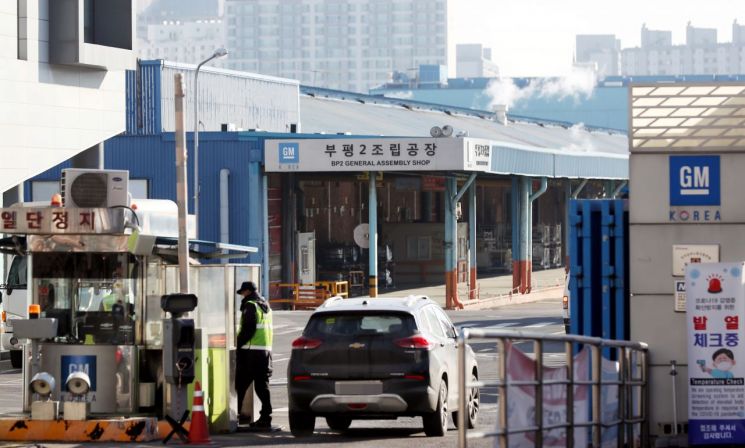
The first to be directly hit was Korea GM. Korea GM, whose exports to the U.S. account for an overwhelming proportion, is even facing the possibility of withdrawal due to this tariff decision. Until now, Korea GM has played the role of exporting about 500,000 small sport utility vehicles (SUVs) annually to the U.S. It was able to secure price competitiveness thanks to low labor costs, production innovation, and tariff-free benefits under free trade agreements (FTA).
However, if a high tariff of 25% is imposed, Korea GM’s price competitiveness will disappear. It is also known that Korea GM’s difficulties in securing follow-up models were due to the uncertainty of such policies. While global automakers including Hyundai and Kia have been mentioning expanding production in the U.S., there are predictions that the U.S. company GM will also increase domestic production. Some analyses suggest that if a 25% tariff is imposed, prices of some imported car models in the U.S. could rise by more than $10,000.
Hyundai and Kia will also have about 700,000 units affected by the tariff. Last year, the export volume to the U.S. was 637,638 units for Hyundai and 377,367 units for Kia, totaling 1,015,005 units. Last year, Hyundai and Kia sold 1.7 million units in the U.S. market, and even with 300,000 units produced at HMGMA in Georgia, U.S., they will have to export about 700,000 units annually.
Even if they increase production in the U.S. to avoid tariffs, the natural decline in domestic factory operating rates remains a problem for Korea. As Korea’s position as an automobile manufacturing country narrows, there are concerns that reduced exports could lead to economic recession and job losses.
At the 'Tasks to Enhance Production Competitiveness in the Automotive Industry' forum hosted by the Korea Automobile Mobility Industry Association on the 27th, Cho Cheol, senior research fellow at the Korea Institute for Industrial Economics & Trade, emphasized, "Companies have no choice but to move to regions with favorable conditions to secure production competitiveness," adding, "For companies to make additional investments in domestic factories such as smart and AI manufacturing, clear incentives must exist."
According to Research Fellow Cho, Korea’s automotive industry production capacity was 4.39 million units last year, down about 7% from 4.73 million units in 2015 over the past nine years. Also, Korea, which had maintained its position as the 5th largest automobile producer for a long time, fell to 6th place in 2023 and 2024. As of last year, Korea’s production was 4.128 million units, similar to Mexico’s 4.112 million units.
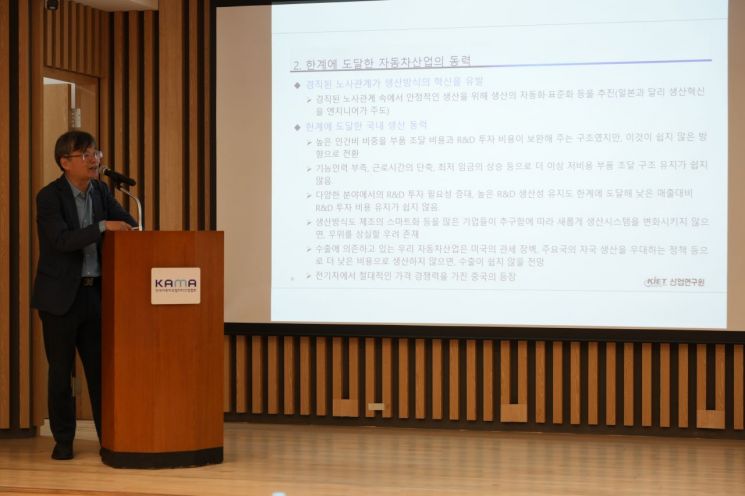 On the 27th, Cho Cheol, Senior Research Fellow at the Korea Institute for Industrial Economics and Trade, is giving a keynote presentation at the forum on "Tasks to Enhance Production Competitiveness in the Automotive Industry," hosted by the Korea Automobile Mobility Industry Association. Provided by the Korea Automobile Mobility Industry Association
Concerns are also rising about the Korean economy, which is highly export-dependent, as domestic factory production and investment decline. In a recent report, IBK Industrial Bank’s Economic Research Institute analyzed that if the U.S. imposes a 25% tariff on the automotive industry, Korea’s automobile exports to the U.S. could decrease by 18.59% compared to last year. Last year, Korea’s automobile exports to the U.S. amounted to $34.744 billion, accounting for 49% of the total automobile export value ($70.786 billion).
Citibank analyzed that imposing a 25% tariff on Korean automobiles, parts, pharmaceuticals, and semiconductors could result in a 0.203% decrease in Korea’s gross domestic product (GDP).
© The Asia Business Daily(www.asiae.co.kr). All rights reserved.


















