Bank of Korea Warns: Strengthen Management of Debt Repayment Capacity in Vulnerable Sectors
Last Year, High-Risk Households Held 72 Trillion Won in Financial Debt, Provincial Risks Rising
427,000 Vulnerable Self-Employed Borrowers, Debt Reaches 125 Trillion Won
"Support Measures Should Be Applied Differently Based on Repayment Capacity and Willingness"
In the context of low growth, the polarization of South Korea's economy by sector is becoming more pronounced. The gap in the real estate market between Seoul and other regions, as well as within the self-employed sector, is widening. The Bank of Korea warned that, given the slow economic growth conditions and increasing domestic and international uncertainties, preparations must be made for potential insolvencies centered on the real estate market situation. It emphasized closely monitoring whether the rapid rise in apartment prices, mainly in the Gangnam area, spreads throughout Seoul and leads to a surge in household debt, while also carefully managing the real estate slump in other regions. The sluggish real estate market in the provinces could exacerbate insolvencies not only in related project financing (PF) sites and construction companies but also among 'high-risk households' with deteriorating debt repayment capacity.
According to the Bank of Korea's Financial Stability Report on the 27th, as of the end of last year, household credit stood at 1,927.3 trillion won, increasing by 0.7% from the previous quarter, mainly due to housing-related loans (11.7 trillion won). The proportion of vulnerable borrowers rose from 6.6% at the end of Q3 last year to 6.9% at the end of Q4, and the share of potentially vulnerable borrowers also increased slightly from 17.5% to 17.6%. Vulnerable borrowers refer to multiple debtors who are either low-income (bottom 30%) or have low credit scores (664 points or below), while potentially vulnerable borrowers are those close to the characteristics of vulnerable borrowers. The bank delinquency rate continued its upward trend, rising from 0.36% at the end of Q3 to 0.38% at the end of Q4 last year. Non-bank delinquency rates decreased from 2.17% to 2.07%, influenced by year-end bad debt cleanups.
The Bank of Korea also expressed concerns about the deterioration of financial institutions' soundness due to vulnerabilities in certain sectors. It pointed out that housing prices in some parts of Seoul and the metropolitan area have recently risen rapidly again and are spreading to other regions, which could lead to an expansion in the previously stable growth rate of household debt. Lee Jong-ryeol, Deputy Governor of the Bank of Korea, said, "The market says that real estate transaction volumes have slowed and stabilized following the recent expansion of the land transaction permit system, but it is still too early to obtain accurate data." He added, "Household debt ratios remain high compared to major countries, and if the rapid rise in housing prices in preferred areas like Seoul spreads to other regions, the increase in housing-related loans could expand again."
Last Year’s High-Risk Households’ Financial Debt at 72 Trillion Won, Increasing Risks in Provinces
Particular concern was raised about the widening polarization due to the continued decline in housing prices in the provinces. Housing prices, which constitute a significant portion of household assets mainly in provincial areas, are falling, potentially increasing the debt repayment burden on high-risk households in these regions. Last year, the number of high-risk households in South Korea was estimated at 386,000. High-risk households are those with a debt service ratio (DSR) exceeding 40% and a debt-to-asset ratio (DTA) exceeding 100%, evaluating debt repayment capacity comprehensively based on household assets and liabilities.
High-risk households accounted for 3.2% of households holding financial debt last year. The financial debt held by these households amounted to 72.3 trillion won, representing 4.9% of total household debt. Although the number and debt share of high-risk households decreased compared to 2023 (3.5% and 6.2%, respectively), when interest rates rose sharply, they remain higher than in 2022. The number of households exceeds the long-term average (3.1%) from 2017 to 2024. Households lacking repayment capacity in either DSR or DTA indicators account for 26.5% (3.18 million households) and hold 34.8% (512 trillion won) of total financial debt.
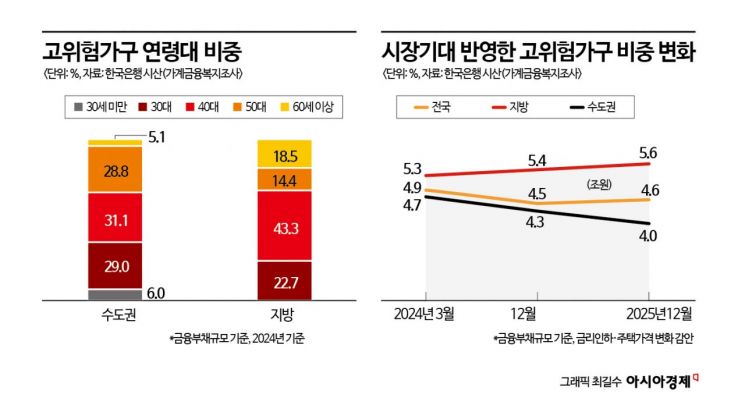
The Bank of Korea assessed that the median DSR and DTA of high-risk households in South Korea are 75.0% and 150.2%, respectively, indicating a significant deterioration in debt repayment capacity in terms of income and assets. The median DSR and DTA of high-risk households in the provinces are 70.9% and 149.7%, respectively, not significantly different from those in the metropolitan area (78.3% and 151.8%). However, the proportion of household heads aged 60 or older among high-risk households in the provinces (18.5%) is higher than in the metropolitan area (5.1%), suggesting a relatively weaker income base.
The decline in housing prices could increase the number of high-risk households. The Bank of Korea estimated the proportion of high-risk households (based on financial debt) in the provinces and metropolitan area by reflecting changes in interest rates, housing prices, and housing price forecasts. As of the end of last year, the proportions were 5.4% and 4.3%, respectively. By the end of this year, the gap between the provinces (5.6%) and metropolitan area (4.0%) is expected to widen to 1.6 percentage points. Deputy Governor Lee emphasized, "Housing prices between the metropolitan area and provinces have become too differentiated. The current poor situation in the provincial real estate market makes it difficult for provincial construction companies as well." He added, "The provinces have a higher proportion of elderly high-risk households, so the impact of falling housing prices could be greater." He further stressed, "We must closely monitor related trends and the effectiveness of government response measures to prevent the expansion of insolvency risks, especially among high-risk households in the provinces."
Non-Bank Bad Debt Ratio Approaches 7%... Provincial Increase Rate Higher
The sluggish real estate market in the provinces is also raising the ratio of non-performing loans (NPLs) among domestic non-bank financial institutions, especially in provincial areas. As the real estate slump accelerates in the provinces, the rate of bad debts has increased more steeply compared to the metropolitan area.
As of the end of last year, the ratio of non-performing loans among non-bank deposit-taking institutions was 6.8%. This marks an increase of 2.4 percentage points over one year, from 2.2% at the end of 2022 and 4.4% in 2023. Quarterly data shows the ratio peaked at 7.1% in Q3 last year but fell by 0.3 percentage points in Q4. The non-performing loan ratio is a key indicator of asset quality, reflecting the level of problem loans held by banks.
A significant portion of last year's increase is attributed to the deterioration in asset quality of project financing (PF) loans, including PF loans and land-secured loans. Excluding PF loans, the non-performing loan ratio drops to 5.6%. The Bank of Korea estimates that 1.0 percentage point of the 2.4 percentage point increase is due to PF loan defaults.
Regionally, asset quality of institutions located in the provinces is deteriorating more than those in the metropolitan area. The non-performing loan ratio of savings banks stood at 10.2% at the end of last year, with 9.8% in the metropolitan area and 12.2% in the provinces. The annual increase was 2.6 percentage points in the metropolitan area but 4.7 percentage points in the provinces. The ratio for mutual finance cooperatives (agricultural, fishery, industrial, and credit cooperatives) was 5.1% at the end of last year, with 4.5% in Seoul and 5.5% in the provinces. The increase was 1.5 percentage points in the metropolitan area and 1.9 percentage points in the provinces during the same period.
Looking at individual institutions, asset quality of savings banks and mutual finance cooperatives in the provinces is worse than in the metropolitan area. At the end of last year, 27% of savings banks in the provinces had non-performing loan ratios exceeding 16%, compared to 7.1% in the metropolitan area. For mutual finance cooperatives, those with non-performing loan ratios below 6%, indicating relatively sound asset quality, accounted for an overwhelming 72.5% in the metropolitan area.
The impact of the provincial real estate market slump was significant. While housing prices in the metropolitan area rose by 1.3% last year, the provinces, burdened by a large accumulation of unsold homes, saw declines in both the five major metropolitan cities (-2.0%) and eight other cities (-0.2%), continuing the slump since 2022. Deputy Governor Lee noted, "As the real estate market situation diverges between the metropolitan area and provinces, we must pay attention to the deteriorating asset quality of non-bank deposit-taking institutions, especially those located in the provinces." He added, "Efforts to improve asset quality and expand liquidity must be strengthened to enhance risk response capabilities, preventing localized insolvencies from spreading instability across the entire sector."
Vulnerable Self-Employed Debt Increases by 10 Trillion Won to 125 Trillion Won... Selective Support Needed
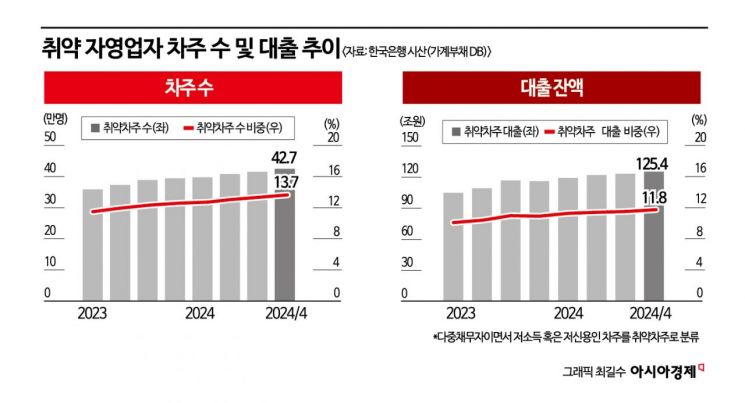
Polarization among the self-employed is also at a serious level, not just in real estate. Due to the economic downturn, income recovery for the self-employed has been delayed, and loan delinquency rates remain high, especially among vulnerable borrowers. The number of 'vulnerable self-employed borrowers,' defined as multiple debtors who are low-income or have low credit, reached 427,000 at the end of last year, an increase of 31,000 from 396,000 at the end of the previous year. This accounts for 13.7% of all self-employed individuals. Although the number of multiple-debt self-employed borrowers decreased by 22,000 compared to the previous year, the number of low-income and low-credit borrowers increased by 21,000 and 47,000, respectively. Loans to vulnerable self-employed borrowers rose by 9.6 trillion won, from 115.7 trillion won at the end of 2023 to 125.4 trillion won last year, representing 11.8% of total self-employed loans.
The delinquency rate on self-employed loans has also approached the long-term average level before COVID-19 (1.68% average from 2012 to 2019), raising warning signs. Delinquent self-employed borrowers have steadily increased since the second half of 2022, pushing the delinquency rate on self-employed loans up to 1.67%. Although the delinquency rate slightly decreased from the previous quarter due to increased year-end cleanup of delinquent loans by financial institutions, it remains high, especially among non-bank lenders (3.43%) and vulnerable self-employed borrowers (11.16%).
The rise in delinquency rates among the self-employed is largely due to reduced debt repayment capacity caused by high loan interest rates and income declines from the sluggish service sector economy. The average income of self-employed individuals decreased to 41.31 million won at the end of 2022 and slightly increased to 41.57 million won at the end of last year. However, due to structural factors such as the high proportion of self-employed individuals and continued sluggishness in the service sector, income has not recovered to pre-COVID-19 levels (42.42 million won at the end of 2019). Particularly, delinquent self-employed borrowers saw their average income drop from 39.83 million won at the end of 2020 to 37.36 million won at the end of last year, while their average loan amount increased to 229 million won at the end of last year from 205 million won at the end of 2020, indicating worsening conditions.
Deputy Governor Lee said, "Support policies for the self-employed should be applied differentially based on individual repayment capacity and willingness, including financial support, debt adjustment, and rehabilitation assistance." He added, "For borrowers repaying debts normally, selective support for business and financial costs is appropriate, while delinquent and closed borrowers should receive debt adjustment through a fresh start fund, and policies supporting employment and re-entrepreneurship should be promoted for self-employed individuals wishing to restart."
© The Asia Business Daily(www.asiae.co.kr). All rights reserved.



















