Average Loan Amount for Wage Workers Rises Again in 2023
Delinquency Rate Increases for Second Consecutive Year
Elderly Show Higher Delinquency Rates Compared to Other Age Groups
In 2023, the average loan amount of wage workers turned to an upward trend. Bank and mortgage loans increased. The delinquency rate continued to rise for the second consecutive year. The delinquency rate among the elderly was higher compared to other age groups.
 Last November, office workers wearing thick coats were heading to work at the Yeouido Bus Transfer Center in Seoul.
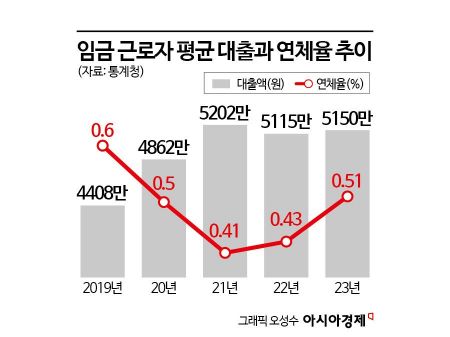
According to the '2023 Job Administration Statistics Wage Worker Debt' released by Statistics Korea on the 27th, as of the end of December 2023, the average loan amount of wage workers was 51.5 million KRW, an increase of 0.7% (350,000 KRW) compared to the previous year. During the same period, the delinquency rate based on loan balance was 0.51%, up 0.08 percentage points.
The average loan amount of wage workers had been continuously increasing in recent years but seemed to decrease in 2022 (-1.7%), then turned to an upward trend again in 2023. The delinquency rate, after declining, has shown an upward trend for two consecutive years since 2022 (0.02 percentage points).
A Statistics Korea official explained, "The average loan amount in 2023 showed a slight increase from the decrease in 2022, indicating a stable level." He added, "The notable point is that the composition of loans has changed." He continued, "Bank loans increased while non-bank loans decreased, and mortgage loans increased but credit loans and others decreased, resulting in an overall stable trend."
Looking at loan amounts by financial institution, compared to the previous year, bank loans increased by 1.7% while non-bank loans decreased by 1.2%. By loan type, mortgage loans (3.7%) and non-mortgage housing loans (2.1%) increased compared to the previous year, but credit loans (-5.4%) and other loans (-4.0%) decreased. The median loan amount for wage workers was 50 million KRW, unchanged from the previous year.
Average loans by age group were highest in the order of ▲40s (77.9 million KRW) ▲30s (69.79 million KRW) ▲50s (59.93 million KRW) ▲60s (37.45 million KRW) ▲70 and older (18.53 million KRW) ▲29 and younger (16.01 million KRW). Compared to the previous year, loans increased in the 40s (2.0%) and 70 and older (1.4%) age groups. The delinquency rates were ▲60s (0.86%) ▲50s (0.66%) ▲70 and older (0.65%) ▲29 and younger (0.49%) ▲40s (0.46%) ▲30s (0.31%) in descending order.
By housing type, apartment residents had the highest average loan amount at 62.65 million KRW. This was followed by officetel and others (45.56 million KRW), row houses and multi-family houses (39.77 million KRW), and detached houses (29.93 million KRW). Compared to the previous year, loans increased by 0.3% for apartment residents but decreased by 2.3% for officetel and others. The delinquency rate was highest for detached houses (1.39%) and lowest for apartments (0.29%).
The higher the income bracket, the larger the loan amount. Specifically, the order was ▲100 million KRW or more (157.03 million KRW) ▲70 million to 100 million KRW (107.69 million KRW) ▲50 million to 70 million KRW (80.56 million KRW) ▲30 million to 50 million KRW (47.32 million KRW) ▲less than 30 million KRW (24.82 million KRW). The delinquency rate was inversely ranked as ▲less than 30 million KRW (1.32%) ▲30 million to 50 million KRW (0.45%) ▲50 million to 70 million KRW (0.22%) ▲70 million to 100 million KRW (0.14%) ▲100 million KRW or more (0.08%) in descending order.
The larger the company size, the higher the average loan amount. Wage workers in large companies had 77.82 million KRW, non-profit organizations 49.35 million KRW, and small and medium enterprises 42.99 million KRW. Compared to the previous year, small and medium enterprises increased by 2.2%, while non-profit organizations decreased by 1.7% and large companies by 0.5%. The delinquency rates were 0.82% for small and medium enterprises, 0.29% for large companies, and 0.23% for non-profit organizations.
By industry, wage workers in ▲finance and insurance (100.27 million KRW) ▲information and communication (73.42 million KRW) ▲professional, scientific, and technical services (69.76 million KRW) ▲manufacturing (63.95 million KRW) ▲public administration (63.34 million KRW) had the highest loan amounts. Compared to the previous year, loans increased in business support and rental services (4.3%) but decreased in education (-1.5%). The delinquency rates were high in ▲construction (1.28%) ▲accommodation and food services (1.12%) ▲transportation and warehousing (0.98%) ▲real estate (0.91%).
© The Asia Business Daily(www.asiae.co.kr). All rights reserved.
![Clutching a Stolen Dior Bag, Saying "I Hate Being Poor but Real"... The Grotesque Con of a "Human Knockoff" [Slate]](https://cwcontent.asiae.co.kr/asiaresize/183/2026021902243444107_1771435474.jpg)
















