Price of Mexican and Canadian Cars Expected to Rise by $6,000
North American Single Market Means U.S.-Made Vehicles Also Unavoidably Affected
Restricted Competition... Consumer Burden to Increase as Affordable Imports Disappear
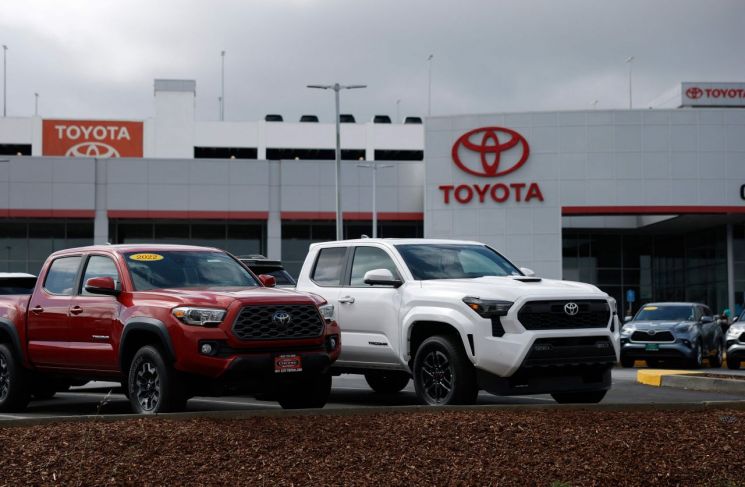 On the 26th (local time), pickup trucks were lined up in front of a Toyota store located in California, USA. / Photo by AFP and Yonhap News
U.S. President Donald Trump announced on the 26th (local time) that the 25% tariff imposition targets include not only foreign-made sedans and pickup trucks but also auto parts, leading to expectations that car prices in the U.S. will surge by thousands of dollars. There are also concerns that even 'American-made' cars emphasized by President Trump will inevitably be affected by tariffs due to their heavy reliance on parts from Canada and Mexico.
According to U.S. CNN and The New York Times (NYT) on the same day, market research firm Cox Automotive predicted that the tariff measures would raise the prices of vehicles from Mexico and Canada by about $6,000. Representative import models expected to be affected include Toyota's Tacoma, Chevrolet Equinox, and Ram pickup trucks under Stellantis. Jonathan Smoke, Chief Economist at Cox Automotive, said in a conference call with the media, "By mid-April, most North American automobile production is expected to face disruptions. Production declines, supply shortages, and price increases will soon become a reality."
The problem is that the impact on 'American-made' cars produced domestically in the U.S. is also significant. Anderson Economic Group, a think tank based in Michigan, analyzed that manufacturing costs for vehicles produced in the U.S. will increase by thousands of dollars. The group forecasted, "Full-size sport utility vehicles (SUVs) with a high proportion of Mexican parts are expected to see cost increases of about $9,000 per vehicle," and warned that without production adjustments, the increase could exceed $10,000.
This is due to the high interdependence among the three North American countries. The North American automotive industry has operated like a single market for decades following the North American Free Trade Agreement (NAFTA) and the United States-Mexico-Canada Agreement (USMCA). CNN pointed out that under current trade law standards, parts from both Canada and the U.S. are considered 'domestic' products, stating, "No vehicle exceeds 75% 'American-made' content." The 'exemption clause' in President Trump's tariff measures, which temporarily maintains tariff-free status for auto parts complying with USMCA regulations, is interpreted as a measure considering these concerns.
The U.S. auto sales market is expected to slow down in the future. According to Cox Automotive, vehicle sales in the U.S. are projected to decrease by 20,000 units per week, representing a 30% reduction compared to previous levels. Chief Economist Smoke stated, "Consumers will be reluctant to purchase vehicles due to the tariffs," adding, "Automakers will have no choice but to reduce production."
Some express concerns that if market competition decreases, overall consumer prices could rise. This would eliminate the advantages of a perfectly competitive market completed through international trade. It is pointed out that the absence of affordable imported cars could lead to an overall price increase. An anonymous executive from the automotive industry told CNN, "One of the biggest harms consumers will suffer from the tariffs is the loss of product variety."
According to the proclamation posted after President Trump's signing of the executive order that day, the 25% tariff applies to sedans, SUVs, crossovers, minivans, cargo vans, and small trucks. Among auto parts, it applies to engines, transmissions, powertrains, and electrical components. The proclamation states that tariffs on key parts will be imposed on the date of publication in the official gazette, but before May 3, suggesting that the tariff on auto parts will be applied about a month later than the auto tariff.
© The Asia Business Daily(www.asiae.co.kr). All rights reserved.

















