An innovative 'photodetector' technology capable of broadly detecting the mid-infrared spectrum range has been developed domestically.
NASA's James Webb Space Telescope precisely analyzes molecular components such as water vapor and sulfur dioxide in exoplanet atmospheres using the mid-infrared spectrum. High-sensitivity photodetector technology, which can accurately measure even minute light intensities, is key to mid-infrared analysis where molecules exhibit unique patterns like 'fingerprints.'
 (From left) Dr. Inki Kim, PhD candidate, Department of Electrical Engineering, KAIST (co-author), Professor Sanghyun Kim (corresponding author), Dr. Junseop Shim (first author), Dr. Jinha Lim (co-author). Provided by KAIST
On the 27th, KAIST announced that Professor Sanghyun Kim's research team from the Department of Electrical Engineering and Computer Science developed a mid-infrared photodetector technology that operates stably at room temperature, marking a turning point for the commercialization of ultra-compact optical sensors.
The photodetector developed by the research team features low-cost mass production capability using existing silicon-based CMOS processes and stable operation at room temperature.
In particular, the team successfully detected carbon dioxide gas in real time using an ultra-compact and ultra-thin optical sensor applying this photodetector, demonstrating various application possibilities such as environmental monitoring and harmful gas analysis.
Previously developed mid-infrared photodetectors generally require cooling systems due to high thermal noise. These cooling systems increase the size and cost of equipment, making sensor miniaturization and portable device applications difficult. Additionally, existing mid-infrared photodetectors are incompatible with silicon-based CMOS processes, hindering mass production and commercialization.
In contrast, the research team utilized an optical platform based on low-germanium semiconductor, a group 14 element in the periodic table like silicon, to develop a new type of waveguide-integrated photodetector that secures mid-infrared detection performance over a wide band while operating stably at room temperature.
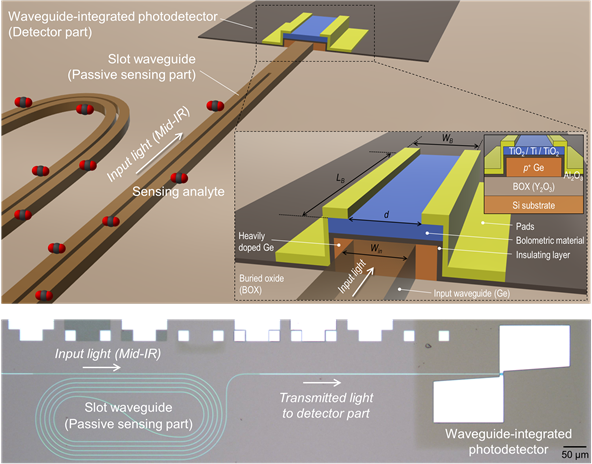
A 'waveguide' refers to a structure that effectively guides light along a specific path without loss. To implement various optical circuits on-chip, the development of optical devices based on waveguides, including waveguide-integrated photodetectors, is essential.
This technology differs from the conventional bandgap absorption principle commonly used in photodetector operation by utilizing the bolometric effect, enabling response across the entire mid-infrared spectrum range and allowing versatile real-time molecular sensing. The bolometric effect refers to the principle where absorbed light raises temperature, and electrical signals change according to temperature variations.
The room-temperature operation and CMOS-compatible mid-infrared waveguide-integrated photodetector developed by the research team is evaluated as an innovative technology that solves the cooling requirement, mass production difficulties, and high cost issues of existing mid-infrared sensor technologies.
The research team anticipates that this technology can be applied in fields such as environmental monitoring, medical diagnostics, industrial process management, defense and security, and smart devices. They also expect it to provide a critical breakthrough for next-generation mid-infrared sensor technology.
Professor Kim stated, "This research is a new approach that overcomes the limitations of existing mid-infrared photodetector technology, and it has great potential for practical use in various application fields. Especially, as a sensor technology compatible with CMOS processes, it enables low-cost mass production and is expected to be actively utilized in next-generation environmental monitoring systems and smart manufacturing sites."
Meanwhile, this research, supported by the National Research Foundation of Korea, involved Dr. Junseop Shim (currently a postdoctoral researcher at Harvard University) as the first author. The research results were also published on the 19th in the international journal Light: Science & Applications (JCR 2.9%, IF=20.6).
© The Asia Business Daily(www.asiae.co.kr). All rights reserved.


















