Passenger Cars and Light Trucks Tariff Raised from 2.5% to 25%
"Tariffs Imposed on Countries That Have Taken Away Our Jobs and Wealth"
U.S. President Donald Trump announced on the 26th (local time) that starting from the 2nd of next month, a permanent 25% tariff will be imposed on foreign automobiles imported into the United States. This formalizes the second product-specific tariff measure following the steel and aluminum tariffs that took effect on the 12th.
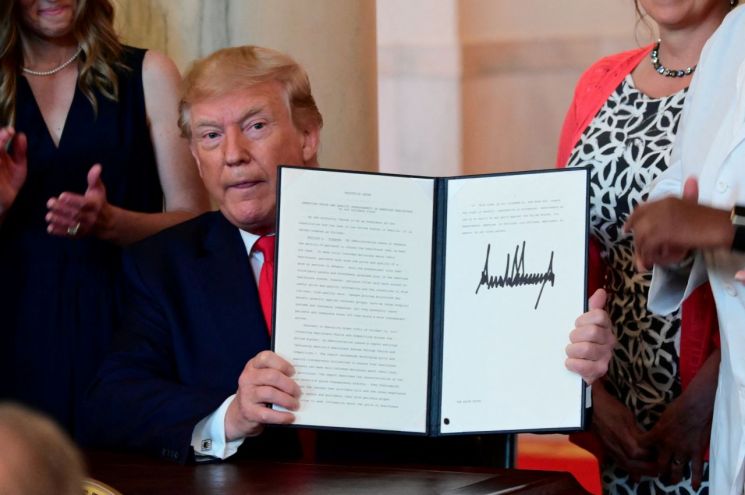
President Trump held a press conference in the Oval Office, the presidential office at the White House, stating, "What we are going to do is impose a 25% tariff on all cars not produced in the United States," and described this measure as a "very modest" action. He explained that the automobile tariffs will take effect on April 2, the day the reciprocal tariffs are announced, and the U.S. will begin collecting tariffs the following day.
He emphasized, "We will impose tariffs on countries that operate businesses in our country, take away our jobs and wealth, and have taken a lot from us over the years," adding, "There will be no tariffs at all on vehicles produced in the United States."
This automobile tariff measure came ahead of the reciprocal tariff announcement scheduled for April 2. Regarding the types of vehicles subject to the 25% tariff, Will Sharp, White House Document Secretary, explained, "The new tariffs will apply to foreign passenger cars and light trucks," and "this will generate over $100 billion in new imports annually." Until now, the U.S. has applied a 25% tariff on pickup trucks but only a 2.5% tariff on passenger cars and light trucks.
Following the steel and aluminum tariffs that took effect on the 12th, President Trump has now formalized tariff measures on two product categories since his inauguration on January 20. If the previously announced 25% tariffs on semiconductors, pharmaceuticals, and other products are implemented, the tariff front is expected to expand further. Additionally, President Trump has hinted at tariffs on lumber and the possibility of tariffs on copper, suggesting that more tariff announcements are likely to follow.
Immediately, companies including Hyundai Motor are expected to face unavoidable impacts from this tariff measure. South Korea is one of the top three automobile exporters to the U.S., making it one of the countries President Trump aims to address regarding the automobile trade imbalance. According to statistics from the International Trade Administration (ITA) under the U.S. Department of Commerce, the value of automobiles imported by the U.S. from South Korea in 2024 was $36.6 billion, ranking third after Mexico ($78.5 billion) and Japan ($39.7 billion). The number of automobiles imported from South Korea in the same year was 1,535,616 units, ranking second after Mexico (2,961,598 units). Automobiles also represent the largest share of South Korea's exports to the U.S. According to the Korea International Trade Association, South Korea's exports to the U.S. in 2024 reached a record high of $127.786 billion, with automobile exports accounting for $34.744 billion, or 27.1%, the largest share among all product categories.
Bloomberg News analyzed, "Such tariffs significantly expand the president’s trade battles and are likely to put many of the largest automakers in key U.S. trading partners, including Japan, Germany, and South Korea, in a difficult position," adding, "It also risks disrupting the operations of North American automakers that rely on highly integrated supply chains across the U.S., Mexico, and Canada."
Amid growing concerns over the U.S. automobile tariff bombshell, Hyundai Motor Group announced on the 24th at the White House a new investment plan of $21 billion (approximately 31 trillion won) in the U.S. over the next four years. Attention is focused on whether Hyundai’s large-scale investment in the U.S. can play a role in reducing trade pressures such as tariff rate relief in future individual tariff negotiations with the U.S.
© The Asia Business Daily(www.asiae.co.kr). All rights reserved.

















