Caution Remains Ahead of Reciprocal Tariff Announcement on April 2
Trump: "Tariffs Will Be More Lenient Than Reciprocal"
Core PCE Price Index for February to Be Released on March 28
The three major indices of the U.S. New York stock market showed mixed trends in early trading on the 26th (local time). Ahead of the announcement of reciprocal tariffs by the Donald Trump administration next week, investors are cautiously watching the market. As concerns about a tariff-induced economic recession have emerged, the market is focusing on key economic indicators that provide insight into the economic situation, including the core Personal Consumption Expenditures (PCE) price index to be released this week.
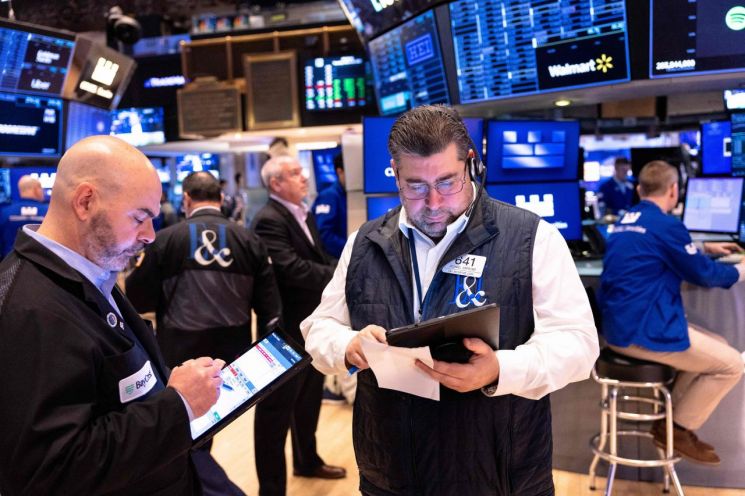
As of 10:25 a.m. in the New York stock market, the Dow Jones Industrial Average, which centers on blue-chip stocks, was up 129.57 points (0.3%) from the previous trading day, standing at 42,717.07. The S&P 500, which focuses on large-cap stocks, was down 25.23 points (0.44%) at 5,751.42, and the Nasdaq, which is tech-heavy, was trading at 18,033.85, down 238.01 points (1.3%).
Investors’ attention is focused on the outline of reciprocal tariffs to be announced on April 2. President Trump said in an interview with Newsmax the day before that the reciprocal tariffs are likely to be "more lenient than reciprocal." Following his remarks on the 21st mentioning "flexibility" and on the 24th stating that "exemptions could be given to several countries," he has repeatedly made dovish comments. Local media also reported that the scope and targets of the reciprocal tariffs might be narrower than expected and that the announcement of tariffs by product category could be delayed, easing extreme anxiety about tariffs for the time being.
However, the market’s caution remains as President Trump’s tariff statements and policies have been inconsistent and fluctuating. Inflation and the possibility of economic slowdown due to tariffs are also weighing on investor sentiment. The consumer sentiment index released the previous day showed widespread concerns about an economic downturn. According to the economic research group Conference Board (CB), the Consumer Confidence Index for March was 92.9, the lowest level in four years since early 2021. The expectations index, reflecting short-term outlook six months ahead, fell 9.6 points from the previous month to 65.2, the lowest in 12 years, and the expected inflation one year ahead rose from 5.8% in February to 6.2% in March, the highest in two years. Since the Consumer Confidence Index is an indicator of consumers’ confidence in the U.S. economy, these results suggest that consumers’ economic outlook has become more pessimistic recently.
Art Hogan, Chief Market Strategist at B. Riley Wealth Management, said, "Tariffs will continue to attract attention," adding, "Traders are looking for new information regarding the U.S. reciprocal tariffs that will take effect on April 2."
Investors are awaiting additional indicators that will reflect the U.S. economic situation. On the 27th, the final GDP growth rate for the fourth quarter of last year will be released. The following day, on the 28th, the February core Personal Consumption Expenditures (PCE) price index will be announced. According to Bloomberg’s estimates, the core PCE price index is expected to have risen 2.7% year-over-year, up from 2.6% in January.
By stock, Nvidia is sharply down 4.65%. Tesla is down 4.12%. Alphabet, Google’s parent company, is down 1.49%, while Amazon and Meta, Facebook’s parent company, are down 1.52% and 1.86%, respectively.
U.S. Treasury yields are showing strength. The 10-year U.S. Treasury yield, a global bond yield benchmark, rose 4 basis points (1bp = 0.01 percentage points) from the previous trading day to 4.35%, and the 2-year U.S. Treasury yield, sensitive to monetary policy, increased 3 basis points to 4.01%.
© The Asia Business Daily(www.asiae.co.kr). All rights reserved.
![Clutching a Stolen Dior Bag, Saying "I Hate Being Poor but Real"... The Grotesque Con of a "Human Knockoff" [Slate]](https://cwcontent.asiae.co.kr/asiaresize/183/2026021902243444107_1771435474.jpg)















