Second Trial Acquits Lee of All Charges in Public Official Election Act Case
Prosecution Announces Immediate Appeal; Supreme Court Ruling Unlikely Before June 26
Limited Impact Expected from Four Other Ongoing Cases, Including Witness Tampering Appeal and Daejang-dong, Baekhyeon-dong First Trials
The Criminal Division 6-2 of the Seoul High Court (Presiding Judges Choi Eun-jung, Lee Ye-seul, and Jung Jae-oh) acquitted Lee Jae-myung, leader of the Democratic Party of Korea, of all charges related to violations of the Public Official Election Act on the 26th, giving Lee a new lease on life 131 days after he was sentenced to a suspended prison term with a 10-year disqualification from running for office in the first trial on November 15 last year. With this ruling, Lee has overcome the biggest hurdle in a trial directly linked to his political career and now only awaits the Supreme Court's legal review.
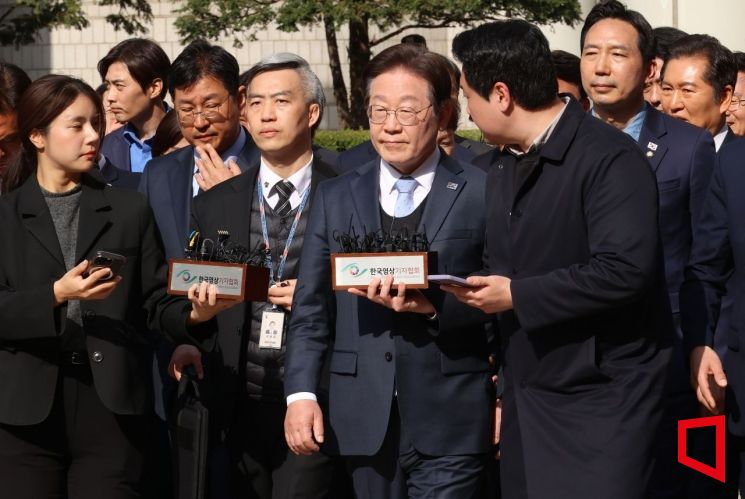 Lee Jae-myung, leader of the Democratic Party of Korea, is leaving the courthouse after being acquitted in the appeal trial of a violation of the Public Official Election Act held at the Seoul High Court on the 26th. March 26, 2025 Photo by Joint Press Corps
The prosecution immediately issued a statement, protesting that "the defendant's claims were blindly trusted," and announced plans to appeal. However, since it is expected to take considerable time even if the Supreme Court remands the case, there is an analysis that Lee has effectively shaken off the risk of disqualification from running for office. Additionally, although four other trials are ongoing besides the Public Official Election Act case, the legal community widely agrees that additional rulings within the first half of the year are unlikely.
The second trial court stated the day before, "The evidence for the charges did not reach the level of eliminating reasonable doubt, thus there is no proof of criminal facts," and acquitted Lee. Lee was indicted in September 2022 on charges that his statements during broadcast interviews and National Assembly audits during the last presidential election campaign?claiming he did not know the late Kim Moon-gi, former head of Seongnam Urban Development Corporation during his tenure as mayor of Seongnam, and that the land-use change of Baekhyeon-dong site was due to pressure from the Ministry of Land, Infrastructure and Transport?were false.
Unlike the first trial, which sentenced him to one year in prison with a two-year suspension, the second trial court judged that Lee's problematic statements were not denials of specific acts but rather subjective perceptions and expressions of opinion. The court particularly ruled that regarding the golf controversy during an overseas trip with Kim, "the prosecution's interpretation was an overextension based on external suspicions" and could not be considered false. The court applied the criminal law principle that "political freedom of expression must be fully considered, and in cases of doubt, the benefit of the doubt should be given to the defendant," dismissing all prosecution claims.
The court also acquitted Lee regarding his statements about the land-use change of the Baekhyeon-dong site. The court judged that Lee's claim that Seongnam City was pressured by the Ministry of Land, Infrastructure and Transport during the land-use change process was an "overall expression of opinion" and, considering official documents from the Ministry with legal grounds, "cannot be regarded as false."
With the second trial court completely overturning the first trial's judgment, attention on Lee's Public Official Election Act violation case has shifted to the Supreme Court's decision. The prosecution immediately expressed its intention to appeal the second trial ruling. Unlike the first and second trials, which are 'fact-finding' trials that examine facts and apply laws, the appeal trial is a 'legal review' focusing on legal interpretation. The deadline for the court ruling is June 26, and for cases with sentences of up to 10 years in prison, the trial proceeds only by disputing legal errors. If the Supreme Court confirms the second trial's acquittal, Lee will be completely relieved of the judicial risks related to the Public Official Election Act. However, if the Supreme Court finds legal errors in the second trial's ruling and remands the case, it will return to the Seoul High Court.
If the early presidential election, in which Lee is expected to run, is held in June, the Supreme Court's ruling on the Public Official Election Act case will be the last major hurdle on the election path. However, the legal community widely agrees that the ruling is unlikely to be issued before then. According to Article 270 of the Public Official Election Act, the first trial for election offenders should be ruled within six months, and the second and third trials within three months each. However, there are no penalties for violations, and the submission of appeals, transfer of case records and evidence, delivery of notices of receipt, and submission of appeal reasons take nearly a month, which is a considerable amount of time. Even if the Supreme Court remands the case, it could take at least nine months for a guilty verdict to be rendered through the remand trial and for a final ruling by the Supreme Court.
Lee is also undergoing four other trials besides the Public Official Election Act case, but these are unlikely to affect his presidential campaign. Lee is on trial for four cases: allegations of witness tampering, suspicions related to Daejang-dong, Baekhyeon-dong, Seongnam FC, and Wirye New Town, allegations of remittance to North Korea via Ssangbangwool, and allegations of misuse of corporate credit cards. Only the witness tampering case, in which he was acquitted in the first trial on November 26 last year, is currently in the appeal stage; the other three trials remain at the first trial stage.
The witness tampering trial is being heard by the Criminal Division 3 of the Seoul High Court (Presiding Judge Lee Chang-hyung). The appeal trial preparation hearing began on the 11th, and an additional preparation hearing is scheduled for the 1st of next month. Since no full trial schedule has been set, the possibility of a ruling within the first half of the year is very low.
The Seoul District Court Criminal Division 33 (Presiding Judge Lee Jin-gwan) is conducting a consolidated trial for the Daejang-dong, Baekhyeon-dong, Seongnam FC, and Wirye New Town suspicion cases. However, since multiple cases are consolidated, it is widely expected that even the first trial ruling will take several years. This trial began in October 2023. Moreover, the trial panel was replaced last month due to judicial personnel reshuffling, and the trial renewal procedures are underway.
The Gyeonggi Province corporate credit card misuse case, being heard by the Suwon District Court Criminal Division 1, will begin its trial on the 8th of next month following the prosecution's indictment last November. Lee is accused of significant breach of duty for allegedly using corporate credit cards to spend 8.89 million KRW on food, 27.91 million KRW on fruit, and a total of 106.53 million KRW.
© The Asia Business Daily(www.asiae.co.kr). All rights reserved.
![Clutching a Stolen Dior Bag, Saying "I Hate Being Poor but Real"... The Grotesque Con of a "Human Knockoff" [Slate]](https://cwcontent.asiae.co.kr/asiaresize/183/2026021902243444107_1771435474.jpg)















