Containment Rate Drops to 78% After Reaching 98% the Previous Day
Forest Damage Area Estimated at 658 Hectares
On the 26th, the fifth day since a large forest fire broke out in Onyang-eup, Ulju-gun, Ulsan City, the flames have still not been contained. The phenomenon of hidden embers reigniting due to the wind repeatedly occurred in areas where the fire had once been controlled, causing the containment rate, which had once reached 98% the previous day, to fall back to 78%.
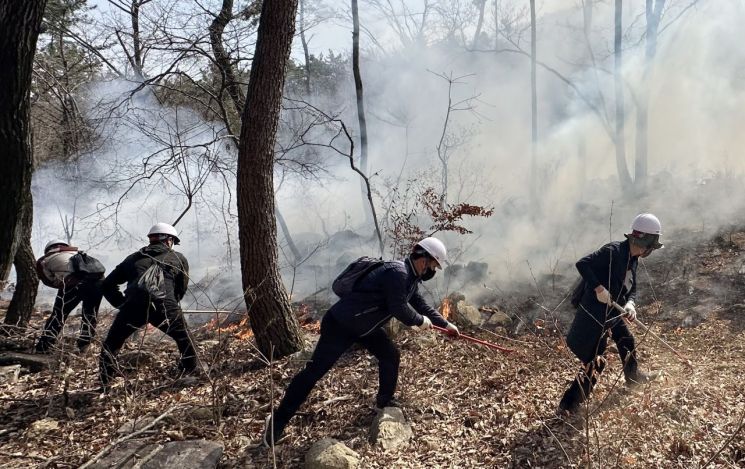
At around 6:10 a.m. that day, the forestry authorities deployed 13 helicopters to Daewoonsan in Onyang-eup to focus all efforts on extinguishing the main fire. Along with 76 pieces of equipment including fire trucks and wildfire suppression vehicles, about 1,200 personnel were also mobilized.
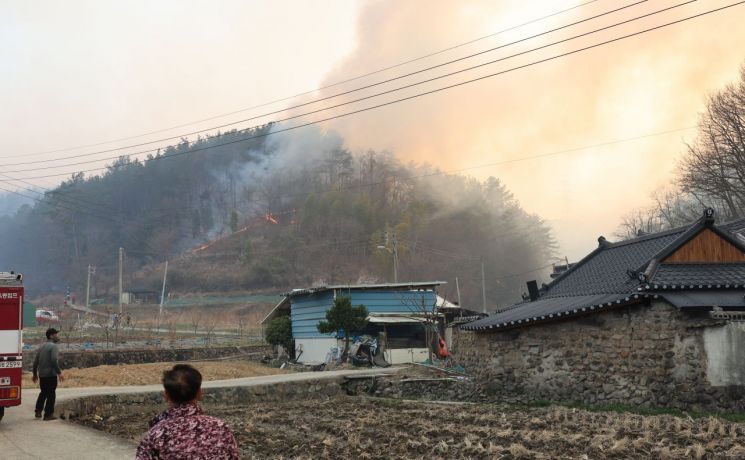
Since the main fire of the Hwajangsan wildfire in Eonyang-eup, Ulju-gun, which occurred the previous day, was contained that morning, the forestry authorities concentrated on extinguishing the Daewoonsan wildfire. Nevertheless, as of 12 p.m. that day, the containment rate of the Daewoonsan wildfire was 78%, a significant drop from 92% as of 6 p.m. the previous day.
Out of the total 18.8 km of fire lines, 14.8 km have been extinguished, but the flames remain uncontrolled in the remaining 4 km. The area of forest damage has been estimated at 658 hectares.
Kim Doo-gyeom, mayor of Ulsan City and commander of the on-site integrated command center, explained in a briefing, "The containment rate has actually decreased because the hidden embers, which were concealed in fumigation piles for pine wilt disease or in leaf litter about 2 meters thick left behind after the fire was extinguished, have been reignited repeatedly by the wind."
Mayor Kim said, "To stop these backfires, people need to approach the area, but the steep slopes and dense forests make access very difficult. Experiencing this fire has made me keenly realize that the Korea Forest Service and local governments need to seriously consider creating forest roads on all mountains for wildfire response."
That morning at the wildfire site, the wind had calmed to an average speed of 1 m/s and a maximum speed of 4 m/s compared to the previous day. However, in the afternoon, the wind strengthened to 5-7 m/s, making firefighting efforts more difficult. The flames, driven by the wind, grew stronger and even reached areas just behind villages.
In Pyeonggwang Village, Oegwang-ri, as the wildfire intensified, repeated evacuation announcements were broadcast to residents. Smoke was seen behind the houses on the hills, and police officers recommended evacuation, but residents hesitated to leave their homes and wandered around the village.
In the Onyang-eup area, the fire that had been lingering on the Daewoonsan ridge the previous evening descended toward residential areas on the mountain slopes, prompting additional evacuation orders for 10 villages. As a result, 394 residents from 345 households evacuated to the Onyang-eup Administrative Welfare Center and nearby senior citizen centers.
On one side of the wildfire zone, the flames crossed the boundary into Yangsan, Gyeongnam, driven by the wind, causing 94 Yangsan residents to evacuate. The police have been controlling both directions from Gwangcheong-ro Yongdang Intersection to the entrance of the Buul Expressway Onyang IC since 4:10 p.m. that day in preparation for the wildfire impact. As the sun set that evening, the forestry authorities withdrew helicopters and shifted to nighttime disaster prevention measures centered around residential areas.
Rain was forecasted in the Ulsan area from dawn to night on the 27th, but with an expected precipitation of only 5-10 mm, it remains uncertain whether it will aid in firefighting efforts.
© The Asia Business Daily(www.asiae.co.kr). All rights reserved.
![Clutching a Stolen Dior Bag, Saying "I Hate Being Poor but Real"... The Grotesque Con of a "Human Knockoff" [Slate]](https://cwcontent.asiae.co.kr/asiaresize/183/2026021902243444107_1771435474.jpg)
















