Emergency Meeting Led by Vice Mayor: Intensive Inspection of Water Supply and Sewage Pipelines
Collaboration with Autonomous Districts, KEPCO, and Korea Gas Corporation for Underground Facility Management
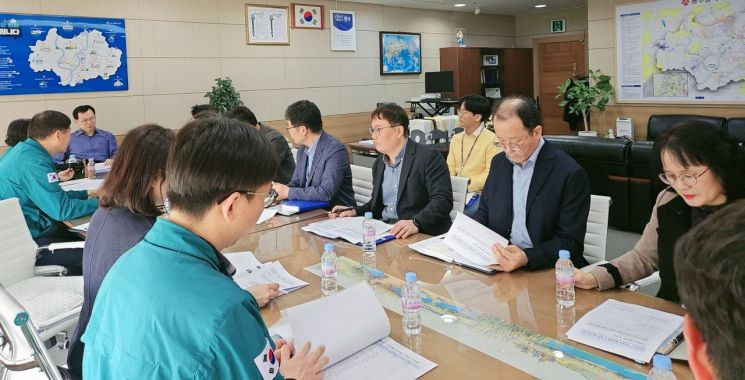 Kwangwan Ko, Deputy Mayor for Administration, is presiding over the "Future Countermeasure Plan Meeting Regarding Ground Subsidence in Gangdong-gu, Seoul," held on the afternoon of the 25th at the Deputy Mayor's Office in City Hall. Provided by Gwangju City
Gwangju City will strengthen ground safety management to prevent major sinkhole accidents by intensively inspecting the water supply pipeline block system.
On the 26th, Gwangju City announced that on the afternoon of the 25th, a meeting was held presided over by Vice Mayor for Administrative Affairs Ko Gwangwan, with officials from the Integrated Airport and Transportation Bureau, Water Management Policy Division, Waterworks Business Headquarters, Urban Railway Construction Headquarters, and safety managers from five autonomous districts, to discuss future countermeasures related to the ground subsidence incident in Gangdong-gu, Seoul.
The meeting was convened to establish effective measures to prevent ground subsidence following the large sinkhole accident in Gangdong-gu, Seoul, on the 24th, which raised concerns about potential ground subsidence.
The Road Division of Gwangju City has selected 40 km of road sections at risk of ground subsidence and plans to conduct a ground-penetrating radar (GPR) survey in August. The Water Management Policy Division is also conducting a study to repair aging sewage pipelines, which are a major cause of ground subsidence.
The Waterworks Business Headquarters is carrying out regular safety inspections and intensive leak checks to prevent ground subsidence in advance. They conduct regular safety inspections at least once a year on underground water supply facilities to check for ground subsidence, deformation, and leaks around water pipelines, and immediately restore any problems found. In particular, to ensure smooth water supply and prevent leak accidents, 40 vulnerable areas among the 126 block systems are selected every year for intensive inspection.
Additionally, GPR surveys are conducted every five years to investigate and restore underground cavities in water supply pipelines with a diameter of 500mm or more. In fact, about 60 underground cavities were quickly restored through GPR surveys in 2023.
The Urban Railway Construction Headquarters operates a "Waterworks Damage Prevention Task Force (TF Team)" and conducts joint inspections at least twice a year to prevent water supply pipeline damage and ground subsidence accidents that may occur during the construction of Urban Railway Line 2.
In November last year, the Urban Railway Construction Headquarters, together with the Iksan Regional Land Management Office, conducted a special inspection of excavation sites along the Urban Railway Line 2 construction section, and found that the condition of the road substructure was generally good with no abnormalities detected.
The city also plans to establish a cooperative safety management system for underground facilities with relevant organizations such as the underground facility management departments of the autonomous districts, Korea Electric Power Corporation, Korea Gas Corporation, Haeyang Energy, and Gwangju Urban Corporation, to conduct safety inspections.
Vice Mayor Ko Gwangwan said, "We will do our best to manage ground safety by establishing a cooperative system with relevant organizations in the water supply and sewage, electricity, and communication sectors, and by preparing organic response measures."
© The Asia Business Daily(www.asiae.co.kr). All rights reserved.
![Clutching a Stolen Dior Bag, Saying "I Hate Being Poor but Real"... The Grotesque Con of a "Human Knockoff" [Slate]](https://cwcontent.asiae.co.kr/asiaresize/183/2026021902243444107_1771435474.jpg)















