Ha Yoojin and Kim Sangwoo's Yonsei University Research Team Publishes Paper in Nature on the 27th
Domestic researchers have genetically identified the cause of 'spina bifida' for the first time in the world. They revealed the cause and biological mechanism of 'meningomyelocele,' whose genetic cause had not been clarified until now, providing clues for treating patients with congenital neural tube defects.
The Ministry of Science and ICT announced that Professor Kim Sang-woo's research team from the Department of Medical and Life Systems Informatics at Yonsei University has genetically identified the cause of spina bifida for the first time worldwide, and their findings were published in the international journal Nature on the 27th (4 p.m. local time on the 26th).
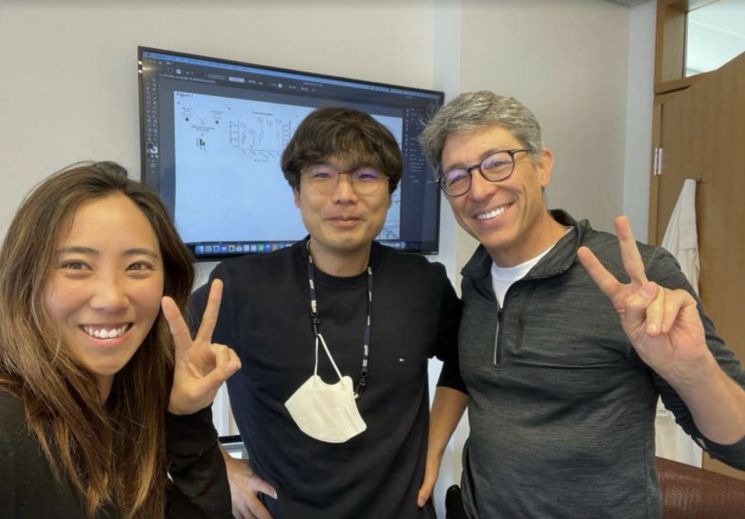 From the left, Ha Yoo-jin, Ph.D., Department of Biomedical Systems Informatics, Yonsei University; Professor Kim Sang-woo; Professor Joseph Gleeson, University of San Diego. Provided by Professor Kim Sang-woo's research team.
The title of the paper is "The contribution of de novo coding mutations in Meningomyelocele." The first author is Dr. Ha Yoo-jin from Yonsei University's Department of Medical and Life Systems Informatics, and Professor Kim Sang-woo is the corresponding author. Professor Joseph Gleeson from the University of California, San Diego, is registered as a co-corresponding author.
'Spina bifida' is a congenital disorder caused by the incomplete closure of the neural tube, the precursor of the central nervous system, during fetal development. It is one of the types of congenital neural tube defects. In severe cases, meningomyelocele occurs, where the membranes surrounding the brain and spinal cord fail to form at birth, exposing neural tissue and causing serious neurological damage such as gait disturbances and sensory abnormalities.
Since this disease has a high incidence rate of about 1 in 3,000 newborns, researchers have long speculated that specific genetic mutations in patients with spina bifida might influence disease onset.
However, unlike typical genetic diseases, identifying the key genes responsible for spina bifida has remained a long-standing challenge. Although some genes were identified in animal experiments, these genes had not been found in humans.
Moreover, due to the complex nature of the disease influenced by environmental factors, conventional approaches have been insufficient, and aside from folic acid intake during pregnancy, there have been virtually no special preventive measures.
Professor Kim Sang-woo's team focused on de novo mutations, which are newly appearing mutations in offspring not inherited from parents, and collaborated with researchers from the University of California to conduct genetic analysis on 851 spina bifida patients and 2,451 family members worldwide.
The analysis revealed that approximately 22.3% of patients had mutations with a high likelihood of gene damage, and among these, 28% were evaluated to have a direct impact on neural tube defect occurrence. This is the first time that gene mutation characteristics directly causing spina bifida have been identified in humans.
The genes identified as influencing the onset of meningomyelocele are the inactivation of Nostrin and Whamm genes. Experiments using the frog Xenopus laevis, whose gene structure is about 80% similar to humans, confirmed that the neural tube did not close completely. Furthermore, these two genes are predicted to be involved in the same biological process, and when both genes are inactivated, the neural tube closure is even more impaired.
The research team found that these genes are related to functions such as cytoskeleton maintenance, neural signal transmission, and chromatin remodeling. Through experimental validation of the detected genes, they confirmed the impact of major gene mutations on neural tube defects.
The significance of this study lies in revealing the genetic causes and biological mechanisms of meningomyelocele, whose genetic origins had not been clearly identified until now. Although patients with congenital neural tube defects have continued to be born, the inability to identify the cause had limited diagnosis and treatment; this study has now made it possible to clarify the cause.
Professor Kim Sang-woo stated, "This achievement was possible through collaboration between the American research team, which was able to recruit a large number of patients, and the Korean research team, which possesses advanced DNA analysis techniques." He added, "This will provide important clues for developing diagnostic technologies in the future and can be utilized not only for developing preventive measures for neural tube defect diseases but also for studying complex diseases where genetic mutations and environmental factors act together, such as autism."
© The Asia Business Daily(www.asiae.co.kr). All rights reserved.
![Clutching a Stolen Dior Bag, Saying "I Hate Being Poor but Real"... The Grotesque Con of a "Human Knockoff" [Slate]](https://cwcontent.asiae.co.kr/asiaresize/183/2026021902243444107_1771435474.jpg)















