Import Restrictions Surge by 75%
If All Announced Tariffs Are Implemented, Average Tariff Rate Could Reach 18%... Highest in 90 Years
"Trade barriers worldwide are rising at the fastest pace in decades."
The Wall Street Journal (WSJ) reported on the 25th (local time) that with the launch of the second term of the Donald Trump administration, the average tariff rate has increased fivefold compared to the first term, and import restrictions have surged by 75%. Experts expressed concerns that this recent trend could lead to strengthened protectionism in various countries. However, they predicted that the global trend of erecting trade barriers triggered by U.S. President Donald Trump's tariff policies would not lead to situations like the Great Depression of the 1930s or the subsequent collapse of the global trade order.
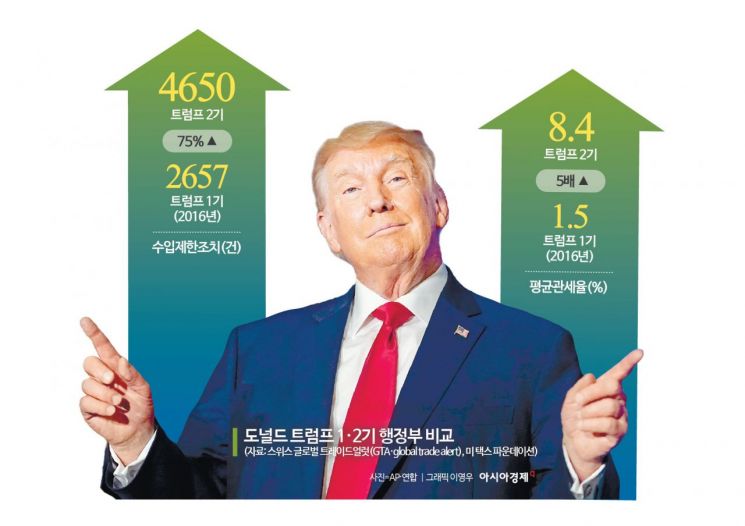
On the same day, WSJ cited statistics from the tax-related think tank Tax Foundation, reporting that the average tariff rate on goods imported into the United States has reached 8.4%, a level last seen in 1946. The tariff rate in 2016, the first year of President Trump's term, was 1.5%. This means the tariff rate has nearly quintupled in ten years.
The problem is that there is room for further tariff increases. President Trump has pledged to impose reciprocal tariffs at levels equal to those imposed by other countries, which could provoke retaliatory tariff hikes from those countries. According to Fitch Ratings, even if all the tariff measures announced by Trump are implemented, the average tariff on U.S. imports is expected to reach 18%. This tariff level is the highest in 90 years.
Trade barriers such as import restrictions have also increased. According to Swiss Global Trade Alert, the total number of import restrictions (anti-dumping duties, tariffs, quotas, and other import regulations) implemented by the Group of Twenty (G20) countries reached 4,650 as of March 1, a 75% increase compared to 2016 when President Trump first took office. Extending the comparison period to 2008 shows that similar import restrictions have increased nearly tenfold in recent years.
Eswar Prasad, a professor at Cornell University, said, "We are on the threshold of a much broader, full-scale trade war," adding, "In this hostile new environment, every country is fighting for itself."
WSJ cited the crisis in American jobs and industries caused by the free trade order as the background for President Trump's tough trade policies. The newspaper stated, "The decades of expanded global trade have been a disaster for the United States," and added, "The president and his supporters say his policies will create new jobs, promote domestic investment, and bring new economic vitality for a new era."
However, as trade conflicts escalate, voices warning of increased uncertainty and potential contraction in consumption, investment, and employment have emerged. Fitch Ratings forecasted that as the trade war intensifies between the U.S. and other regions, global economic growth will slow from 2.9% in 2024 to 2.4% this year.
Some worry that once countries start erecting trade barriers driven by nationalism, it will be difficult to reverse the trend. Douglas Irwin, a professor at Dartmouth University and author of "Clashing over Commerce: A History of US Trade Policy," said, "All trade regulations are potential bargaining chips, so no one wants to unilaterally disarm," and noted, "Considering geopolitical competition with China and domestic priorities such as industrial rebuilding and rearmament, the current wave of protectionism is unlikely to subside." He added, "Therefore, I fear that scenarios for easing tensions will be very challenging."
However, there are also views that the current tariff war will not lead to a situation like the Great Depression. WSJ stated, "Economists do not believe the world is heading toward a situation like the Great Depression of the 1930s or the collapse of the global trade order in the following decade," and noted, "The average global tariff rate is still much lower than in the 1930s and 1940s."
© The Asia Business Daily(www.asiae.co.kr). All rights reserved.
![Clutching a Stolen Dior Bag, Saying "I Hate Being Poor but Real"... The Grotesque Con of a "Human Knockoff" [Slate]](https://cwcontent.asiae.co.kr/asiaresize/183/2026021902243444107_1771435474.jpg)
















